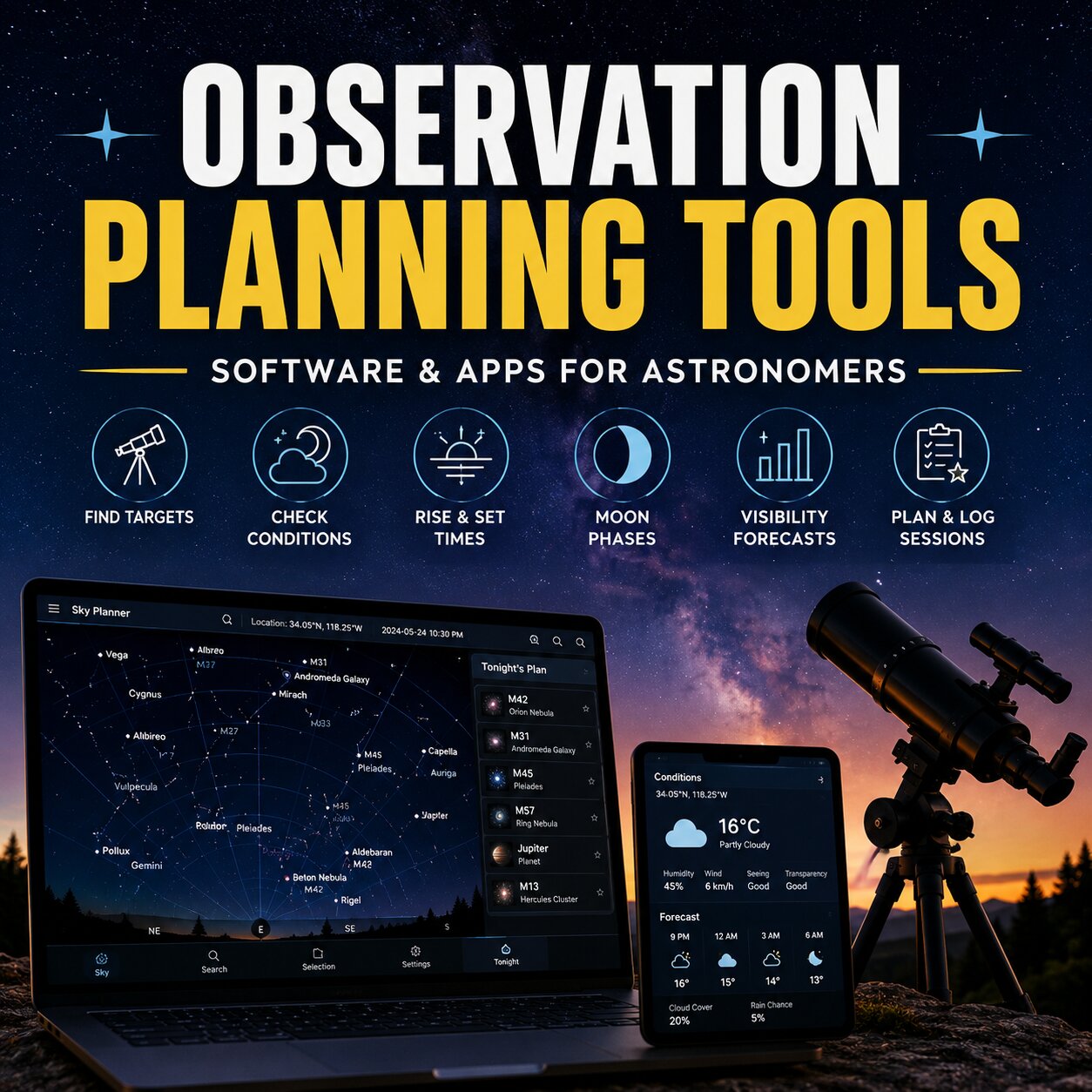

Successful astronomy sessions rarely happen by accident. Whether you are using binoculars, a Dobsonian telescope, or a sophisticated astrophotography setup, preparation can significantly improve your observing experience. This is where observation planning tools become invaluable. These software applications help astronomers identify targets, predict observing conditions, and make the most of available viewing time.
From beginners learning the night sky to experienced observers pursuing challenging deep-sky objects, observation planning tools can transform a good observing session into a great one.
Why Observation Planning Matters
The night sky changes constantly. The positions of planets, stars, galaxies, nebulae, and comets vary throughout the year, while local weather and moonlight conditions can dramatically affect visibility.
Without planning, observers may spend valuable time searching for targets that are below the horizon, hidden by moonlight, or poorly positioned for viewing. Observation planning tools help eliminate much of this uncertainty by providing accurate information before you set up your equipment.
Many applications also include sky simulations that allow users to preview the night sky from their specific location.
Features Found in Observation Planning Tools
Modern observation planning tools offer a wide range of capabilities designed to simplify session preparation and improve efficiency.
Common features include:
- Interactive star charts
- Object databases
- Moon phase tracking
- Rise and set times
- Weather integration
- Visibility forecasts
- Observation lists
- Telescope control support
These observation planning tools and features allow observers to create detailed plans tailored to their equipment, location, and interests.
Popular Observation Planning Applications
Several excellent tools are available for amateur and professional astronomers alike.
Applications such as Stellarium provide realistic sky simulations and object tracking. SkySafari offers extensive databases and mobile convenience, while AstroPlanner focuses on organising observing sessions and target lists. Cartes du Ciel remains a popular free option for detailed star chart generation.
Many observers use a combination of tools to take advantage of different strengths, particularly when planning astrophotography sessions or tracking seasonal observing targets.
Planning Observations For Different Astronomy Interests
Different areas of astronomy require different planning approaches. A visual observer searching for galaxies and nebulae will often prioritise dark skies, moonless nights, and object altitude above the horizon. Planetary observers, on the other hand, may focus on atmospheric seeing conditions and the position of planets throughout the evening.
Astrophotographers typically require even more detailed preparation. Exposure times, target framing, equipment orientation, meridian flips, and moonlight interference all need to be considered before a session begins. Observation planning tools can help photographers identify the best imaging windows and avoid wasting valuable clear-sky opportunities.
Variable star observers, comet hunters, and lunar enthusiasts also benefit from customised planning. Many applications allow users to create specialised target lists that match their preferred observing style and long-term projects.
The ability to tailor observation plans to individual interests makes these tools valuable for nearly every type of astronomer.
Weather, Light Pollution, And Sky Conditions
One of the greatest challenges facing astronomers is dealing with environmental conditions. Even the best equipment cannot overcome heavy cloud cover, poor atmospheric stability, or excessive light pollution.
Many modern observation planning tools integrate weather forecasts directly into their interfaces. Users can monitor cloud cover, humidity, wind speeds, transparency, and seeing conditions before committing to an observing session. This information helps astronomers decide whether to proceed with visual observations or astrophotography.
Light pollution mapping has also become an important feature. Tools that display Bortle Scale ratings and satellite-based light pollution data help observers identify suitable viewing locations. For those willing to travel, these maps can reveal darker sites capable of delivering significantly better results.
By combining weather data with sky quality information, observers can maximise their chances of success.
Creating And Managing Observation Logs
Observation planning does not end when a session begins. Many astronomy applications also support observation logging, allowing users to record what they observed and under what conditions.
Observation logs can include notes, sketches, equipment details, magnifications used, atmospheric conditions, and personal impressions. Over time, these records become valuable references that help astronomers track progress and revisit targets under different conditions.
Some planning tools can automatically update observation lists to indicate which objects have already been viewed. This feature is particularly useful for those working through observing programmes such as the Messier Catalogue, Caldwell Catalogue, or Herschel lists.
Maintaining detailed records encourages continuous learning and helps astronomers build a deeper understanding of the night sky. For many enthusiasts, observation logs become as rewarding as the observations themselves.
Making the Most of Your Observing Sessions
Observation planning tools have become an essential part of modern astronomy. They help observers spend less time searching and more time exploring the wonders of the universe.
Whether you are hunting distant galaxies, following planetary events, or simply learning the constellations, the right software can improve efficiency, increase success rates, and make every observing session more rewarding. Investing time in planning before heading outside often results in clearer goals, better observations, and a deeper appreciation for the night sky.