
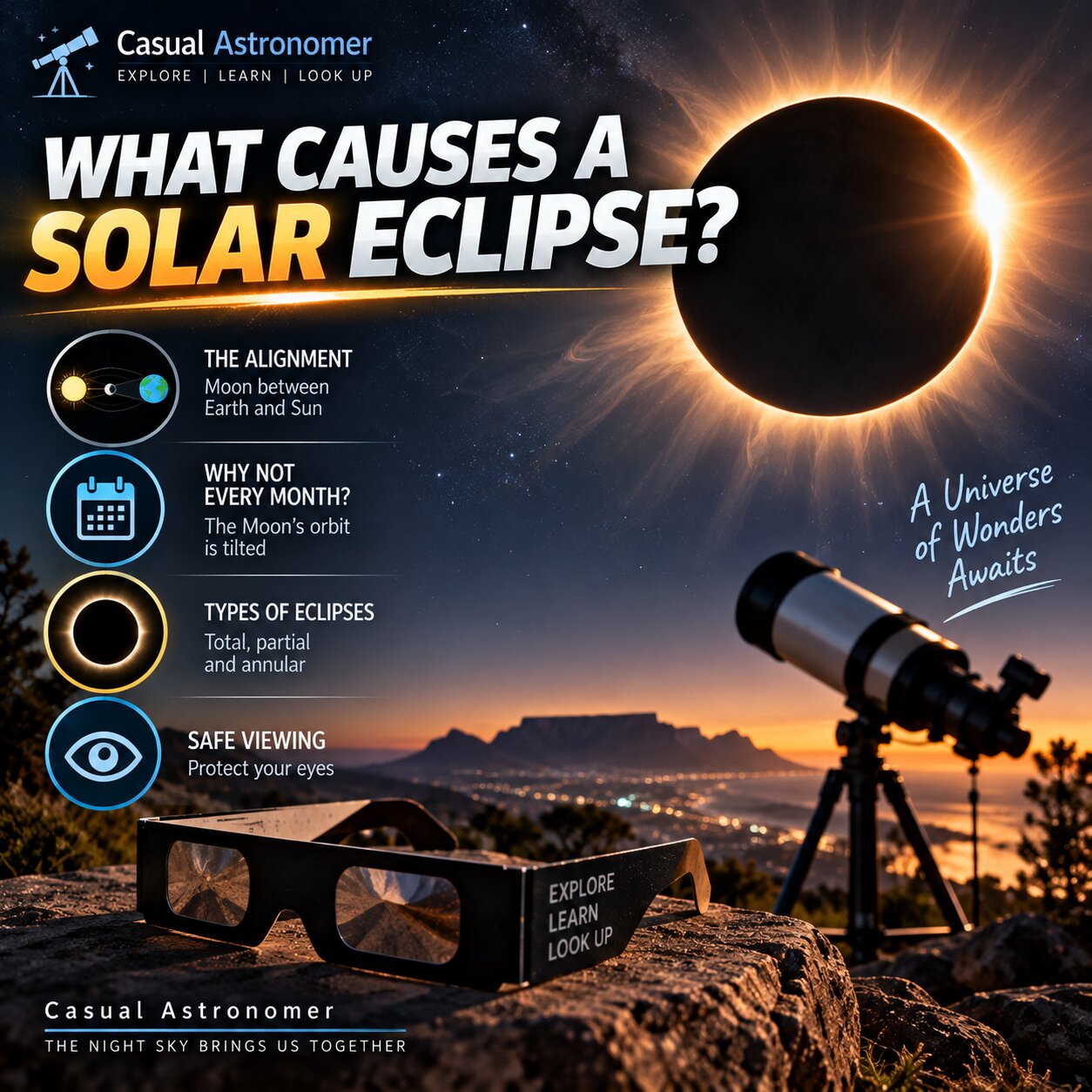

Few astronomical events are as dramatic as watching the Sun seemingly disappear during the day. A solar eclipse occurs when the Moon passes between Earth and the Sun, causing its shadow to fall across part of our planet.
During a total solar eclipse, the Moon appears large enough in our sky to completely cover the bright disc of the Sun for observers within a relatively narrow region. Outside that path, observers may instead witness a partial eclipse.
Why Doesn’t It Happen Every Month?
The Moon passes between Earth and the Sun roughly once every lunar cycle, so you might expect a solar eclipse every month.
It doesn’t happen because the Moon’s orbit is tilted relative to Earth’s orbit around the Sun. Most months, the Moon’s shadow therefore passes above or below Earth rather than across its surface.
Only when the alignment is right can a solar eclipse occur.
There are also annular eclipses, when the Moon is farther from Earth and appears slightly too small to completely cover the Sun, leaving a bright ring visible around it.
Solar eclipses provide a spectacular demonstration of orbital motion — but proper certified solar viewing protection is essential whenever any part of the Sun remains visible.

Leave a Reply