
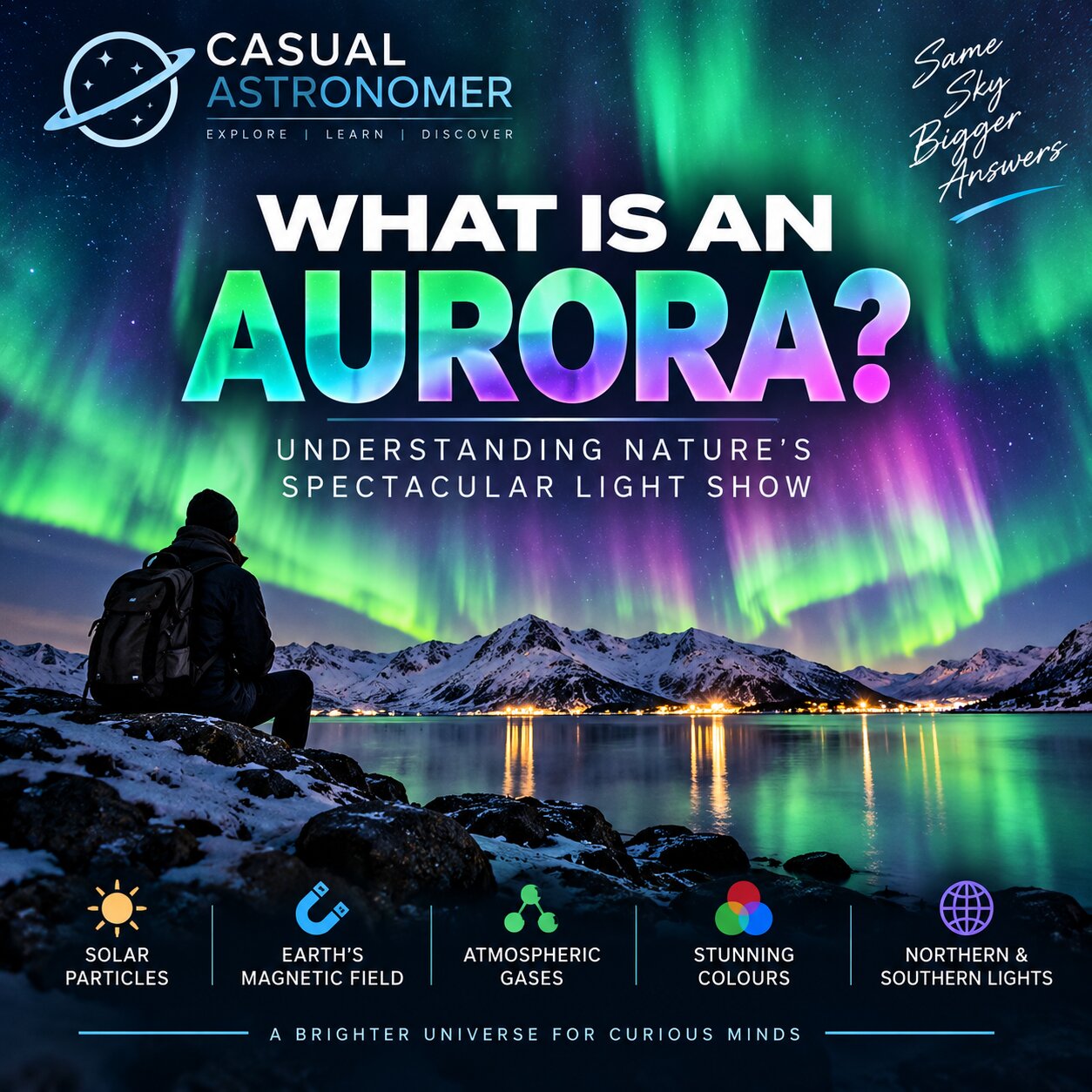

An aurora is a spectacular display of coloured light in the night sky caused by interactions between charged particles from the Sun and Earth’s atmosphere.
Few astronomical sights are as immediately recognisable as an aurora. Curtains of green light can stretch across the night sky, sometimes accompanied by shades of red, purple, blue and pink. The lights may appear as faint arcs at first before suddenly developing into rippling structures that seem to dance above the landscape.
Although they can appear almost otherworldly, auroras have a well-understood connection to both the Sun and Earth’s magnetic environment.
So, what is an aurora, and why are these displays usually associated with Earth’s polar regions?
How Does an Aurora Form?
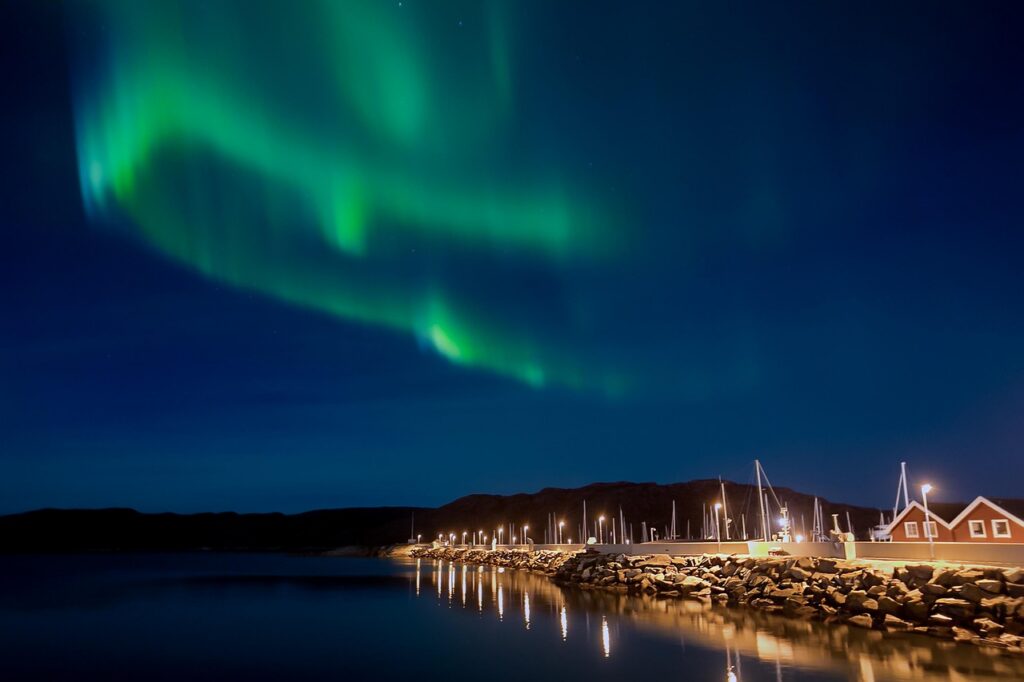
The story begins approximately 150 million kilometres away at the Sun.
The Sun continually releases a stream of electrically charged particles known as the solar wind. Activity on the Sun, including solar flares and coronal mass ejections, can sometimes send enhanced quantities of energetic particles towards Earth.
Fortunately, our planet possesses a magnetic field.
Earth’s magnetosphere deflects much of the incoming solar wind. However, interactions between the solar wind and magnetosphere can transfer energy into Earth’s magnetic environment and accelerate charged particles towards the polar regions.
When these particles enter the upper atmosphere, they collide with atoms and molecules such as oxygen and nitrogen.
Those collisions transfer energy to the atmospheric particles. As they subsequently release that energy, they emit light.
The enormous glowing display produced by countless interactions is what we see as an aurora.
Why Are Auroras Different Colours?
One of the most beautiful characteristics of an aurora is its colour.
Green is probably the colour most commonly associated with auroral displays. It is primarily produced by excited oxygen at altitudes of roughly 100 to 300 kilometres.
Oxygen can also produce red auroras at higher altitudes.
Nitrogen contributes blue and purple colours, while mixtures of emissions and viewing conditions can produce pinkish or other shades around particularly active displays.
The colours we observe therefore provide clues about which atmospheric particles are being excited and the altitude at which the interactions occur.
Aurora Borealis and Aurora Australis
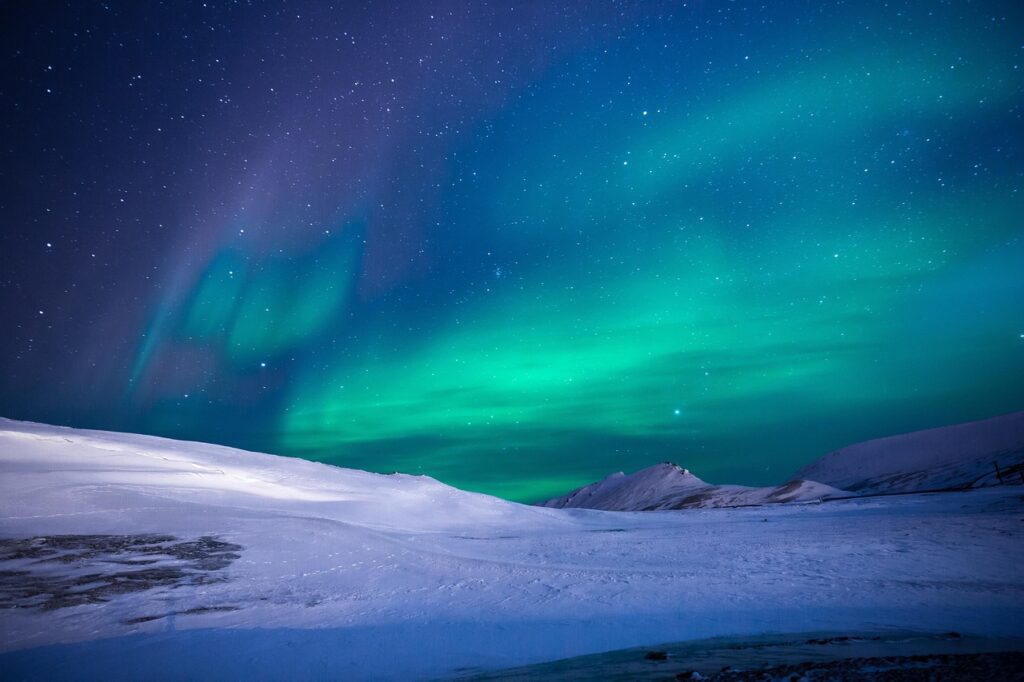
Auroras occur in both hemispheres.
In the Northern Hemisphere, the phenomenon is known as the aurora borealis, or Northern Lights. Countries within and near the Arctic Circle—including Norway, Sweden, Finland, Iceland, Canada and parts of the United States—are famous for auroral displays.
The Southern Hemisphere has its own equivalent: the aurora australis, commonly called the Southern Lights.
Antarctica provides some of the world’s most dramatic southern auroras, although its isolation makes them considerably harder for most people to observe.
Displays can also sometimes be seen from southern regions of countries such as New Zealand and Australia.
Why Do Auroras Usually Appear Near the Poles?
Earth’s magnetic field plays an important role in determining where auroras appear.
Charged particles travelling through the magnetosphere are guided along magnetic field lines towards regions surrounding the magnetic poles. This creates broad rings of auroral activity known as auroral ovals.
These ovals are why high-latitude locations experience auroras much more frequently than areas closer to the equator.
However, the ovals aren’t fixed.
Strong geomagnetic storms can cause auroral activity to expand towards lower latitudes. During particularly powerful events, people hundreds or even thousands of kilometres farther from the poles than usual may suddenly find colourful lights appearing in their skies.
Are Auroras Dangerous?
The visible aurora itself isn’t dangerous to people watching from the ground.
However, particularly intense auroras can accompany geomagnetic storms, which can affect technology.
Strong space-weather events can interfere with radio communications, satellite operations and navigation systems. In extreme cases, changes in Earth’s magnetic environment can induce electrical currents capable of affecting power infrastructure.
This means scientists aren’t studying auroras simply because they’re beautiful.
Observing them forms part of the broader study of space weather and the relationship between the Sun and Earth.
Can Other Planets Have Auroras?
Earth isn’t the only world with auroras.
Jupiter has extraordinarily powerful auroral displays associated with its immense magnetic field. Saturn also possesses auroras around its poles, while auroral phenomena have been detected elsewhere in the Solar System.
These observations give astronomers valuable information about planetary atmospheres and magnetic environments.
Studying auroras on different worlds also helps scientists understand how planets interact with particles and radiation travelling through space.
Watching the Sky Come Alive
So, what is an aurora?
At its simplest, it’s light produced when energetic charged particles interact with gases in a planet’s upper atmosphere. Yet that straightforward physical process can create one of the most extraordinary spectacles visible from Earth.
Auroras are also a visible reminder that our planet isn’t isolated from the rest of the Solar System.
Every shimmering curtain of green, red or purple light tells part of a much larger story—one that begins at the Sun, travels millions of kilometres through space and finally illuminates Earth’s atmosphere above us.


Leave a Reply