
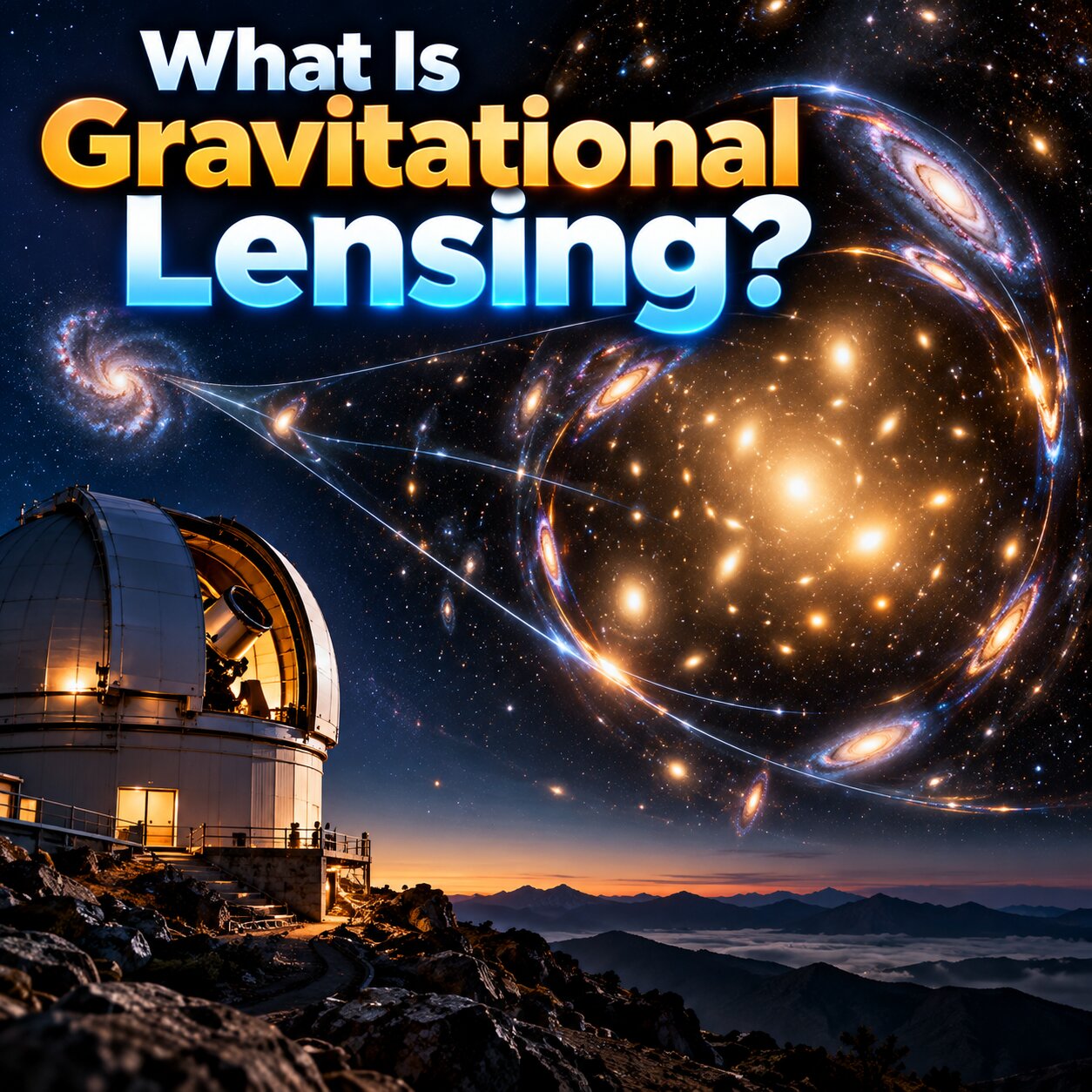

Imagine looking at a distant galaxy through a gigantic cosmic magnifying glass. There is no physical lens floating in space, however. Instead, gravity itself can bend the path travelled by light. This phenomenon is known as gravitational lensing.
Albert Einstein’s general theory of relativity describes gravity as the curvature of spacetime caused by mass and energy. When light from a distant object travels past something extremely massive, such as a galaxy or galaxy cluster, its path can consequently appear distorted to an observer.
Depending on the alignment and masses involved, astronomers may observe:
- Stretched arcs of distant galaxies
- Multiple images of the same object
- Nearly complete or complete Einstein rings
- Magnification of otherwise faint objects
- Tiny brightness changes caused by microlensing
The effect is more than an astronomical curiosity. Massive foreground objects can magnify extremely distant galaxies, allowing telescopes to detect objects that might otherwise be too faint to study.
Gravitational lensing also provides astronomers with a way of investigating matter that cannot be seen directly. By studying how background light is distorted, researchers can map the distribution of mass within galaxy clusters. The amount of gravitational lensing observed often indicates far more mass than visible stars and gas can account for, providing important evidence used in studies of dark matter.
A smaller version called gravitational microlensing can occur when a star or another compact object passes between Earth and a more distant star. The temporary magnification of the background star can even help astronomers discover exoplanets.
Gravitational lensing therefore turns one of the universe’s fundamental forces into an observational tool.
The cosmos itself becomes the telescope, with enormous concentrations of mass bending and magnifying ancient light before it finally reaches our instruments on Earth.

Leave a Reply