
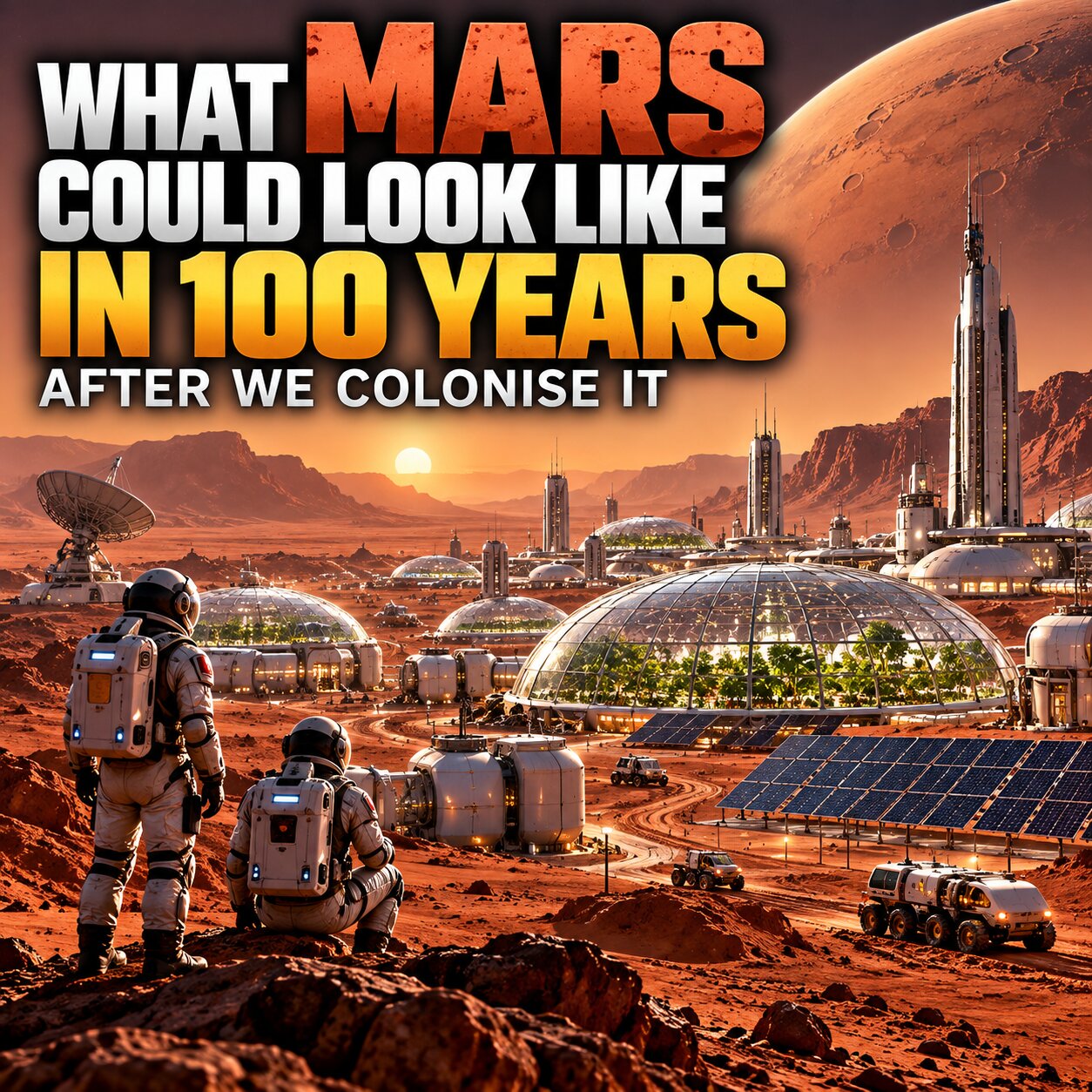

Imagine standing on a ridge on Mars in the year 2126. Below you, the familiar red landscape stretches towards the horizon, but something is different. Lights glow from a settlement in the valley. Pressurised vehicles travel along established routes, solar farms cover sections of previously empty terrain, and enormous greenhouses provide food for thousands of people living millions of kilometres from Earth.
Mars would still be Mars. Its atmosphere would remain hostile, temperatures would be brutally cold and stepping outside without protection would almost certainly still be impossible. Yet, if humans establish permanent settlements during the coming decades, what Mars could look like in 100 years may be dramatically different from the untouched planet we know today.
Rather than a fully terraformed second Earth, our first Martian civilisation would probably consist of protected pockets of humanity surrounded by one of the most hostile environments we have ever attempted to inhabit.
The First Martian Cities May Grow Underground
Science fiction often portrays Mars colonies as enormous glass domes covering futuristic cities. Some transparent structures may exist, particularly for agriculture, but early Martian settlements could develop in a very different direction.
Radiation is one of the greatest challenges facing anyone attempting to live permanently on Mars. Unlike Earth, Mars lacks a strong global magnetic field and thick atmosphere capable of providing comparable protection against cosmic radiation and energetic particles from the Sun.
One solution is conveniently available almost everywhere on Mars: regolith.
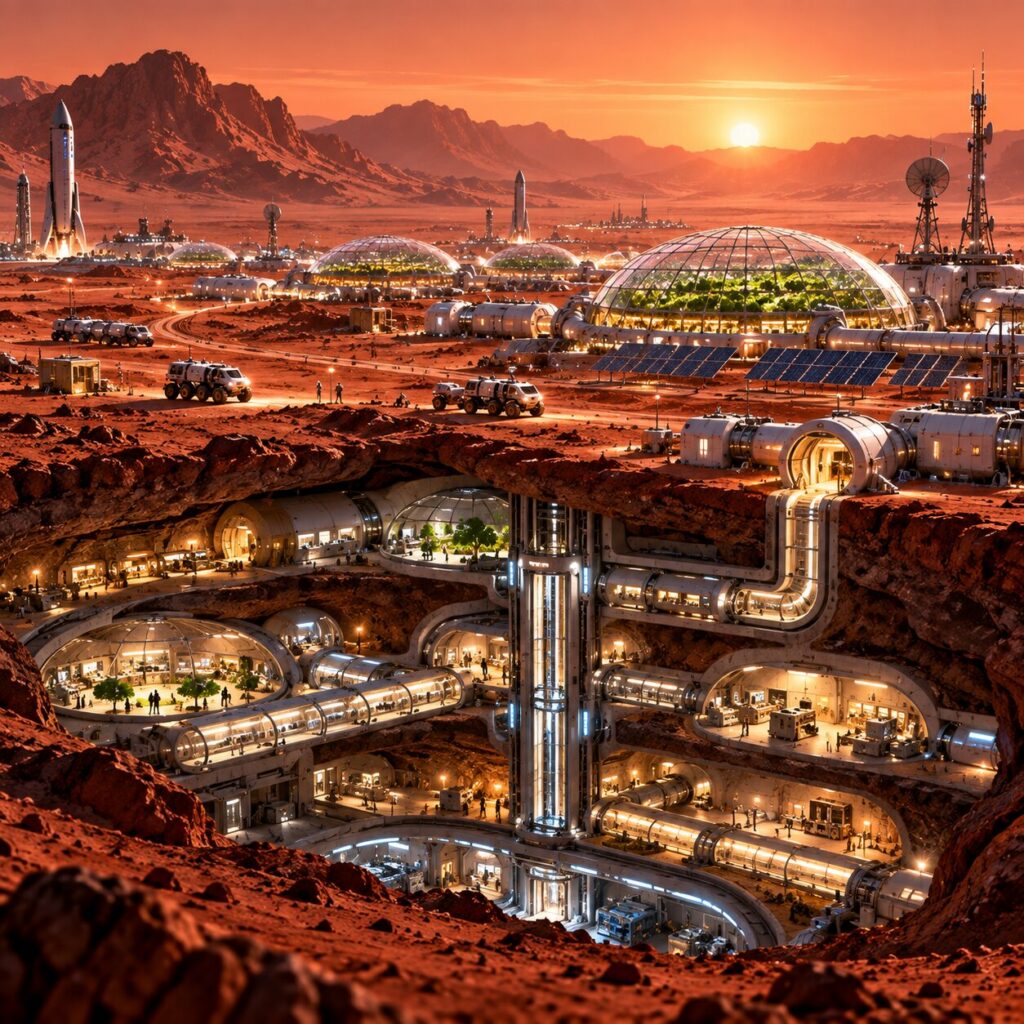
Habitats could be buried beneath Martian soil or constructed inside natural features such as lava tubes. Thick layers of material above living spaces would provide radiation shielding while also offering additional protection against extreme temperature changes and small meteorite impacts.
After a century of colonisation, entire neighbourhoods could therefore exist beneath the surface. What appears from outside to be a collection of entrances, communications towers and industrial facilities might conceal a surprisingly large city underground.
Giant Greenhouses Could Feed Mars
A permanent Martian population cannot depend indefinitely on regular food shipments from Earth. Agriculture would need to become one of the foundations of any successful colony.
Large pressurised greenhouses could eventually become some of the most visually distinctive structures on Mars. Inside them, carefully controlled environments would provide crops with suitable temperatures, water, nutrients, atmospheric pressure and light.
Hydroponic and aeroponic systems could reduce the amount of soil and water required. Water itself may increasingly come from Martian ice deposits, with sophisticated recycling systems ensuring that very little is wasted.
Food production would probably extend far beyond keeping people alive. As settlements grow, colonists may want variety, fresh ingredients and foods associated with life on Earth. A Martian greenhouse a century from now could contain vegetables, fruit, herbs and perhaps even small trees.
Seeing an enormous green agricultural space surrounded by kilometres of barren red desert might become one of the defining sights of a colonised Mars.
Mars Could Develop Its Own Roads and Transport Networks
Early Mars explorers will probably rely heavily on specialised rovers, but a civilisation containing thousands or potentially hundreds of thousands of people would require considerably more infrastructure.
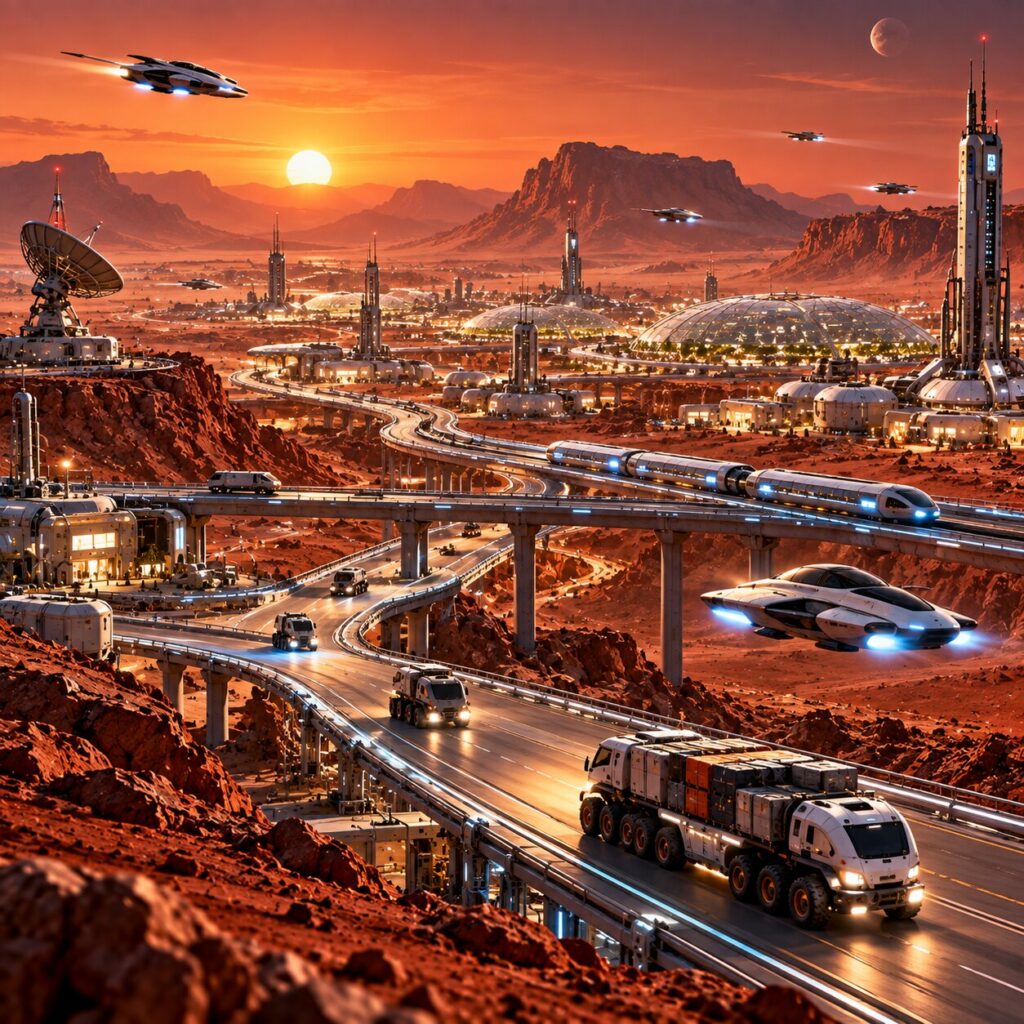
Settlements could become connected by established transport routes across the surface. Pressurised vehicles would allow passengers and cargo to travel between colonies without wearing spacesuits throughout the journey, while autonomous freight vehicles could continuously move resources between mines, factories and population centres.
Longer distances may eventually be served by specialised rail systems or other forms of mass transport. Mars has no oceans separating its continents, which could theoretically allow enormous overland networks to develop as settlement expands.
Launch facilities would also become crucial pieces of infrastructure. Spaceports could connect Mars with Earth, orbital stations and perhaps eventually mining or research operations elsewhere in the Solar System.
Martian Industry Could Become Enormous
Shipping every building component from Earth would be extraordinarily expensive, so Mars colonisation would eventually need to depend on resources found locally.
That could transform parts of the Martian landscape.
Mining operations might extract water ice, metals and minerals required by expanding settlements. Martian regolith could potentially become a construction material, while manufacturing facilities might produce everything from structural components to replacement machinery.
Three-dimensional printing and highly automated manufacturing could become especially valuable when the nearest replacement component from Earth might be months away.
After 100 years, some Martian settlements may therefore resemble industrial cities as much as scientific outposts. Humanity would no longer simply be visiting Mars to study it. People would be extracting resources, manufacturing products and building the infrastructure required for generations to live there.
Renewable and Nuclear Energy Could Power the Colonies
Energy would determine almost everything a Martian civilisation could accomplish.
Large solar farms are an obvious possibility, although Mars receives less sunlight than Earth and dust can reduce solar-panel performance. Future colonies could use extensive automated systems to keep panels operating efficiently.
Nuclear power may provide another important source of dependable energy, particularly during dust storms or for settlements located where solar conditions are less favourable.
Over a century, the Martian energy network could become increasingly sophisticated, combining solar installations, nuclear reactors, large-scale storage and technologies we may only be beginning to develop today.
The result could be sprawling energy facilities surrounding settlements and industrial regions, providing the electricity needed for life-support systems, agriculture, manufacturing, transportation and scientific research.
Could We Begin Terraforming Mars?
Terraforming Mars is where predictions become considerably more speculative.
Transforming the entire planet into an Earth-like environment would be vastly more difficult than building protected settlements. Mars has an extremely thin atmosphere, low temperatures, lower gravity and no global magnetic field comparable with Earth’s.
Even if humanity eventually develops technologies capable of deliberately warming the planet or increasing atmospheric pressure, noticeable planetary transformation would probably take far longer than a century.
However, colonists living in 2126 might conduct the first serious experiments aimed at modifying local environments.
Scientists could investigate methods of releasing trapped gases, engineering microorganisms capable of surviving Martian conditions or creating increasingly large controlled ecosystems. Instead of terraforming an entire planet, humanity might initially concentrate on “paraterraforming” smaller enclosed regions where Earth-like conditions can be maintained.
Mars may become greener inside its cities long before the planet itself becomes green.
A New Martian Culture Could Emerge
Perhaps the greatest transformation would not be technological at all.
If people begin having children on Mars and permanent settlements survive for several generations, a distinct Martian identity could develop. Someone born on Mars in 2100 may consider the red planet home in exactly the same way we consider our countries and cities home today.
Architecture, clothing, recreation, food and social customs could adapt to Martian conditions. Lower gravity might even influence sports and entertainment in ways we have never experienced on Earth.
Communication delays would also encourage greater independence. Depending on the positions of the planets, messages between Earth and Mars can take several minutes in each direction. Mars could not rely on Earth for immediate instructions during emergencies, forcing settlements to become increasingly self-sufficient.
Eventually, Martian communities may stop thinking of themselves primarily as people from Earth living on Mars and begin thinking of themselves simply as Martians.
What Mars Could Look Like in 100 Years
A century after the first permanent colonies are established, Mars probably won’t resemble the lush second Earth frequently depicted in science fiction. Step beyond the protected boundaries of a settlement and you may still encounter the same freezing, radiation-battered desert humans first explored with robotic spacecraft.
The difference will be what we have built within it.
There could be underground cities protected by metres of Martian soil, enormous agricultural domes glowing green against the red landscape, sprawling solar farms, nuclear power facilities, mines, factories, roads and regular spacecraft travelling between Mars and Earth.
Most importantly, there could be people who have never known another home.
Colonising Mars would represent much more than placing human footprints on another planet. If those settlements survive for a century and continue growing, humanity will have achieved something unprecedented in our history: we will have transformed from a civilisation living on one world into a species permanently inhabiting another.

Leave a Reply