Astronomers using the James Webb Space Telescope may have identified the earliest supernova ever seen, dating back to a time when the universe was still in its infancy. If confirmed, the discovery offers a rare glimpse into the death of one of the first generations of stars, formed just a few hundred million years after the Big Bang.
The finding highlights Webb’s unique ability to peer deeper into cosmic history than any telescope before it, revealing events that were previously thought to be beyond observational reach.
A supernova from the universe’s earliest era
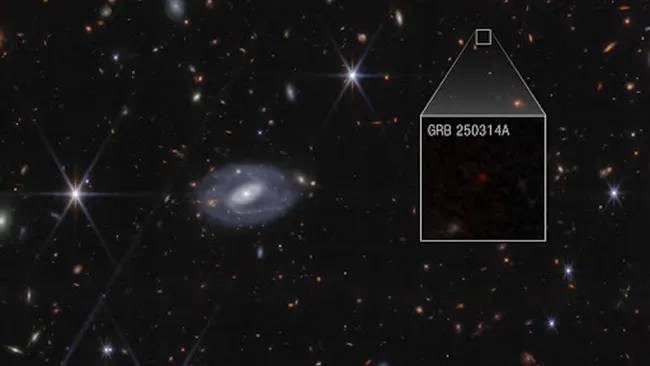
The potential supernova was detected in a distant galaxy observed as it appeared roughly 700 million years after the Big Bang. At this point in cosmic history, the universe was still forming its earliest stars and galaxies, making stellar explosions from this era extremely rare and difficult to detect.
Unlike nearby supernovae, which can be studied in detail across multiple wavelengths, this event appears as a faint but distinct brightening in Webb’s infrared observations. The light has travelled for more than 13 billion years to reach us, stretched and reddened by the expansion of the universe.
Why this discovery surprised astronomers
Researchers were not specifically searching for a supernova when the signal appeared. Instead, it emerged unexpectedly while Webb was observing distant galaxies as part of a deep-field survey. The sudden increase in brightness stood out against the background, prompting further analysis.
Scientists described their reaction as amazement because detecting a supernova at such an early cosmic time challenges existing assumptions about how quickly massive stars formed, lived, and died in the young universe. It suggests that stellar evolution may have progressed faster than previously believed.
What makes early supernovae so important
Supernovae play a crucial role in shaping the universe. They forge heavy elements such as carbon, oxygen, and iron, then scatter them into surrounding space, enriching future generations of stars and planets.
An early supernova provides direct evidence of when these processes began. If massive stars were already exploding within the first billion years, it means the building blocks of complex chemistry appeared earlier than expected. This has implications for galaxy formation, star formation rates, and the long-term evolution of cosmic structures.
Why confirmation takes time
Identifying a supernova so far away is challenging. Astronomers must rule out other explanations, such as active galactic nuclei or other energetic events that can mimic similar signals. Follow-up observations and modelling are required to determine whether the light curve and energy profile match what scientists expect from a true stellar explosion.
Even if this specific event turns out not to be a supernova, the detection still demonstrates Webb’s unprecedented sensitivity to early-universe phenomena and its ability to uncover transient events from cosmic dawn.
News source: Live Science
A glimpse into the universe’s first stellar deaths
If confirmed, this discovery would mark the earliest supernova ever observed, offering a direct window into the life cycles of the universe’s first stars. It underscores the transformative power of the James Webb Space Telescope and its role in reshaping our understanding of cosmic history.
As Webb continues to explore deeper into space and further back in time, more discoveries like this are likely to emerge, revealing how the earliest chapters of the universe were written.