A pulsar is one of the most extreme and fascinating objects in the universe. At first glance, it appears as a faint point of light in space, but in reality, a pulsar is the ultra-dense remnant of a massive star that has collapsed and exploded as a supernova.
What makes pulsars special is the way they emit energy. As they spin, they release powerful beams of radiation from their magnetic poles. When one of these beams sweeps past Earth, astronomers detect it as a regular pulse of radiation, which is how pulsars get their name.
How Are Pulsars Formed?
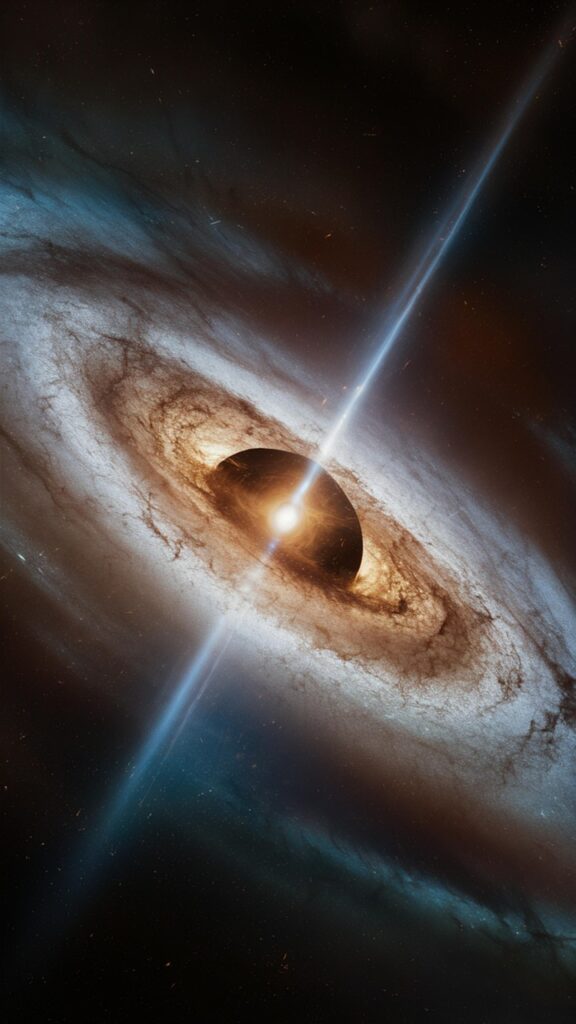
Pulsars form after a massive star reaches the end of its life. When such a star runs out of fuel, its core collapses under gravity and the outer layers explode outward in a supernova. What remains behind is an incredibly dense core known as a neutron star.
If this neutron star is rotating rapidly and has a strong magnetic field, it becomes a pulsar. Despite being only about the size of a city, a pulsar can contain more mass than the Sun, making it one of the densest objects known in space.
Why Do Pulsars Appear to Pulse?
The pulsing effect is caused by the pulsar’s rapid rotation combined with its intense magnetic field. Pulsars do not emit radiation evenly in all directions. Instead, energy is focused into narrow beams that shoot out from the magnetic poles.
As the pulsar spins, these beams sweep through space like the light from a lighthouse. Each time a beam points toward Earth, astronomers detect a pulse. Some pulsars spin hundreds of times per second, producing incredibly precise and regular signals.
How Do Astronomers Detect Pulsars?
Most pulsars are detected using radio telescopes, which can pick up the faint radio waves emitted by these spinning neutron stars. Some pulsars are also observed in X-ray and gamma-ray wavelengths, depending on how energetic they are.
Because their pulses are so regular, pulsars are sometimes described as the universe’s most accurate natural clocks. Astronomers use them to study gravity, test theories of physics, and even help navigate spacecraft.
Why Are Pulsars Important?
Pulsars are more than cosmic curiosities. They help scientists understand extreme physics that cannot be recreated on Earth. The intense gravity, magnetic fields, and densities found in pulsars provide insights into how matter behaves under the most extreme conditions.
They also play a role in studying black holes, gravitational waves, and the structure of our galaxy. Some pulsars orbit other stars, while others spin alone in deep space, offering clues about stellar evolution and the aftermath of supernova explosions.
Can You See a Pulsar With a Telescope?
Unfortunately, pulsars cannot be seen directly with amateur telescopes. They are far too small and distant to appear as anything more than faint points of light. Their presence is revealed through specialised instruments that detect their radiation rather than visible light.
However, knowing that these objects exist adds depth to stargazing. When you look up at the night sky, some of the stars you see may be the remnants of long-dead suns, spinning silently as pulsars far beyond human perception.
Final Thoughts on Pulsars
Pulsars remind us just how strange and extreme the universe can be. Born from violent stellar deaths, they continue to spin for millions of years, sending out rhythmic signals across space.
For casual astronomers, pulsars offer a glimpse into the life cycles of stars and the incredible forces at work beyond our planet. They are small, distant, and invisible to the naked eye, yet they play an outsized role in helping us understand the cosmos.