
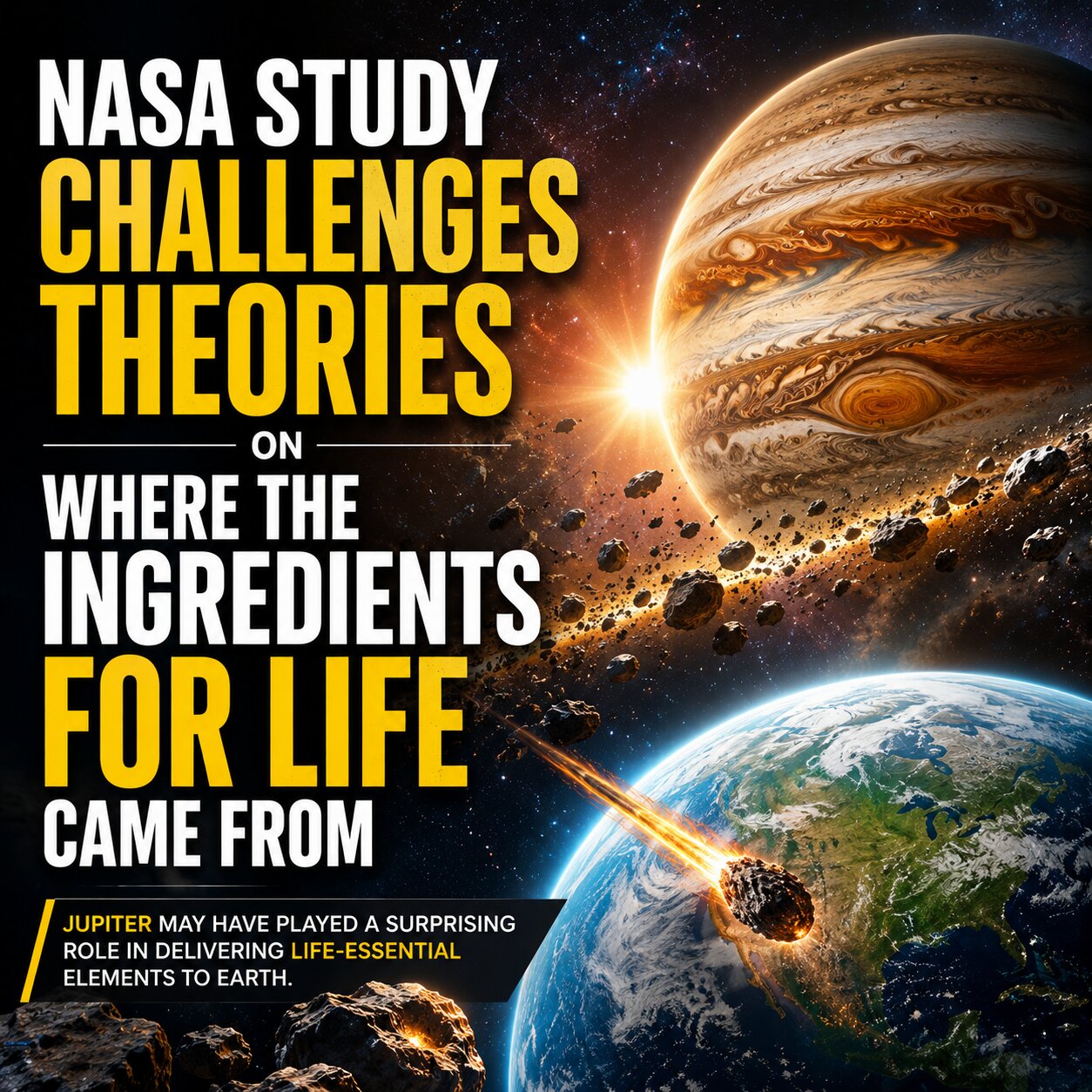

The origin of life on Earth remains one of science’s greatest mysteries. While researchers have gathered substantial evidence showing that life emerged roughly four billion years ago, many questions remain about how the essential building blocks of life arrived on our young planet. For decades, scientists have generally believed that comets and asteroids from the outer Solar System delivered many of these critical ingredients during a period known as the Late Heavy Bombardment.
However, a new NASA-supported study is challenging that traditional view. Researchers now suggest that some of the most important elements needed for life may have originated much closer to Earth, with Jupiter playing a surprising role in determining where those ingredients ended up throughout the Solar System.
The Essential Ingredients for Life
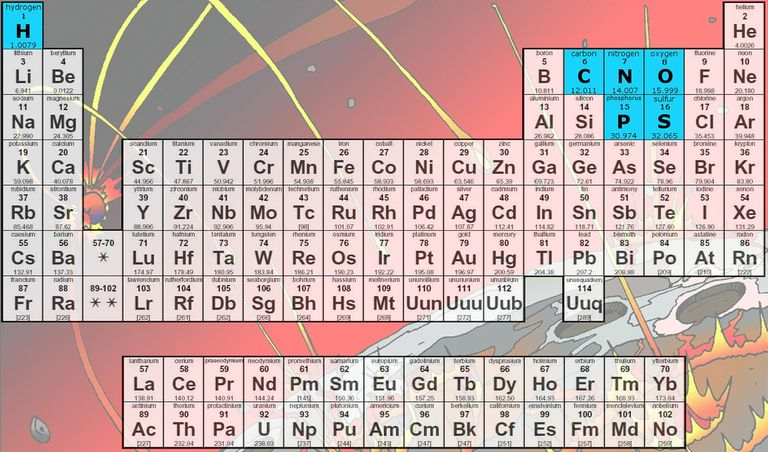
Every known form of life on Earth depends on a collection of elements often referred to as CHNOPS: carbon, hydrogen, nitrogen, oxygen, phosphorus, and sulphur. These elements form the chemical foundation of living organisms, from simple microbes to complex plants and animals.
Scientists have long debated how Earth acquired sufficient quantities of these elements during its formation. Traditional models suggested that many life-essential elements were delivered by chondrites, a type of stony meteorite originating in the outer Solar System.
This theory seemed reasonable because the early Solar System was a chaotic environment filled with collisions between planets, asteroids, comets, and countless smaller bodies. During this period, material from distant regions could potentially have been transported inward toward the young Earth.
Yet new research indicates the story may be more complicated than previously thought.
Reconstructing the Early Solar System
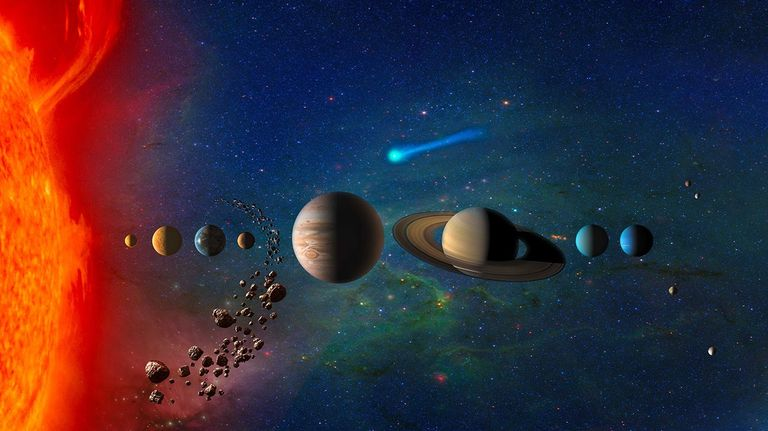
To better understand the origins of life-essential elements, researchers examined the distribution of phosphorus and nitrogen throughout the early Solar System. Both elements are critical for life, playing major roles in DNA, cellular processes, and biological energy transfer.
The team used laboratory experiments and advanced geochemical models to recreate conditions during the formation of the Solar System. By analysing phosphorus-to-nitrogen ratios in different types of meteorites, they were able to trace how these elements may have moved during the earliest stages of planetary development.
Their findings revealed an unexpected pattern:
- Early planetesimals showed higher phosphorus-to-nitrogen ratios farther from the Sun
- Later planetesimals displayed the opposite trend
- Inner Solar System bodies retained more phosphorus and nitrogen than previously believed
- Earth’s chemical signature closely matches material from the inner Solar System
- Jupiter‘s formation appears to have altered the movement of these elements
These results challenge the long-standing assumption that Earth’s life-essential elements primarily arrived from distant regions beyond the asteroid belt.
Jupiter’s Surprising Influence
Jupiter is the largest planet in our Solar System and has influenced planetary evolution for billions of years. According to the new study, its formation may have dramatically changed how material moved through the Solar System.
As Jupiter grew, its immense gravity likely acted as a barrier that restricted the outward movement of phosphorus and nitrogen from the inner Solar System. This created distinct chemical environments on either side of the giant planet.
When later generations of planetesimals formed, those located closer to the Sun retained a greater abundance of these life-essential elements. As a result, Earth may have acquired much of its phosphorus and nitrogen from nearby material rather than relying heavily on incoming bodies from the outer Solar System.
This finding suggests that Jupiter’s presence may have indirectly helped create the conditions necessary for life to emerge on Earth.
What This Means for Other Planetary Systems
One of the most intriguing implications of this research extends beyond our own Solar System. If Jupiter played a crucial role in distributing life-essential elements, similar giant planets may influence the habitability of worlds orbiting other stars.
Astronomers have discovered thousands of exoplanets over the past few decades, including many giant planets comparable to Jupiter. Understanding how these worlds affect the movement of chemical ingredients could help scientists identify planetary systems with the greatest potential for supporting life.
Future studies will continue investigating how other elements were distributed throughout the Solar System and whether similar processes occur elsewhere in the galaxy.
A New Perspective on Earth’s Origins
The search for life’s origins is constantly evolving as new evidence emerges. While scientists once viewed the outer Solar System as the primary source of Earth’s life-essential ingredients, this new research paints a more nuanced picture.
Instead of relying mainly on distant comets and asteroids, Earth may have inherited much of its phosphorus and nitrogen from material already present within the inner Solar System. Jupiter’s gravitational influence appears to have played a key role in shaping that outcome.
As researchers continue uncovering clues about the formation of our Solar System, each discovery brings us closer to understanding one of humanity’s oldest questions: how life began on Earth, and whether similar conditions exist elsewhere in the universe.


Leave a Reply