
Capturing the beauty of the night sky often requires more than a camera and telescope. While modern imaging equipment has become increasingly capable, astrophotography filters remain essential tools for improving image quality and revealing celestial details that might otherwise remain hidden. Understanding the different filters available can help astrophotographers produce sharper, more colourful, and more detailed images.
Whether photographing planets, nebulae, galaxies, or the Moon, selecting the right filter can significantly enhance your results and make imaging sessions more productive.
Why Astrophotography Filters Matter
Light pollution, atmospheric conditions, and the nature of astronomical objects can all affect image quality. Filters help address these challenges by allowing specific wavelengths of light to pass through while blocking unwanted light.
For urban astrophotographers, filters can reduce the impact of artificial lighting from cities and towns. This enables longer exposures and improved contrast when imaging deep-sky objects.
Filters also help isolate specific emission lines produced by celestial objects. Many nebulae emit light at particular wavelengths, and specialised filters can dramatically increase the visibility of these structures.
Additionally, filters can improve colour balance, reduce glare, and enhance surface details on planets and the Moon.
Common Types of Astrophotography Filters

Different filters serve different imaging purposes depending on the target being photographed.
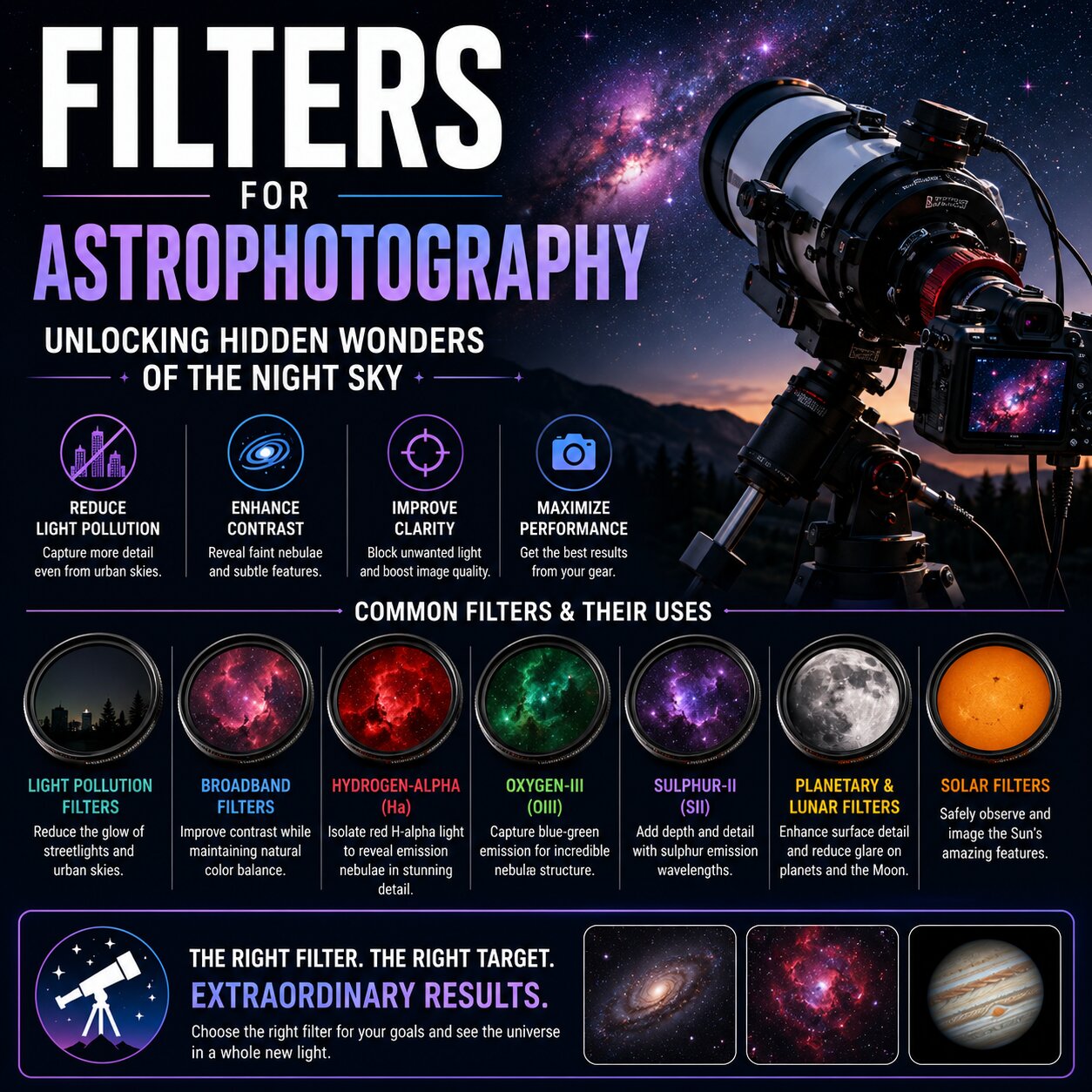
Broadband filters are commonly used to reduce light pollution while preserving much of the natural colour information in an image. They are often a good choice for galaxies, star clusters, and general deep-sky imaging.
Narrowband filters target specific wavelengths associated with emission nebulae. Popular examples include Hydrogen-Alpha (Ha), Oxygen-III (OIII), and Sulphur-II (SII) filters. These are widely used to capture stunning images of nebulae even under less-than-ideal sky conditions.
Colour filters are often used in planetary imaging. By isolating specific colours, they can enhance atmospheric features on planets such as Jupiter, Mars, and Saturn.
Solar filters are designed specifically for safe solar observation and imaging. These filters reduce sunlight to safe levels while allowing photographers to capture details on the Sun’s surface.
Popular Astrophotography Filters and Their Uses

When building an astrophotography toolkit, consider these commonly used filters:
- Light pollution reduction filters
- Broadband filters
- Hydrogen-Alpha (Ha) filters
- Oxygen-III (OIII) filters
- Sulphur-II (SII) filters
- UV/IR cut filters
- Planetary colour filters
- Lunar filters
- Solar filters
- Dual-band and tri-band filters
The best choice depends on your imaging goals, equipment, and observing location.
Enhancing Your View of the Universe
Astrophotography filters open new possibilities for capturing the wonders of the cosmos. They help reveal faint nebulae, improve planetary detail, combat light pollution, and maximise the performance of modern imaging systems.
At Casual Astronomer, we encourage aspiring and experienced astrophotographers alike to learn how filters can improve their results. By understanding the strengths of each filter type and matching them to your imaging targets, you can unlock new levels of detail and create breathtaking images of the night sky.
The universe is filled with hidden beauty, and the right filter can help bring it into view.