
Buying a telescope and camera might feel like the moment your astrophotography setup is complete. Then you try connecting everything, achieving precise focus, keeping dew away from the optics and tracking a faint galaxy for several hours.
Suddenly, you discover an entire world of Imaging Accessories.
Some accessories simply connect components together. Others improve image quality, automate repetitive tasks or solve problems that become increasingly important as exposures grow longer. The challenge for beginners is determining which equipment is actually necessary and which can wait until their astrophotography skills develop.
You certainly don’t need every accessory immediately. Understanding what each component does will help you build an imaging system around the objects you want to photograph.
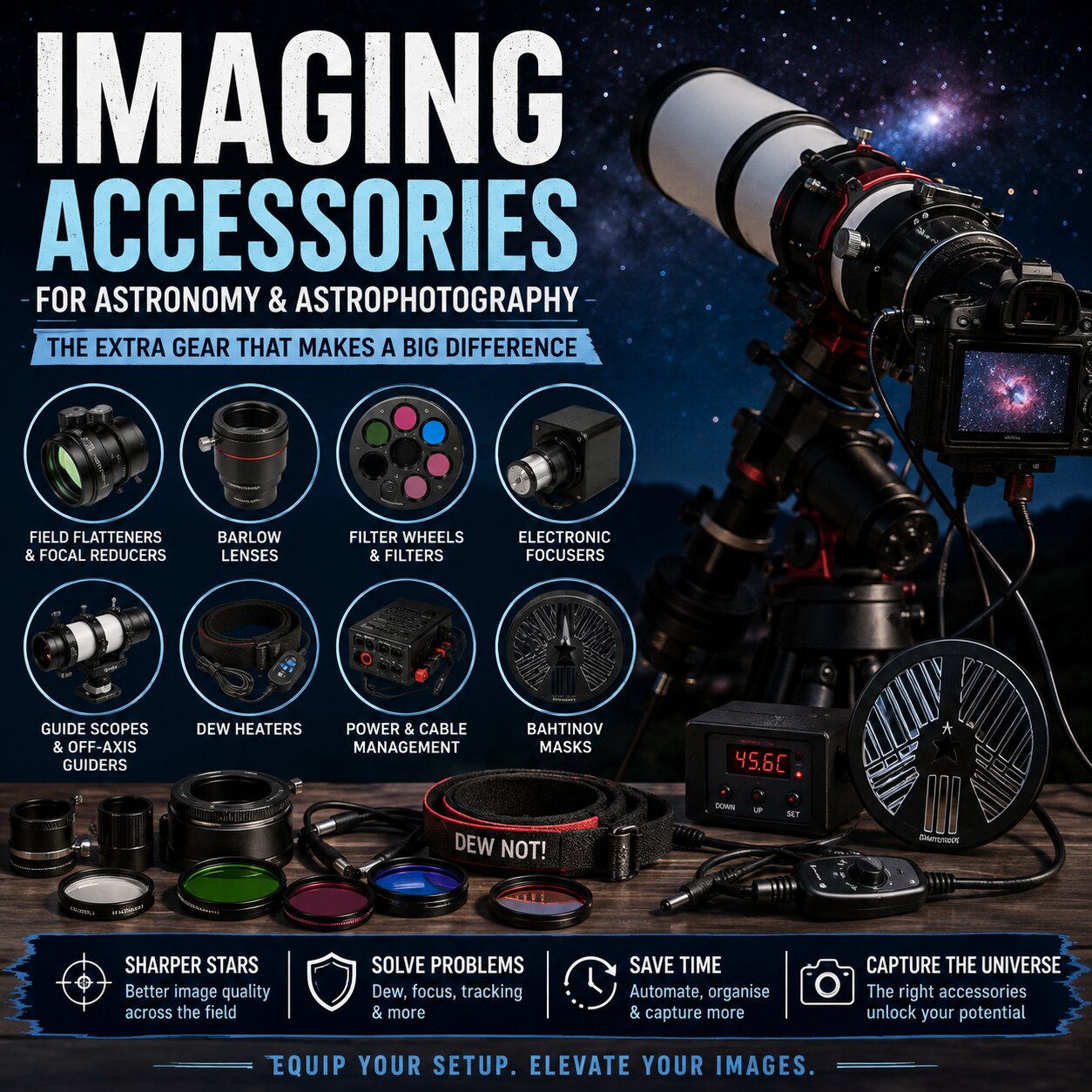
Camera Adapters, T-Rings and Extension Tubes
Before taking an image through a telescope, you need to securely connect the camera to the optical system.
T-rings are among the most common Imaging Accessories used with DSLR and mirrorless cameras. The appropriate T-ring connects to the camera’s lens mount, while a compatible adapter allows the assembly to attach to the telescope.
Dedicated astronomy cameras generally use different threaded connections.
Extension tubes and spacers may also be required to achieve the correct distance between optical components. This becomes particularly important when equipment such as focal reducers and field flatteners requires a specific back-focus distance.
These components aren’t particularly glamorous, but incorrect spacing can affect image quality even when the expensive equipment is functioning perfectly.
Field Flatteners and Focal Reducers
Stars near the centre of an astrophotograph may appear beautifully sharp while those around the edges become stretched or distorted.
A field flattener is designed to reduce field curvature and produce more consistent stars across the image.
Focal reducers perform a different but sometimes related job. By reducing the effective focal length of a telescope, they can create a wider field of view and lower the focal ratio.
These Imaging Accessories can be particularly useful for deep-sky photography, where a wider field may help capture large nebulae and galaxies while a faster effective optical system can benefit imaging efficiency.
Some products combine focal reduction and field flattening into one optical unit.
Compatibility matters, so check whether a particular reducer or flattener is designed for your telescope before purchasing it.
Barlow Lenses for Planetary Imaging
Not every astrophotographer wants a wider field.
If you’re photographing planets, increasing image scale can be extremely useful.
A Barlow lens effectively increases the telescope’s focal length, making objects such as Jupiter, Saturn and Mars appear larger on the camera sensor.
This makes Barlows popular Imaging Accessories for planetary astrophotography, where photographers commonly capture high-frame-rate video before stacking the best frames.
More magnification isn’t automatically better, though.
Atmospheric conditions, telescope aperture, camera pixel size and optical quality all influence how much useful detail can actually be recorded.
There comes a point where additional magnification simply creates a larger blurry planet.
Astronomy Filters and Filter Holders
Filters can become an important part of an astrophotography setup, particularly when moving deeper into specialised imaging.
Depending on the camera and target, astronomers may use broadband, narrowband, ultraviolet/infrared cut or other specialised filters.
There are several ways to place filters within an imaging train.
Common options include:
- Filter drawers for quickly inserting individual filters
- Manual filter wheels for changing between multiple filters
- Electronic filter wheels for automated imaging sessions
- Threaded filters attached directly to compatible equipment
- Clip-in filters designed for certain camera systems
These Imaging Accessories become especially valuable for monochrome astrophotography, where multiple filtered exposures can later be combined into a colour image.
Beginners using a colour astronomy camera or DSLR, however, don’t necessarily need an elaborate electronic filter wheel on their first night.
Bahtinov Masks and Electronic Focusers
Few things are more frustrating than spending hours collecting images only to discover that the stars weren’t properly focused.
A Bahtinov mask provides a wonderfully simple solution.
Placed over the front of a telescope, the mask creates a diffraction pattern around a bright star. The pattern makes it considerably easier to judge when precise focus has been achieved.
For its simplicity and relatively low cost, it can be one of the most useful Imaging Accessories for beginners.
Electronic focusers take things considerably further.
A motorised focuser can adjust telescope focus without physically touching the equipment. Advanced imaging software can also automate focusing during a session, compensating for changes caused by temperature or other factors.
For long automated imaging sessions, this can become enormously useful.
Guiding Accessories for Long Exposures
Tracking accuracy becomes increasingly important as exposure times increase.
Even a well-aligned equatorial mount can experience small tracking errors. Guiding systems monitor a reference star and send corrections to the mount to help keep the target precisely positioned.
A common setup uses a small guide scope fitted with a guide camera.
Another approach is an off-axis guider, which redirects a small portion of light from the primary telescope’s optical path towards the guiding camera.
These Imaging Accessories aren’t necessarily required for every type of astrophotography.
Wide-field imaging with short exposures may work perfectly well without guiding, while serious long-exposure deep-sky photography can benefit enormously from it.
Dew Heaters Can Save an Imaging Session
You can have perfect polar alignment, excellent focus and clear skies and still lose an imaging session because moisture forms on your optics.
As telescope surfaces cool during the night, dew can accumulate on exposed optical elements.
Dew heaters provide gentle warmth around the telescope or lens to help keep its temperature above the dew point.
A typical system may include heater straps, a controller and an appropriate power source.
Among all the Imaging Accessories available, dew-control equipment may not sound particularly exciting.
You may change your mind the first time you discover your telescope lens completely fogged halfway through an otherwise perfect night.
Power and Cable Management
Astrophotography equipment has an unfortunate ability to produce cables everywhere.
Cameras need power and data connections. Dew heaters require electricity. Guiding cameras connect to computers or control systems. Electronic focusers and filter wheels add even more connections.
Poor cable management isn’t merely untidy.
Cables can snag while the mount tracks across the sky, interfere with movement or place unwanted tension on connectors.
Power distribution and cable-management Imaging Accessories can help create a cleaner and more reliable setup.
Portable power stations and astronomy-specific power solutions can also become important when imaging far away from convenient electrical outlets.
Whatever power system you use, ensure it is suitable for the voltage and current requirements of your equipment.
Don’t Buy Every Accessory at Once
Astrophotography can become expensive remarkably quickly.
Once you begin browsing equipment catalogues, it can appear as though successful imaging requires an endless collection of adapters, computers, heaters, filters and electronic devices.
It doesn’t.
Start with the equipment required to make your existing telescope and camera function correctly.
Learn to focus.
Learn your mount.
Learn how exposure time, ISO or gain, tracking and image processing affect your results.
Then identify the problems you’re actually experiencing.
If dew keeps ruining your sessions, investigate dew control. If tracking limits your exposures, consider guiding. If stars around the edges of your images are distorted, research whether a field flattener is appropriate for your telescope.
Let problems guide purchases rather than advertisements.
Build Your Astrophotography Setup Over Time
The best Imaging Accessories are the ones that solve genuine problems within your particular astrophotography system.
A planetary photographer may value a quality Barlow lens far more than a filter wheel. Someone photographing nebulae through a monochrome camera may consider that same filter wheel essential. A beginner shooting the Moon through a DSLR may need little more than the correct camera adapter.
There is no universal accessory collection every astronomer must own.
Build gradually, understand what each component contributes and make sure new equipment is compatible with the rest of your imaging train.
Astrophotography already asks you to learn about cameras, telescopes, tracking, optics, astronomy and image processing.
You don’t need to master every accessory on your first night beneath the stars.
Sometimes the most useful piece of equipment is simply the one that fixes the problem standing between you and your next photograph.