For the first time, astronomers have been able to trace a colossal relativistic jet directly back to the immediate surroundings of the first black hole ever imaged: M87*. Stretching an astonishing 3,000 light-years, this jet of charged particles appears to emerge from the very edge of the black hole’s glowing “shadow,” offering an unprecedented glimpse into how these cosmic powerhouses shape their host galaxies.
Using new observations from the Event Horizon Telescope (EHT), scientists are now beginning to connect theory with direct evidence, revealing how matter and energy escape one of the most extreme environments in the universe.
What the New Observations Reveal
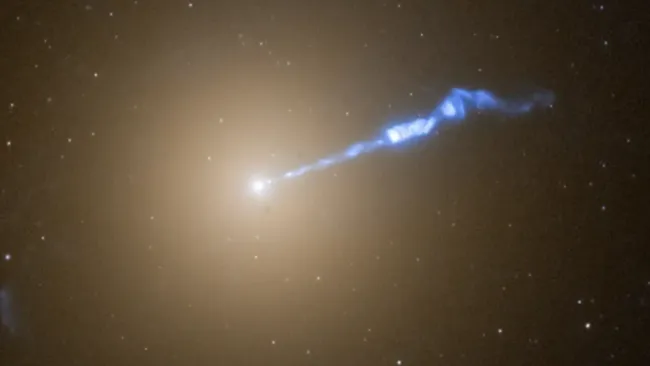
M87* sits at the centre of Messier 87, around 55 million light-years from Earth. With a mass equivalent to about 6.5 billion Suns, it dwarfs the supermassive black hole at the heart of the Milky Way. Unlike our own galaxy’s relatively quiet black hole, M87* is highly active, feeding on surrounding material and launching enormous jets from its poles.
By analysing EHT data collected in 2021 using Very Long Baseline Interferometry (VLBI), astronomers were able to link the bright ring of superheated matter seen in the iconic 2019 image to the base of the jet itself. Missing radio emissions in earlier datasets, but present in the newer observations, appear to originate from a compact region less than a tenth of a light-year from the black hole, effectively pinpointing where the jet is born.
News Source: Space.com
Why This Matters for Black Hole Science
For decades, astrophysicists have proposed models explaining how black holes launch jets, often involving powerful magnetic fields twisting and accelerating matter near the event horizon. Until now, these ideas remained largely theoretical. This new work represents one of the clearest observational links between a black hole’s shadow and the start of a relativistic jet.
By connecting structures on vastly different scales—from the event horizon itself to jets spanning thousands of light-years—scientists can now test and refine long-standing theories about how black holes convert infalling matter into focused, high-energy outflows.
Completing the Multi-Frequency Picture
One of the most exciting aspects of this research is its multi-frequency approach. The jet of M87* has been observed for years in optical and radio wavelengths, but only recently has it been possible to combine these observations with horizon-scale imaging.
As researchers continue to integrate data across the electromagnetic spectrum, they are effectively assembling a complete, layered picture of the jet-launching region. Each new wavelength adds detail, helping astronomers understand how energy flows from the black hole’s immediate environment into intergalactic space.
What This Means Going Forward
This breakthrough is an early but crucial step toward fully understanding how black holes influence galaxy evolution. Jets like the one from M87* regulate star formation, heat interstellar gas, and shape the large-scale structure of galaxies over millions of years.
Future EHT observations, combined with next-generation telescopes, are expected to sharpen this picture even further. As resolution improves, astronomers may soon observe changes in the jet’s structure in near real time, revealing how these cosmic engines evolve.
A Clearer View of a Cosmic Engine
By tracing a 3,000-light-year-long jet back to the glowing edge of M87*’s shadow, astronomers have taken a major step toward understanding how supermassive black holes power some of the universe’s most extreme phenomena. What was once a theoretical puzzle is now becoming an observable process, bringing us closer to a complete picture of how black holes shape the cosmos.