The Subaru Telescope OASIS survey has delivered its first major discoveries, revealing a massive exoplanet and a distant brown dwarf orbiting stars far beyond our Solar System. These early results showcase the impressive capability of combining advanced ground-based imaging with precise space-based observations, giving astronomers a clearer view of planetary systems still in their infancy.
OASIS, which stands for Observational Advances in Substellar Imaging Survey, was designed to directly image faint objects hidden in the glare of their parent stars. Its latest findings offer valuable clues about how planets and brown dwarfs form, evolve and interact within their stellar environments.
A Newly Imaged Giant Exoplanet
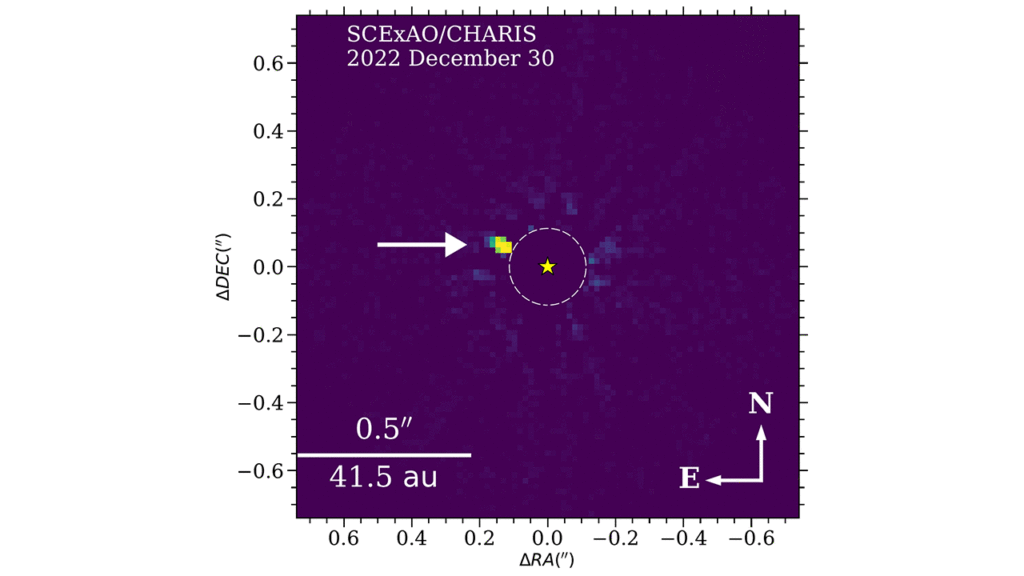
One of the most exciting outcomes of the Subaru Telescope OASIS survey is the direct imaging of a giant exoplanet orbiting a young star. This planet is several times more massive than Jupiter and lies at a considerable distance from its parent star, making it easier to observe but also more mysterious in terms of formation.
Early analysis suggests the planet’s atmosphere contains thick layers of dust and methane, similar to what astronomers observe in gas giants forming in young star systems. Because direct imaging is extremely challenging, every new exoplanet captured in this way helps refine models of planetary development.
A Brown Dwarf Companion Revealed
The OASIS team also uncovered a brown dwarf companion orbiting another distant star. Brown dwarfs sit between planets and stars, massive enough to initiate some fusion reactions yet too small to sustain them fully. This makes them a missing link in our understanding of substellar evolution.
The newly imaged brown dwarf shows strong infrared signatures that point to cloud-rich atmospheres and dynamic weather patterns. Discoveries like this help astronomers map out the diversity of objects that form in the outskirts of stellar nurseries.
Why These Discoveries Matter

The Subaru Telescope OASIS survey pushes the boundaries of direct imaging, one of the hardest techniques in astronomy. These early results matter because:
- They help researchers understand how giant planets form at wide separations
- They improve atmospheric models for gas giants and substellar objects
- They give astronomers rare observational data rather than simulations
- They demonstrate the effectiveness of hybrid observation methods using both ground- and space-based instruments
Every directly imaged world adds another piece to the puzzle of how planetary systems like our own come into being.
News Source: Space.com
A Promising Start for OASIS
These discoveries mark only the beginning. OASIS will continue surveying young, nearby stars for more hidden companions, and astronomers expect its next decade to yield dozens of new exoplanets and brown dwarfs. As imaging technology advances, surveys like OASIS will play an even bigger role in shaping our understanding of the universe.
The universe is full of worlds waiting to be seen. OASIS is helping us find them.