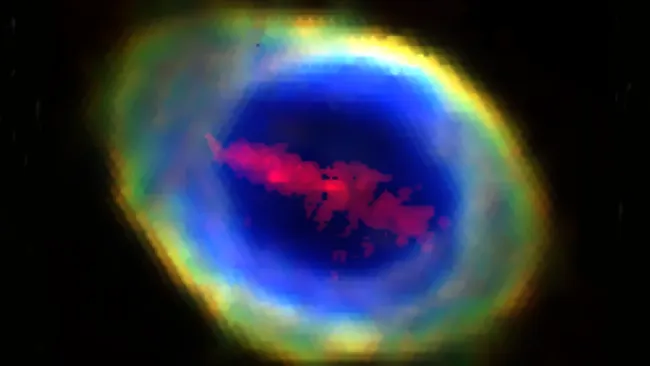
Astronomers studying one of the night sky’s most famous objects have uncovered a striking and completely unexpected feature hidden at its core. A newly discovered iron-rich “bar” inside the Ring Nebula is forcing scientists to rethink what they know about how planetary nebulae form and evolve.
This discovery shows that even celestial objects observed for centuries can still hold major surprises, especially when viewed with new instruments and techniques.
A surprising discovery inside a familiar nebula
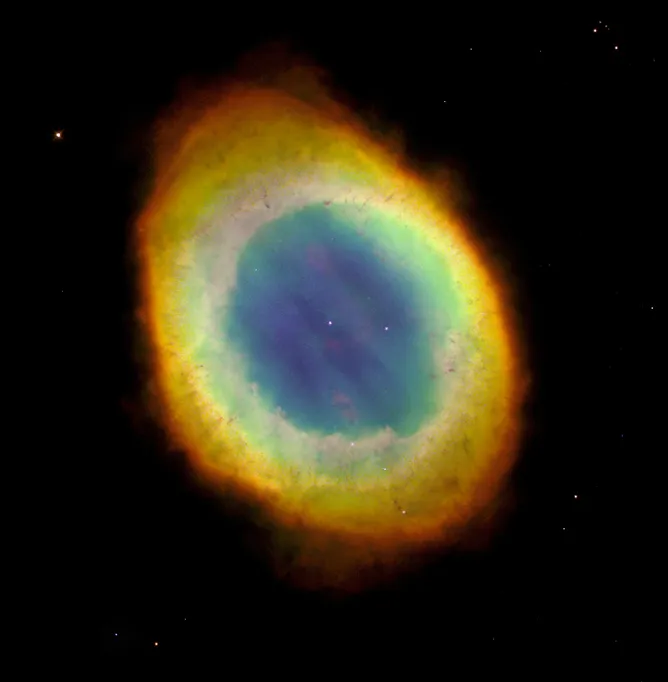
The Messier 57, located about 2,000 light-years away in the constellation Lyra, is the glowing remnant of a Sun-like star that shed its outer layers near the end of its life. While its bright ring-shaped appearance has been studied extensively, the newly identified structure lies deep within its interior.
Using the William Herschel Telescope in Spain, astronomers detected a previously unseen rod-like cloud of ionized iron atoms cutting across the inner region of the nebula. This iron bar stretches an astonishing distance, around 1,000 times the distance between the Sun and Pluto, and contains roughly the same mass of iron as the planet Mars.
The discovery was made possible by a new instrument called WEAVE (WHT Enhanced Area Velocity Explorer), which allowed scientists to map the chemical composition of the nebula in unprecedented detail across its entire structure.
News source: Space.com
Why the iron bar is such a big deal
Planetary nebulae are typically dominated by glowing hydrogen, helium, oxygen, and nitrogen. Finding a concentrated structure made primarily of iron inside such a nebula is highly unusual. Iron is heavy and difficult to ionize, making its presence in this form both unexpected and puzzling.
One leading theory suggests the iron bar could be linked to the way the dying star expelled its outer layers, possibly forming complex internal flows rather than a simple expanding shell. Another intriguing possibility is that the iron originated from a rocky planet that was vaporized as the star expanded into a red giant, leaving behind a trail of metal-rich debris.
Either explanation would have major implications for how astronomers understand the late stages of stellar evolution.
What this could mean for our own solar system
The discovery has implications that extend well beyond the Ring Nebula itself. In about 5 billion years, our Sun is expected to follow a similar path, expanding into a red giant before shedding its outer layers and forming a planetary nebula of its own.
If the iron bar in the Ring Nebula is the result of destroyed planets, it raises sobering questions about the ultimate fate of rocky worlds, including Earth. Studying structures like this gives astronomers rare insight into what happens to planetary systems when their parent stars die.
Why new instruments change everything
This discovery would not have been possible without WEAVE’s ability to collect spectra across the entire nebula simultaneously. Instead of observing small regions one at a time, astronomers can now map chemical elements throughout an object in one coherent dataset.
The research team plans to conduct follow-up observations at higher resolution to determine whether other elements are mixed in with the iron. Understanding the full chemical makeup of the bar will help scientists narrow down which formation models best explain its existence.
The findings were published in Monthly Notices of the Royal Astronomical Society, one of the leading journals in astrophysics.
A reminder that the universe still has secrets
The discovery of an iron bar inside the Ring Nebula highlights how much remains unknown, even about objects that appear well understood. As astronomers continue to study planetary nebulae with next-generation instruments, similar hidden structures may soon be found elsewhere in the galaxy.
For skywatchers, the Ring Nebula will always be a beautiful target in small telescopes. For scientists, it has now become something even more valuable: a reminder that the universe still has the power to surprise us, no matter how familiar it may seem.