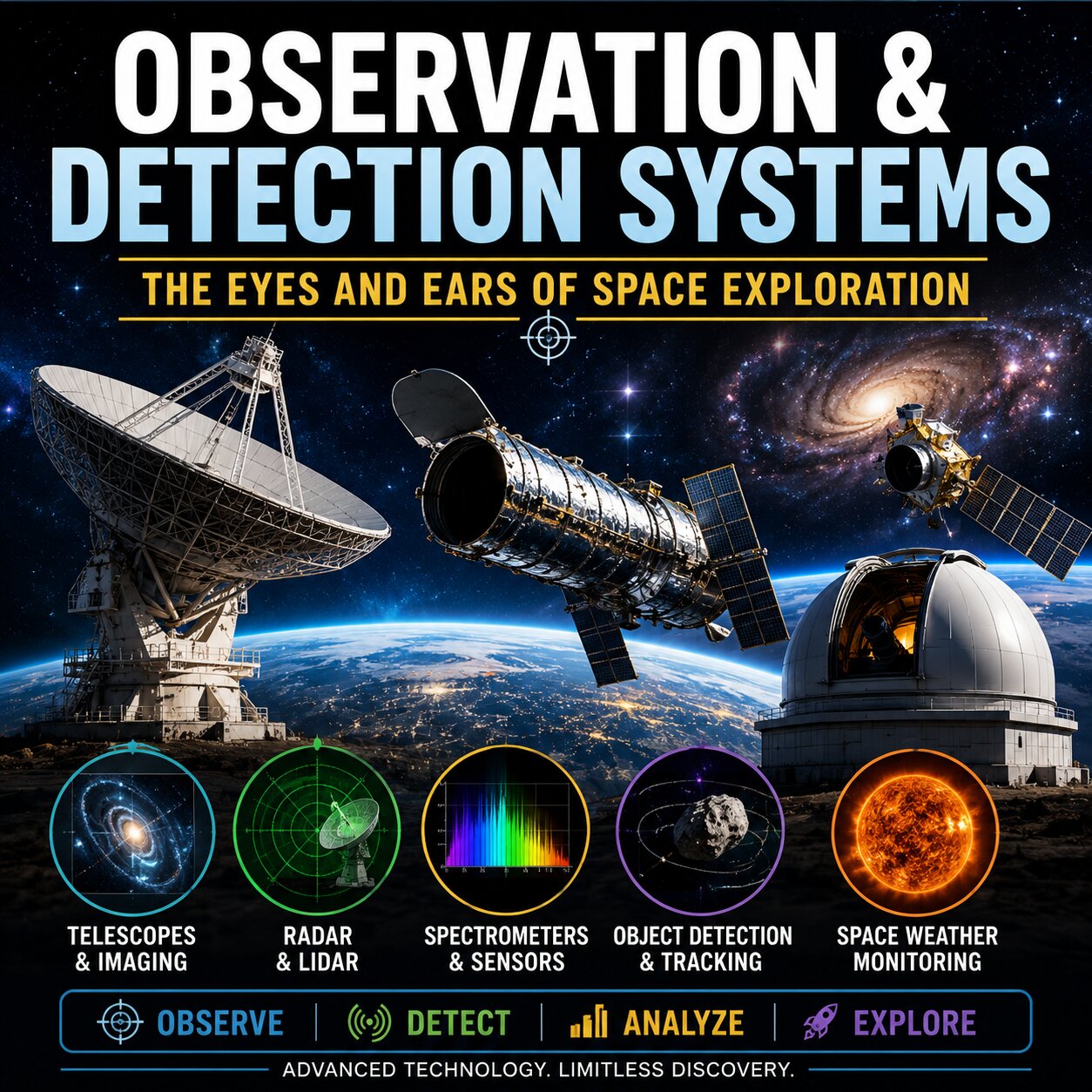

Every space mission depends on one essential capability: the ability to observe, detect, and interpret what is happening beyond Earth’s atmosphere. From identifying distant galaxies to tracking potentially hazardous asteroids, observation and detection systems form the backbone of modern astronomy, planetary science, and space exploration. These sophisticated technologies enable scientists to gather accurate data, monitor changing conditions, and make informed decisions during both robotic and crewed missions.
Without reliable observation systems, humanity would know very little about the universe beyond our own planet.
What Are Observation and Detection Systems?

Observation and detection systems are instruments and technologies designed to collect information from space or detect objects, radiation, and other phenomena. They are found aboard satellites, telescopes, planetary probes, space stations, and Earth-based observatories.
These systems convert light, radio waves, infrared energy, X-rays, gamma rays, and other forms of electromagnetic radiation into scientific data that researchers can analyse.
Common observation technologies include:
- Optical telescopes
- Radio telescopes
- Infrared detectors
- Spectrometers
- Radar systems
- Lidar instruments
- Imaging cameras
- Particle detectors
- Magnetometers
- Thermal sensors
Each instrument provides unique information that contributes to a more complete understanding of the cosmos.
Supporting Space Science
Modern astronomy relies on multiple observation methods working together. Visible-light telescopes reveal stars, planets, and galaxies, while infrared instruments can peer through dust clouds to observe stellar nurseries hidden from ordinary cameras.
Radio telescopes detect signals from pulsars, molecular clouds, and distant galaxies, while X-ray and gamma-ray observatories study some of the universe’s most energetic events, including black holes, neutron stars, and supernovae.
Combining observations across different wavelengths allows scientists to build detailed models of celestial objects and understand processes that would otherwise remain invisible.
Protecting Earth and Space Missions

Observation and detection systems are also essential for planetary defence and mission safety. Ground-based observatories and dedicated survey telescopes continuously monitor near-Earth asteroids and comets that could pose future impact risks.
Satellites track space debris orbiting Earth, helping mission planners avoid collisions that could damage spacecraft or endanger astronauts aboard orbital stations.
Weather satellites and solar observatories monitor solar activity, providing early warning of solar flares and coronal mass ejections that may disrupt satellites, communications, navigation systems, and power infrastructure on Earth.
Enabling Future Exploration
Future space missions will rely on even more advanced observation and detection systems. Artificial intelligence is increasingly helping scientists process enormous volumes of observational data, automatically identifying unusual events or potential discoveries.
Next-generation telescopes will provide higher-resolution images than ever before, while improved sensors will search for biosignatures on distant exoplanets, map planetary surfaces in extraordinary detail, and study the earliest galaxies formed after the Big Bang.
Autonomous spacecraft will also use advanced detection systems for navigation, hazard avoidance, and scientific investigations without requiring constant instructions from Earth.
Looking Deeper into the Universe
As humanity continues exploring the Solar System and beyond, observation and detection systems will remain among the most important technologies in space science. They allow us to discover new worlds, monitor our cosmic neighbourhood, protect future missions, and answer fundamental questions about the origin and evolution of the universe.
Every breakthrough in astronomy begins with better observations. By continuously improving the tools we use to detect and study the cosmos, scientists bring us one step closer to understanding the vast universe we call home.