Astronomers have confirmed the discovery of a rare real-life “Tatooine” exoplanet, a world that orbits not one but two suns. Much like the fictional planet from Star Wars, this distant exoplanet follows a complex path around a binary star system, offering new insight into how planets can form and survive in extreme gravitational environments.
What makes this discovery especially remarkable is that the planet was not found using new telescope observations. Instead, it was hiding in astronomical data collected more than ten years ago, only becoming visible thanks to advances in analysis techniques and image processing.
A Planet Orbiting Two Suns
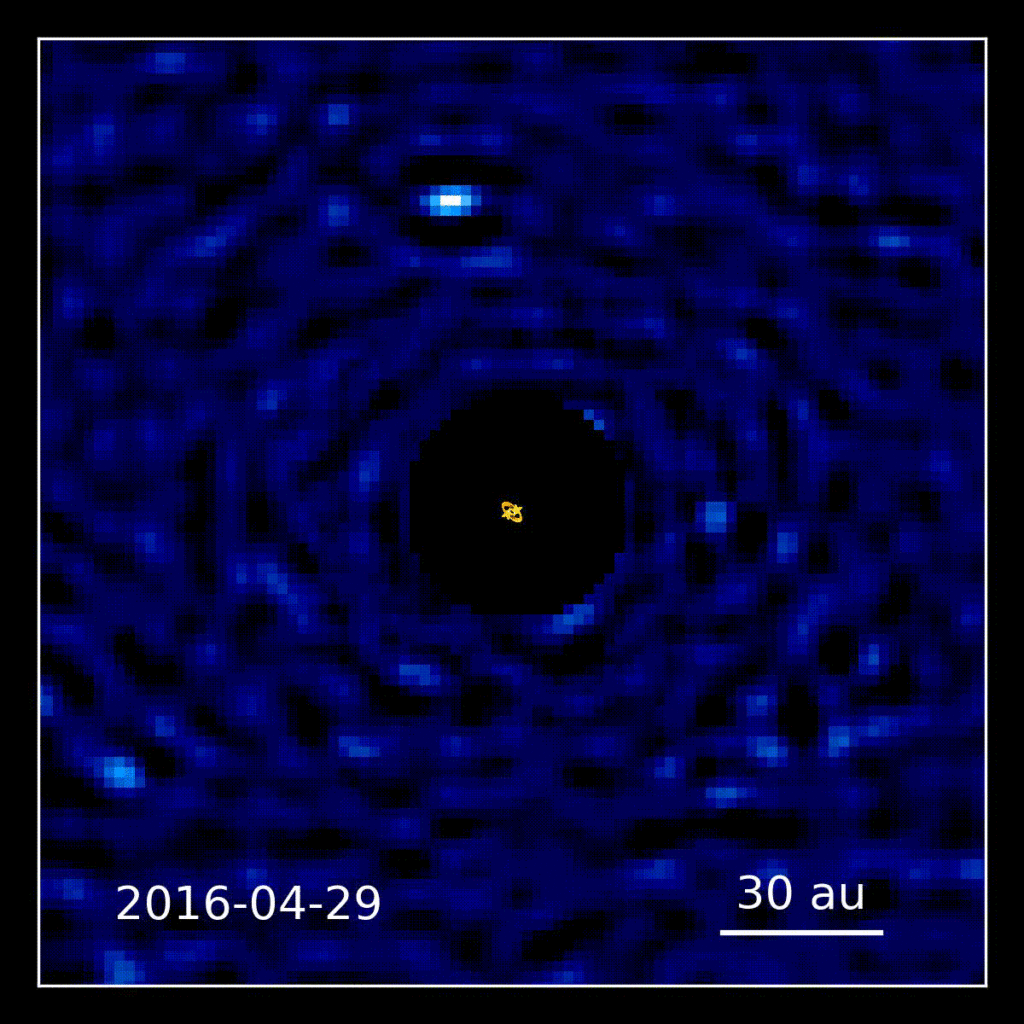
The newly confirmed exoplanet is part of a circumbinary system, meaning it orbits around two stars that circle each other closely. Such systems are notoriously difficult places for planets to exist. The constantly shifting gravitational forces can disrupt planet formation or eject developing worlds entirely.
This particular planet follows a highly unusual orbit that takes roughly 300 Earth years to complete one revolution around its twin stars. It is also one of the closest circumbinary planets ever directly imaged relative to its host stars, placing it in a category of its own when compared to previously known examples.
Hidden in Plain Sight for a Decade
The planet was discovered by re-analysing archival observations originally collected more than a decade ago. At the time, the data did not reveal the planet clearly because the glare from the twin stars overwhelmed its faint signal.
By applying modern image-processing techniques and improved models for separating starlight from surrounding objects, researchers were able to isolate the planet’s faint glow. This breakthrough highlights the growing importance of revisiting older datasets, which may still contain undiscovered worlds waiting to be revealed.
Why This Orbit Is So Strange
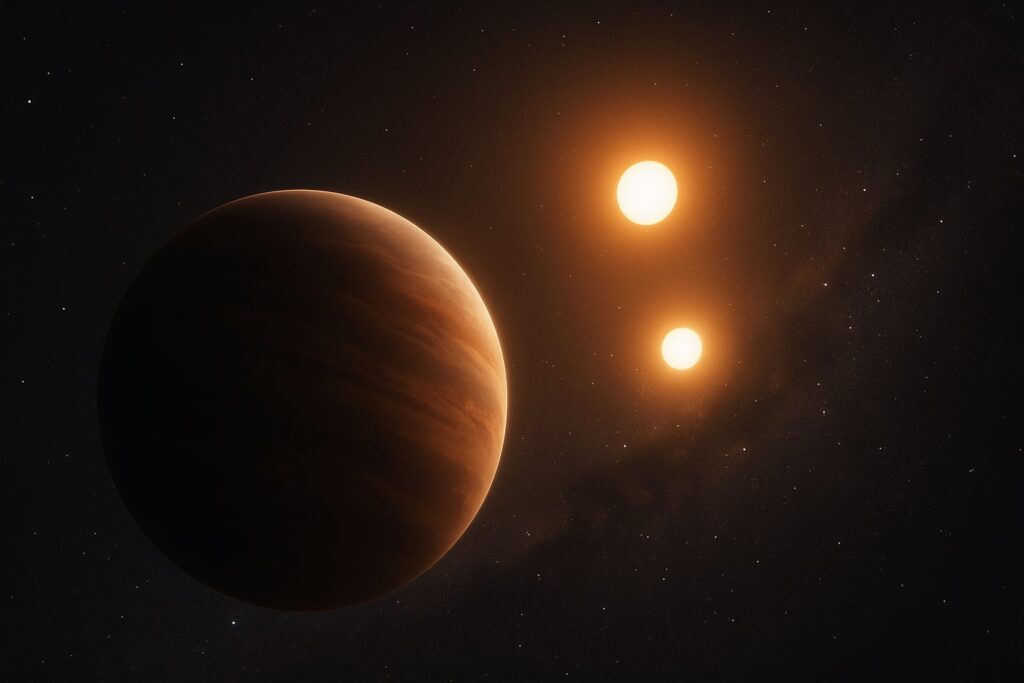
Most known circumbinary planets orbit close to the same plane as their host stars. This newly identified world appears to follow a misaligned and highly elongated orbit, which challenges current theories of planet formation.
According to the peer-reviewed study published in Astronomy & Astrophysics, the planet’s orbit suggests it may not have formed where it currently resides. Instead, it could have migrated outward over time or been gravitationally disturbed by past interactions within the system.
This raises important questions about how stable such planets can be over billions of years, and whether many more similar worlds exist undetected.
Why Astronomers Are Excited
Directly imaging exoplanets is extremely difficult, especially in binary systems. Most exoplanets are discovered indirectly through methods such as transits or stellar wobble. Capturing an actual image of a planet orbiting two stars provides astronomers with valuable information about its brightness, mass, and atmospheric properties.
This discovery also helps refine models of how planetary systems evolve in complex environments. It shows that planets can survive in places once thought too chaotic for long-term stability.
What This Means for Future Discoveries
The success of this discovery suggests that many more hidden exoplanets may be waiting in archival data. As analysis methods continue to improve, astronomers expect to uncover additional unusual worlds without needing entirely new observations.
For planetary science, the real-life “Tatooine” exoplanet is a reminder that the universe often finds ways to build worlds in places we least expect. Each new discovery broadens our understanding of what planetary systems can look like beyond our own Solar System.