

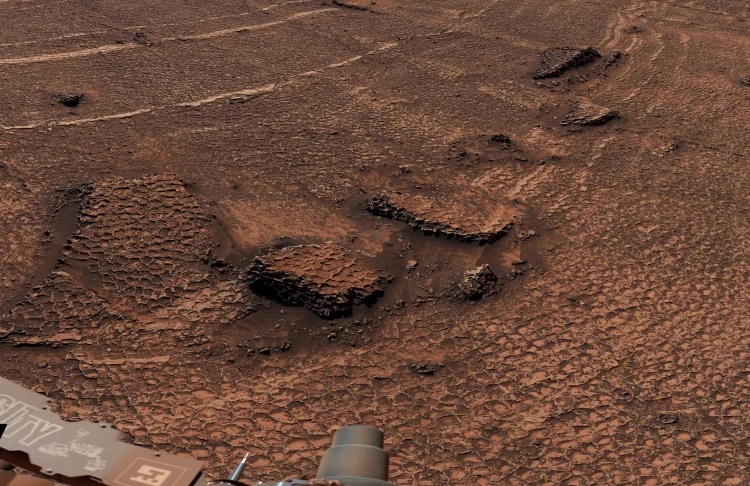
NASA’s Curiosity rover has encountered an extraordinary landscape on Mars: an enormous field covered with tiny geometric fractures resembling a vast natural honeycomb.
The strange terrain was discovered as Curiosity began climbing through a Martian valley that scientists have nicknamed Valle Grande. While the rover has encountered smaller collections of polygonal fractures during its long exploration of Gale Crater, NASA says mission scientists have never seen so many concentrated in one location.
Each individual polygon measures only around 4 to 8 centimetres (1.5 to 3 inches) across, making them dramatically smaller than some of the enormous polygonal structures previously observed from orbit.
Scientists don’t yet know exactly how this particular field formed.
That uncertainty is precisely what makes the discovery so exciting.
A Sea of Honeycomb Shapes on Mars
Curiosity has spent more than a decade revealing the geological history preserved inside Gale Crater.
Now, its cameras have captured terrain covered almost continuously with small polygonal fractures.
NASA describes the formations as having a honeycomb-like appearance. Individual fractures intersect with one another, producing repeating geometric patterns across the Martian surface.
The scale of the discovery immediately attracted the attention of the Curiosity science team.
Project scientist Ashwin Vasavada of NASA’s Jet Propulsion Laboratory said the team had encountered many remarkable landscapes during Curiosity’s mission, but described this particular concentration as a “sea of polygons.”
Researchers have carefully measured both the geometry and chemistry of the formations, hoping the data will reveal how they developed.
The answer could potentially tell us something important about environmental conditions on ancient Mars.
Could Ancient Martian Mud Be Responsible?
One intriguing possibility involves water.
Polygonal features can form when wet material repeatedly dries and contracts. Anyone who has seen dried mud on Earth will recognise the familiar network of cracks that can develop across the surface.
Curiosity has previously discovered evidence of ancient mud cracks inside Gale Crater.
Research published in 2023 examined distinctive hexagonal patterns found by the rover and proposed that they formed through repeated wet-and-dry cycles billions of years ago.
Those earlier formations were particularly interesting because repeated cycles involving liquid water could have created environmental conditions relevant to prebiotic chemistry.
The newly discovered Valle Grande polygons aren’t automatically evidence of the same process.
Scientists still need to determine their origin.
That’s important because Mars can produce polygonal terrain through several different geological mechanisms.
Not Every Martian Polygon Means Water
Polygonal landscapes aren’t unique to Gale Crater.
Orbiting spacecraft have photographed enormous examples across multiple regions of Mars. Depending on their location and geology, polygonal formations can develop through processes involving temperature changes, ice, volcanic activity or stresses within the ground.
Freeze-thaw or thermal contraction processes can create repeating fractures, for example.
Tectonic and volcanic stresses can also fracture terrain into geometric patterns.
Scientists therefore can’t simply photograph a polygon and conclude that liquid water created it.
Curiosity has an important advantage, however.
Unlike an orbiter looking down from hundreds of kilometres above Mars, the rover can examine these formations directly from the surface.
Its instruments can investigate their structure and chemistry at extremely close range.
That gives researchers an opportunity to determine whether the Valle Grande polygons contain chemical or geological clues supporting one formation mechanism over another.
Tiny Polygons Compared With Martian Giants
The scale difference between Curiosity’s discovery and other polygonal terrain on Mars is remarkable.
The Valle Grande formations measure only several centimetres across.
Polygonal features photographed from orbit can extend tens or even hundreds of metres.
Some Martian regions contain large fractured surfaces known as crater-floor polygons. Researchers have investigated whether certain examples could be connected to ancient standing water or other geological processes.
Large polygonal terrains have been observed in areas including Hellas Planitia, Noachis Terra and Margaritifer Terra.
NASA’s Mars Reconnaissance Orbiter and its powerful HiRISE camera have provided scientists with exceptionally detailed orbital observations of Martian geology.
Curiosity provides the complementary perspective.
Instead of seeing the overall landscape, we’re effectively standing beside the rover and examining individual rocks, cracks and mineral deposits.
Sometimes the smallest structures can reveal an enormous story.
Curiosity Continues Reading Mars’ Ancient History
Curiosity landed inside Gale Crater in August 2012.
Its original mission was designed to investigate whether ancient Mars possessed environmental conditions capable of supporting microbial life.
The rover answered that question relatively early in its mission.
Evidence discovered within Gale Crater showed that the region once possessed conditions that could have been suitable for microbial life, including ancient water environments and important chemical ingredients.
Curiosity has continued exploring ever since.
The rover’s journey through the layered terrain of Mount Sharp allows scientists to investigate different periods of Martian history almost like turning the pages of an enormous geological book.
Each layer contains evidence of environmental conditions that existed when those materials formed.
The newly discovered polygons could become another piece of that history.
Why These Martian Polygons Matter
Modern Mars is extremely different from the planet Curiosity is helping us reconstruct.
Today, the surface is cold, dry and exposed to an extremely thin atmosphere.
Billions of years ago, however, Mars possessed rivers, lakes and environments involving substantial amounts of liquid water.
One of the biggest questions in planetary science concerns how that transformation happened.
When did stable surface water disappear?
How long did potentially habitable environments survive?
And did those environments ever provide enough time and suitable chemistry for life to emerge?
The Valle Grande polygon field won’t answer all those questions by itself.
But if scientists can determine precisely how these tiny fractures formed, they may reveal another piece of information about the environment that once existed in Gale Crater.
That’s why seemingly simple cracks in Martian soil can become scientifically fascinating.
Another Martian Mystery for Curiosity
Fourteen years after arriving on Mars, Curiosity is still capable of surprising the scientists operating it.
That’s perhaps the most exciting part of this discovery.
The rover didn’t simply find another isolated polygonal formation. It encountered an extensive landscape unlike anything the mission team had previously seen at this scale.
Now comes the detective work.
Scientists will examine the shapes, chemistry and geological surroundings of the polygons to determine whether water, temperature changes or another process created this remarkable Martian honeycomb.
Whatever the answer turns out to be, Valle Grande has given Curiosity another opportunity to investigate a chapter of Mars’ ancient history preserved directly beneath its wheels.
Sometimes exploring another world means discovering enormous mountains, craters and valleys.
And sometimes, one of the most intriguing discoveries is only four centimetres wide.