NASA’s search for distant worlds took a major step forward as SpaceX successfully launched the Pandora exoplanet mission, a small but powerful space telescope designed to study the atmospheres of planets beyond our solar system. Riding aboard a SpaceX Falcon 9 rocket, Pandora joins a growing fleet of specialised space observatories focused on understanding how planets form, evolve, and potentially support life.
Unlike large flagship telescopes, Pandora is a targeted mission with a clear scientific purpose: to refine how astronomers interpret exoplanet atmospheres by separating planetary signals from the activity of their host stars.
Mission launch and early details
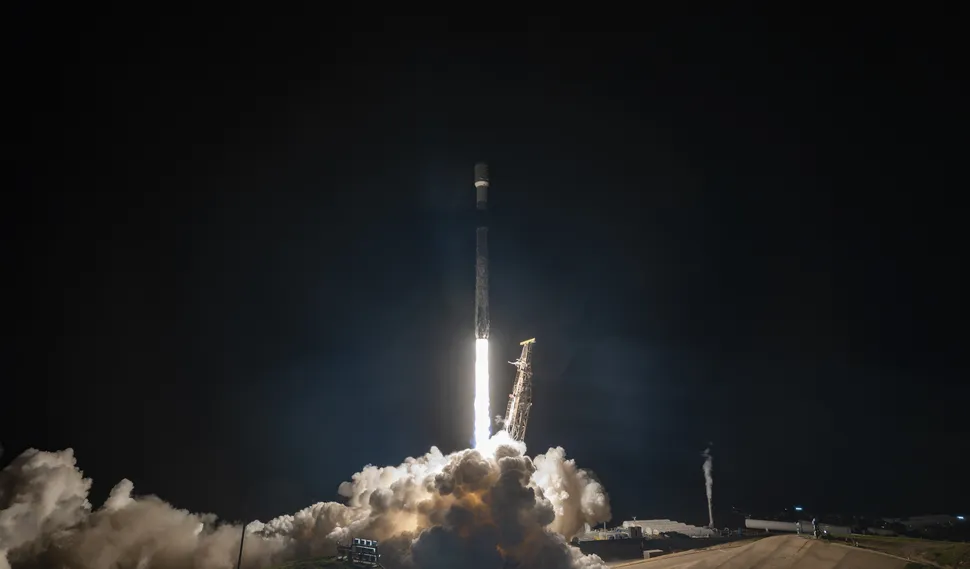
NASA’s Pandora exoplanet mission successfully reached orbit aboard a SpaceX Falcon 9 rocket as part of a rideshare launch from Vandenberg Space Force Base in California. The launch took place on 11 January, delivering around 40 payloads into space during a single coordinated mission.
Named “Twilight” by SpaceX, the flight placed its satellites into a sun-synchronous orbit that follows the boundary between day and night on Earth. This type of orbit allows spacecraft to observe targets under consistent lighting conditions, which is particularly valuable for Earth observation and astronomical missions. All payloads were deployed on schedule over a deployment window lasting roughly 90 minutes.
Pandora is a compact but capable spacecraft, weighing approximately 325 kilograms, and is equipped with a 45-centimetre telescope. Over the course of its planned year-long mission, it will observe at least 20 known exoplanets, focusing on moments when those planets pass in front of their host stars.
These planetary transits cause slight dips in a star’s brightness, a technique that has already led to the discovery of thousands of exoplanets. Pandora will take this method further by analysing the starlight filtered through exoplanet atmospheres, allowing scientists to study their composition in greater detail.
One of Pandora’s key goals is to address a long-standing challenge in exoplanet science: stellar interference. Stars are not uniform surfaces, and features such as starspots can distort atmospheric readings. Pandora will observe host stars in visible light while simultaneously collecting infrared data, helping researchers separate stellar activity from genuine planetary signals.
In addition to Pandora, the Twilight mission carried a wide range of commercial and Earth-observation satellites, highlighting SpaceX’s continued reliance on rideshare launches to deploy diverse payloads efficiently. The Falcon 9 booster returned safely to land shortly after liftoff, marking another successful reusable launch for the company.
News Source: Space.com
What Is the Pandora Exoplanet Mission?
Pandora is a NASA astrophysics mission developed to observe known exoplanets as they pass in front of their parent stars, a method known as transit spectroscopy. By analysing changes in starlight during these transits, scientists can determine the composition of a planet’s atmosphere.
What makes Pandora unique is its ability to observe exoplanets in both visible and infrared wavelengths simultaneously. This dual-view approach allows researchers to distinguish between atmospheric features caused by the planet itself and distortions created by starspots, flares, and stellar variability.
Why Pandora Matters for Exoplanet Science
One of the biggest challenges in exoplanet research is accurately identifying atmospheric molecules such as water vapour, methane, and carbon dioxide. Stellar activity can easily mimic or obscure these signals, leading to uncertainty in earlier observations.
Pandora addresses this problem directly. By monitoring how a star’s brightness changes across multiple wavelengths, the mission helps scientists correct for stellar interference. This will improve the accuracy of data collected by larger observatories and strengthen confidence in atmospheric detections across dozens of known exoplanets.
How Pandora Complements Larger Space Telescopes
Pandora is designed to work alongside major missions rather than replace them. Data from Pandora will help astronomers better interpret observations from powerful space telescopes that focus on exoplanet atmospheres.
By acting as a calibration and validation tool, Pandora enhances the scientific return of current and future exoplanet missions. Its focused observations will also help prioritise which exoplanets are most promising for deeper atmospheric study.
A New Era of Small, Focused Space Missions
The successful launch of Pandora highlights a growing trend in space exploration: smaller, cost-effective missions with highly specialised goals. These missions can be developed and launched faster, allowing NASA and its partners to address specific scientific questions without waiting decades for flagship projects.
As Pandora begins its scientific operations, astronomers expect it to play a crucial role in refining our understanding of alien worlds and bringing us closer to answering one of astronomy’s biggest questions: what are exoplanets really like?