Astronomers have captured breathtaking new views of a dying star at the centre of the Cat’s Eye Nebula, offering an extraordinary glimpse into one of the most dramatic stages of stellar evolution. Observations from the Hubble Space Telescope and the Euclid space telescope reveal intricate layers of gas and expanding shells that formed as the star reached the end of its life.
Located roughly 4,400 light-years from Earth in the constellation Draco, the Cat’s Eye Nebula (NGC 6543) is one of the most detailed and complex planetary nebulae ever studied. The new images combine the sharp detail of Hubble with the wide-field capabilities of Euclid, giving astronomers a clearer picture of how stars shed their outer layers as they die.
What is the Cat’s Eye Nebula?
The Cat’s Eye Nebula is classified as a planetary nebula, a term that dates back to early astronomical observations. When early telescopes first observed these glowing clouds, their round appearance reminded astronomers of planets. Despite the name, planetary nebulas have nothing to do with planets.
Instead, they form when Sun-like stars reach the final stages of their lives. As the star exhausts its nuclear fuel, the delicate balance between gravity and the outward pressure of fusion begins to collapse. The outer layers of the star are then expelled into space, creating expanding shells of gas.
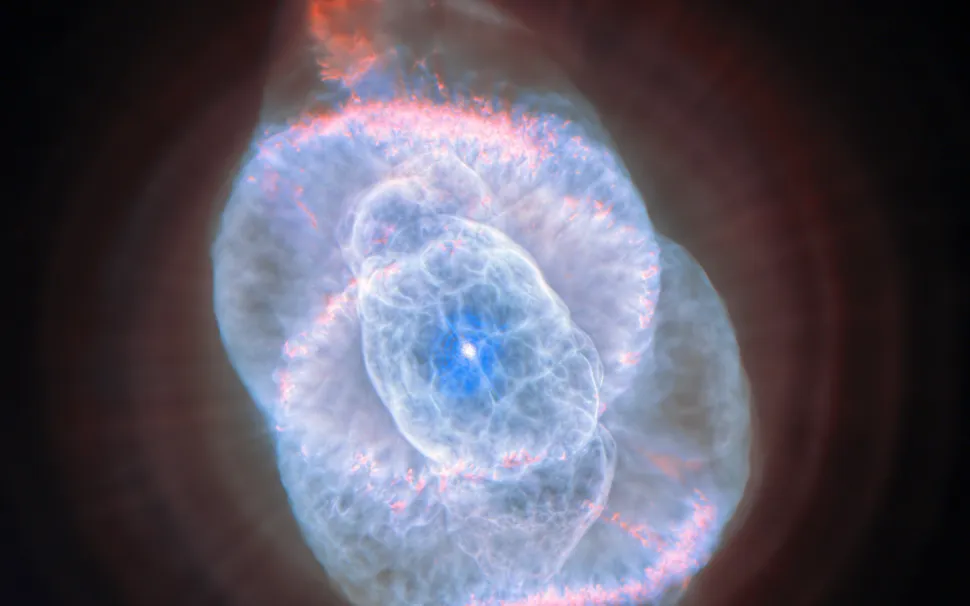
These gas shells are illuminated by intense radiation from the star’s hot core, causing them to glow in vivid colours and intricate shapes. In the case of the Cat’s Eye Nebula, the structure is unusually complex, with nested shells, filaments, and shock waves created by multiple episodes of stellar mass loss.
A Stellar Death Revealed in Unprecedented Detail
The latest observations combine data from two major space observatories.
The Hubble Space Telescope provided an extremely detailed close-up of the nebula’s central region, where the dying star sits surrounded by bright, layered gas shells. These structures show the chaotic processes occurring as the star ejects material into space.
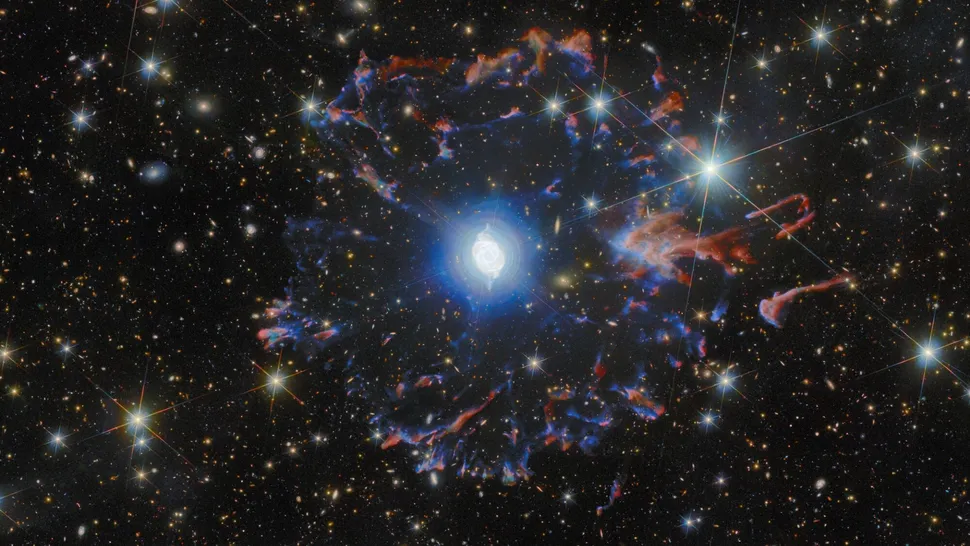
Meanwhile, the Euclid space telescope, designed primarily to map the large-scale structure of the universe, captured a much wider view. This perspective reveals a vast halo of gas surrounding the central nebula, indicating that the dying star expelled material long before the main nebula formed.
Together, the two datasets allow astronomers to study the multiple phases of stellar mass loss, showing that the death of a star can unfold through several dramatic stages over thousands of years.
News source: Space.com
The Science Behind Planetary Nebulas
Planetary nebulas like the Cat’s Eye Nebula form during the final evolutionary stage of stars with masses similar to the Sun.
As the star runs out of hydrogen fuel in its core, fusion slows and the star begins to expand into a red giant. During this phase, powerful stellar winds push the outer layers of the star into space.
Eventually, the exposed stellar core becomes extremely hot. The intense ultraviolet radiation from this core ionises the expanding gas, causing it to glow brightly and form the nebula.
Over tens of thousands of years, the nebula gradually expands and disperses into interstellar space. What remains at the centre is a white dwarf, the dense remnant of the original star.
A Window Into the Future of Our Sun
Studying objects like the Cat’s Eye Nebula helps astronomers understand the future of stars similar to our own.
In roughly five billion years, the Sun will follow a similar evolutionary path. After expanding into a red giant and shedding its outer layers, it will likely form a planetary nebula before leaving behind a white dwarf core.
By observing planetary nebulas across the galaxy, astronomers can better understand the complex physics involved in stellar death, including gas dynamics, shock waves, and the role of stellar magnetic fields.
A Cosmic Scene Filled With Galaxies
One surprising aspect of Euclid’s wide-field image is the number of distant galaxies visible in the background. While the Cat’s Eye Nebula lies within our own galaxy, the deeper image reveals thousands of galaxies far beyond the Milky Way.
This contrast highlights the incredible scale of the universe. Even while studying a nearby stellar death, astronomers are simultaneously observing objects billions of light-years away.
A Powerful Collaboration Between Space Telescopes
The combination of Hubble’s precision imaging and Euclid’s wide-field observations demonstrates the power of collaborative space astronomy. By merging data from different instruments, scientists can explore both the fine details and the broader environment surrounding cosmic objects.
The Cat’s Eye Nebula remains one of the most studied planetary nebulas in astronomy, yet these new observations continue to reveal hidden structures and complex layers that deepen our understanding of stellar evolution.
The Last Breath of a Star
The Cat’s Eye Nebula offers a rare and beautiful look at the final stages of a star’s life. Its intricate patterns of glowing gas capture the moment when a star sheds its outer layers and transitions into a stellar remnant.
While the process unfolds over thousands of years, telescopes like Hubble and Euclid allow astronomers to freeze these cosmic moments in time, revealing the dramatic and delicate structures formed during stellar death.
In doing so, they remind us that even in the vast silence of space, the universe is constantly changing — stars are born, evolve, and ultimately return their material to the cosmos, where new stars may one day form.