Planet Neptune is the most distant major planet in our Solar System and one of the most fascinating worlds orbiting the Sun. Often described as a deep blue ice giant, Neptune is a dynamic planet with violent storms, the fastest winds ever measured in the Solar System, a faint ring system, and a diverse collection of moons led by the intriguing world of Triton.
As the eighth planet from the Sun, Planet Neptune sits at the edge of the classical Solar System. Despite its distance and cold temperatures, Neptune remains an active world with constantly shifting clouds, massive atmospheric storms, and a powerful internal heat source that drives its extreme weather patterns.
Studying Planet Neptune helps astronomers understand ice giant planets, atmospheric physics under low sunlight conditions, and the processes that shape planetary systems both in our Solar System and around distant stars.
Quick Stats: Planet Neptune
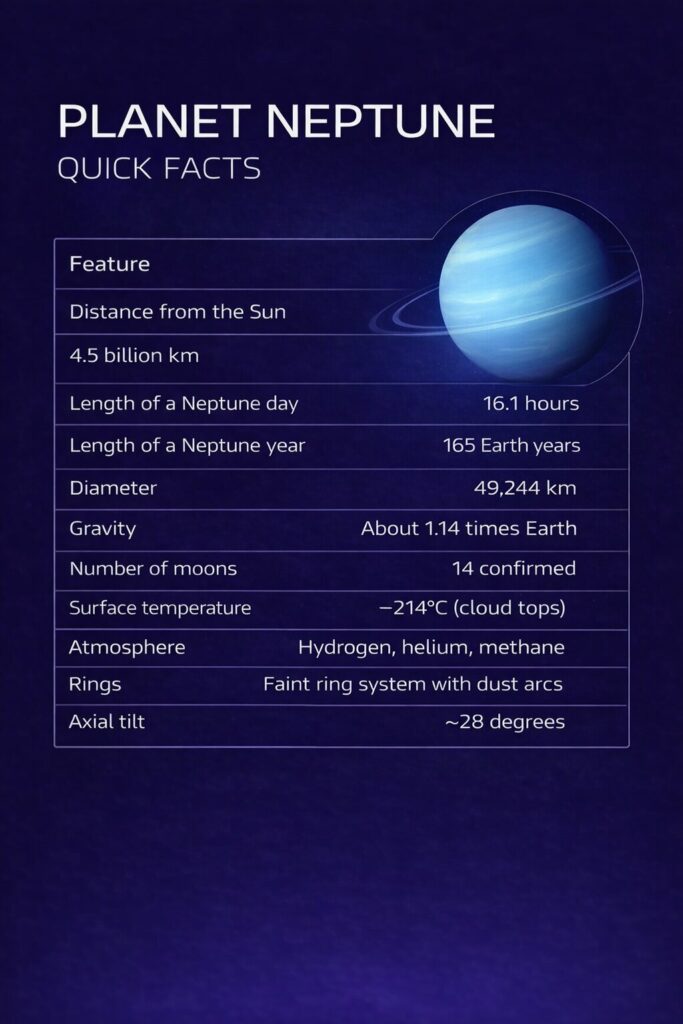
| Feature | Details |
|---|---|
| Distance from the Sun | 4.5 billion km |
| Length of a Neptune day | 16.1 hours |
| Length of a Neptune year | 165 Earth years |
| Diameter | 49,244 km |
| Gravity | About 1.14 times Earth |
| Number of moons | 14 confirmed |
| Surface temperature | −214°C (cloud tops) |
| Atmosphere | Hydrogen, helium, methane |
| Rings | Faint ring system with dust arcs |
| Axial tilt | ~28 degrees |
Neptune’s Position in the Solar System
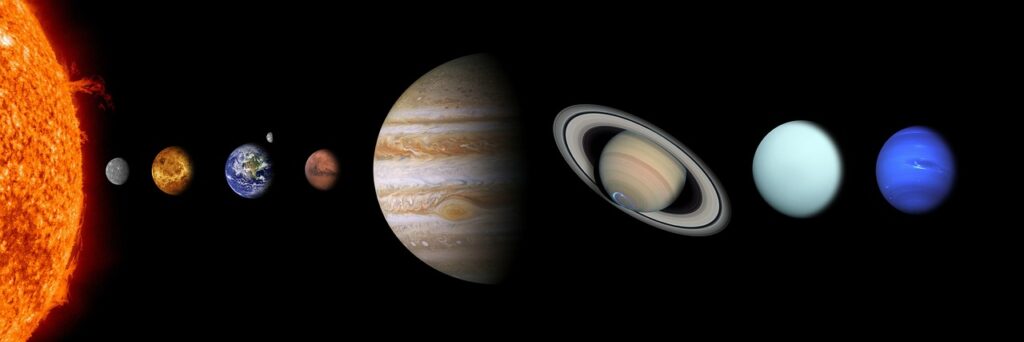
Planet Neptune is the eighth planet from the Sun and the outermost of the major planets in the Solar System. It orbits beyond Uranus and marks the boundary between the traditional planets and the vast region of icy bodies known as the Kuiper Belt.
Neptune belongs to the category of ice giants, along with Uranus. Unlike the gas giants Jupiter and Saturn, which are dominated by hydrogen and helium, ice giants contain large amounts of heavier volatile compounds such as water, ammonia, and methane.
At an average distance of about 4.5 billion kilometres from the Sun, Neptune receives only a fraction of the sunlight that Earth does. Despite this extreme distance, the planet remains surprisingly active, with a turbulent atmosphere and strong internal heat driving dynamic weather systems.
The Deep Blue Colour of Planet Neptune
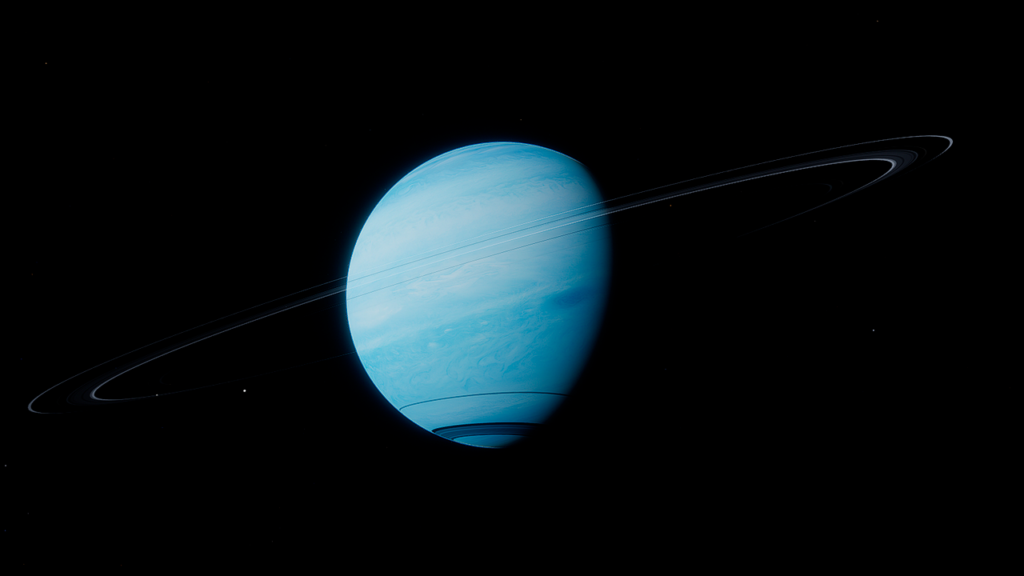
One of the most recognisable features of Planet Neptune is its striking deep blue colour. This colour is primarily caused by methane gas in the planet’s atmosphere, which absorbs red wavelengths of sunlight and reflects blue light back into space.
While methane also gives Uranus its blue-green colour, Neptune appears noticeably deeper and more vivid in hue. Scientists believe this difference may be due to additional atmospheric compounds or variations in atmospheric structure that influence how light is scattered.
High-resolution observations have revealed complex cloud systems in Neptune’s upper atmosphere. Bright white clouds made of methane ice crystals occasionally form and drift across the planet, contrasting sharply against the darker blue background.
Neptune’s Atmosphere: The Fastest Winds in the Solar System
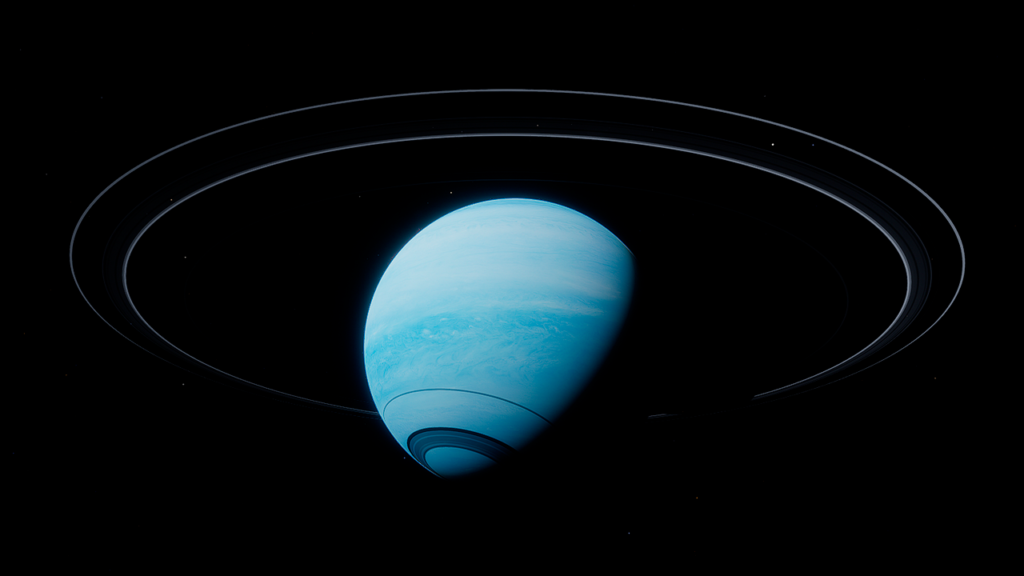
The atmosphere of Planet Neptune is one of the most energetic environments in the Solar System. Despite receiving very little sunlight, Neptune experiences powerful storms and wind speeds that can exceed 2,000 kilometres per hour, making them the fastest winds ever recorded on any planet.
These extreme winds are driven largely by Neptune’s internal heat. Unlike Uranus, which emits relatively little internal energy, Neptune radiates more than twice as much heat as it receives from the Sun. This energy helps power the planet’s dynamic atmospheric circulation.
Neptune’s atmosphere also features large storm systems similar to Jupiter’s Great Red Spot. One of the most famous of these was the Great Dark Spot, observed by Voyager 2 in 1989. Though the original storm later disappeared, similar dark storm systems have since been detected by telescopes.
Inside Planet Neptune: Ice Giant Structure
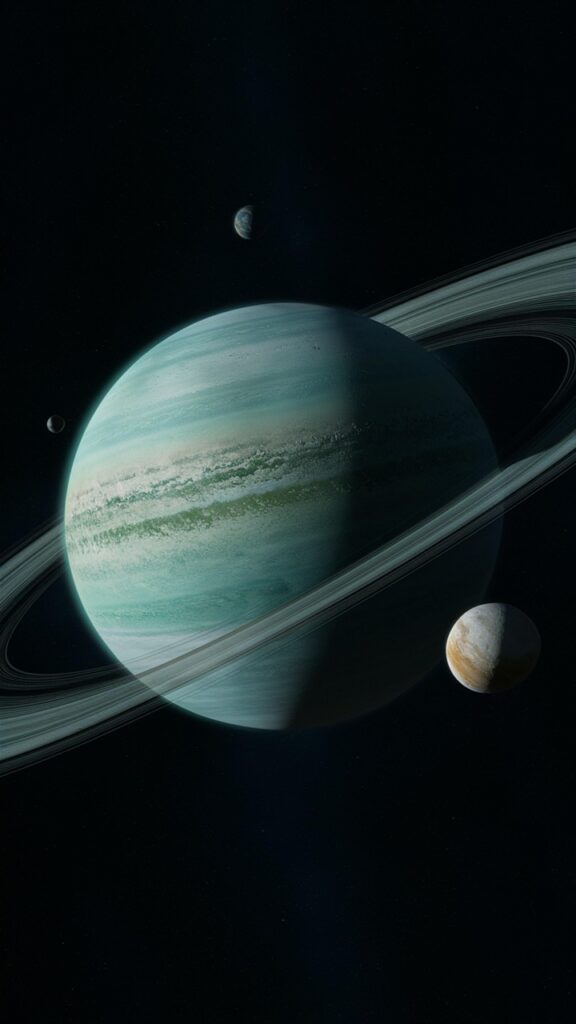
Beneath its turbulent atmosphere, Planet Neptune has a layered internal structure typical of ice giants. The outer atmosphere consists primarily of hydrogen, helium, and methane gas.
Below this lies a deep mantle composed of superheated fluids containing water, ammonia, and methane. Under the immense pressures inside Neptune, these materials behave more like dense liquids than conventional ices.
At the centre of Planet Neptune is believed to be a rocky core roughly the size of Earth. The extreme pressure and temperature conditions inside the planet create a complex environment where exotic forms of matter may exist, including the possibility of diamond formation within the mantle.
Neptune’s Rings: Faint but Unusual
Although not nearly as spectacular as Saturn’s rings, Planet Neptune does possess a faint ring system. These rings were confirmed during the Voyager 2 flyby in 1989 and have since been studied using powerful ground-based telescopes.
Neptune’s rings are composed mostly of dark particles and dust, making them difficult to observe. They are narrow and uneven, containing mysterious structures known as ring arcs.
Ring arcs are dense clumps of material that remain confined to specific regions of the ring rather than spreading out evenly. Scientists believe the gravitational influence of nearby moons helps maintain these unusual structures.
Moons of Planet Neptune: The Strange World of Triton
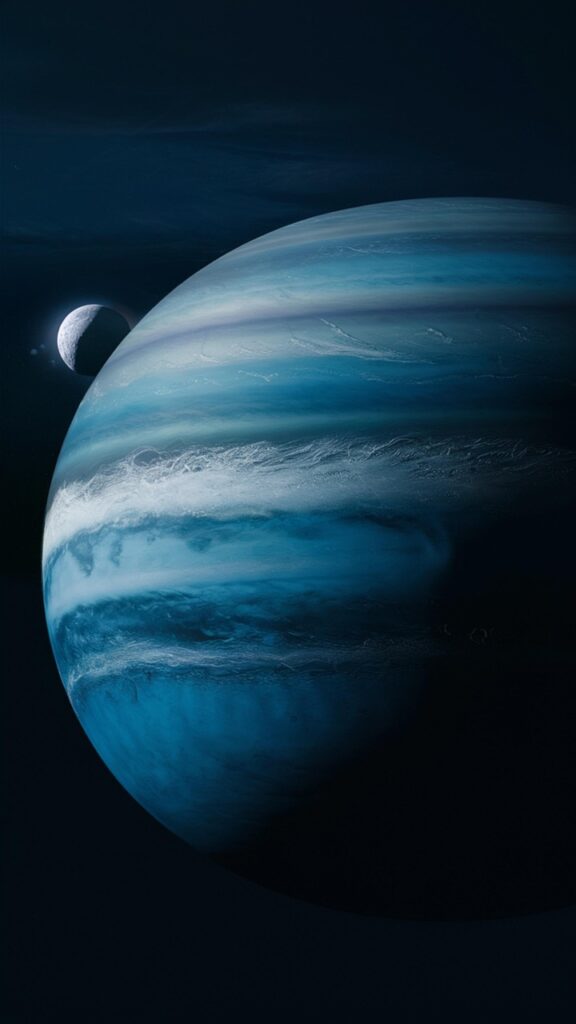
Planet Neptune has 14 known moons, the largest of which is Triton. Triton is one of the most unusual moons in the Solar System and is thought to be a captured object from the Kuiper Belt rather than a moon that formed alongside Neptune.
Triton orbits Neptune in a retrograde direction, meaning it travels opposite the planet’s rotation. This unusual orbit strongly suggests that Triton was captured by Neptune’s gravity billions of years ago.
The surface of Triton is geologically active and extremely cold. Voyager 2 discovered cryovolcanoes on Triton, which erupt nitrogen and other volatile substances instead of molten rock. These icy geysers create dark streaks across the moon’s frozen surface.
Over extremely long timescales, Triton’s orbit may gradually decay due to tidal interactions with Neptune, eventually leading to its destruction and possibly forming a new ring system around the planet.
Exploring Planet Neptune: Voyager 2 and Future Missions
So far, Planet Neptune has been visited by only one spacecraft: NASA’s Voyager 2. During its historic flyby in 1989, Voyager 2 provided the first close-up images of Neptune, revealing its rings, storms, and complex system of moons.
The mission transformed our understanding of Neptune, showing that the distant ice giant is far more dynamic than scientists previously believed. Voyager 2 also discovered several new moons and provided detailed measurements of Neptune’s magnetic field and atmosphere.
Despite these discoveries, Neptune remains one of the least explored planets in the Solar System. Several future mission concepts have been proposed, including orbiters designed to study Neptune and Triton in greater detail.
Why Planet Neptune Matters to Astronomy
Planet Neptune plays an important role in understanding the broader architecture of planetary systems. Ice giants appear to be extremely common in other star systems, making Neptune a key reference point for studying exoplanets.
Many of the planets discovered around other stars resemble Neptune more closely than they do Jupiter or Earth. By studying Neptune’s atmosphere, internal structure, and formation history, scientists can gain valuable insight into how planetary systems evolve.
Neptune’s gravitational influence also helps shape the outer Solar System. Its gravity interacts with objects in the Kuiper Belt, influencing the orbits of many icy bodies beyond the traditional planetary region.
Planet Neptune and the Frontier of the Solar System
Planet Neptune represents the gateway to the outer frontier of our Solar System. Beyond its orbit lies a vast region filled with icy dwarf planets, comets, and remnants from the formation of the Solar System.
Despite its great distance from the Sun, Neptune is far from quiet. Its violent storms, supersonic winds, and complex moon system reveal a world shaped by powerful forces operating in the cold depths of space.
As astronomical technology advances and future missions are planned, Planet Neptune will continue to play a crucial role in expanding our understanding of planetary science, atmospheric dynamics, and the nature of distant worlds.