
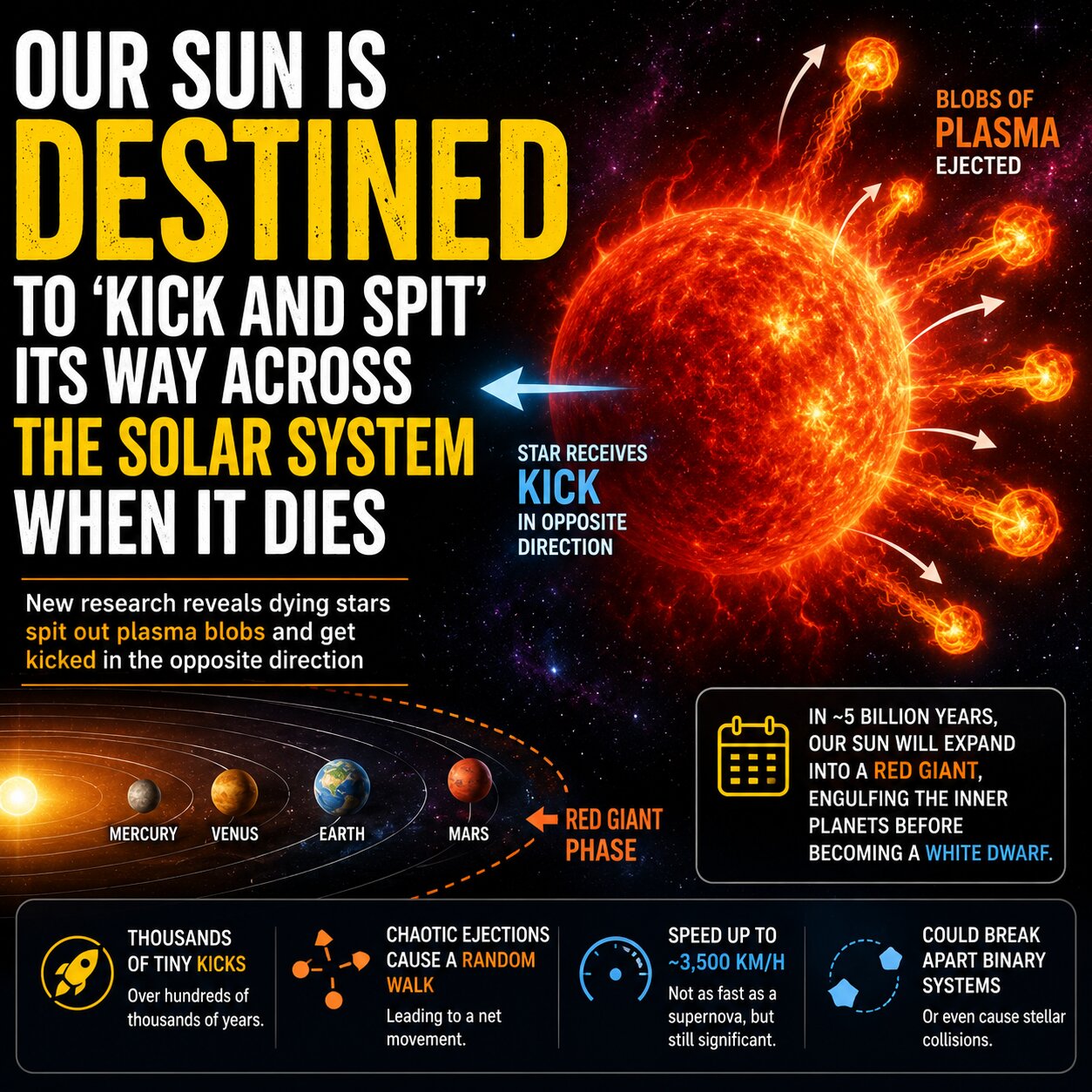

The death of our Sun is often described as a slow and predictable process. In roughly five billion years, it will exhaust the hydrogen fuel in its core, expand into a red giant, and eventually shed its outer layers before settling down as a white dwarf. While that story remains broadly accurate, new research suggests the process may be far more dynamic than previously imagined.
Astronomers now believe that stars like our Sun may spend their final stages receiving thousands of tiny “kicks” as they eject blobs of plasma into space. These repeated pushes could gradually send aging stars wandering through the galaxy, changing our understanding of stellar evolution and the behaviour of dying solar systems.
The discovery adds a fascinating new chapter to the future history of our own star.
The Transformation Into A Red Giant
Stars spend most of their lives converting hydrogen into helium through nuclear fusion. This process provides the energy needed to counteract the crushing force of gravity.
Eventually, however, the hydrogen supply in a star’s core begins to run out. As fusion slows, the core contracts while the outer layers expand dramatically. The star enters the red giant phase, becoming many times larger than it was during its stable years.
For the Sun, this expansion will be catastrophic for the inner Solar System. Mercury and Venus will almost certainly be consumed. Earth’s fate remains uncertain, but current models suggest our planet may also be engulfed as the Sun swells outward.
Yet the latest research suggests that size may not be the only dramatic change occurring during this period.
Thousands Of Tiny Stellar Kicks
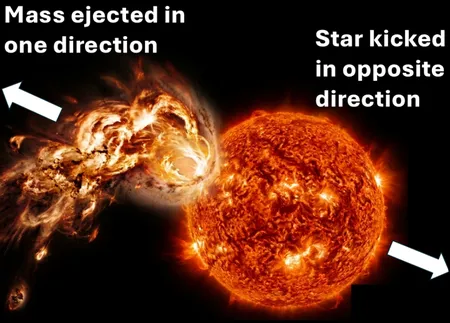
Astronomers propose that red giant stars eject blobs of plasma from their surfaces in an uneven and chaotic manner. Whenever material is expelled in one direction, the star experiences a small push in the opposite direction.
The effect follows the same physical principles that propel rockets through space. Every action produces an equal and opposite reaction.
A single plasma ejection would have little impact, but researchers estimate that a star like the Sun could experience around 10,000 such events over hundreds of thousands of years. Together, these countless small pushes could gradually alter the star’s motion through space.
Rather than remaining perfectly stationary relative to its surroundings, a dying star may slowly drift as these forces accumulate.
Understanding The Random Walk
One of the most interesting aspects of the new model is the concept of a random walk. Because plasma blobs are ejected in unpredictable directions, each kick points differently.
While some kicks cancel one another out, the overall effect still produces gradual movement over time. Mathematicians describe this behaviour as a random walk because the object takes many small steps in random directions yet still ends up displaced from its starting point.
Researchers estimate that these accumulated kicks could move a red giant at speeds approaching 3,500 kilometres per hour. While this is modest compared to the extreme velocities produced by supernova explosions, it is still significant enough to affect the star’s surroundings.
This wandering motion could influence the dynamics of planetary systems and nearby stellar companions.
Consequences For Binary Star Systems
The research may also help explain an existing astronomical mystery involving binary stars.
Many stars exist in pairs, orbiting a common centre of gravity. Observations have shown that widely separated binary systems often appear less common when one star has already evolved into a white dwarf.
The newly proposed stellar kicks provide a possible explanation. Over time, repeated nudges may gradually weaken the gravitational connection between loosely bound stellar partners. Eventually, the pair could separate entirely and continue travelling through the galaxy alone.
Researchers have even suggested that in rare cases, the kicks could send a red giant toward a nearby companion star. Such encounters could result in dramatic collisions and powerful explosions that astronomers may one day observe.
A New Perspective On The Sun’s Future
The Sun’s eventual transformation into a white dwarf remains billions of years away, but studies like this continue to reveal surprising details about the process. Rather than quietly fading into retirement, our star may spend its final active phase ejecting plasma, wandering through space, and subtly reshaping its cosmic neighbourhood.
While humanity will not be around to witness these distant events, understanding them helps astronomers build a clearer picture of how stars evolve and how solar systems change over immense timescales. The Sun’s final journey may be far more energetic and unpredictable than anyone previously imagined, offering another reminder that even familiar stars still hold many secrets waiting to be discovered.



Leave a Reply