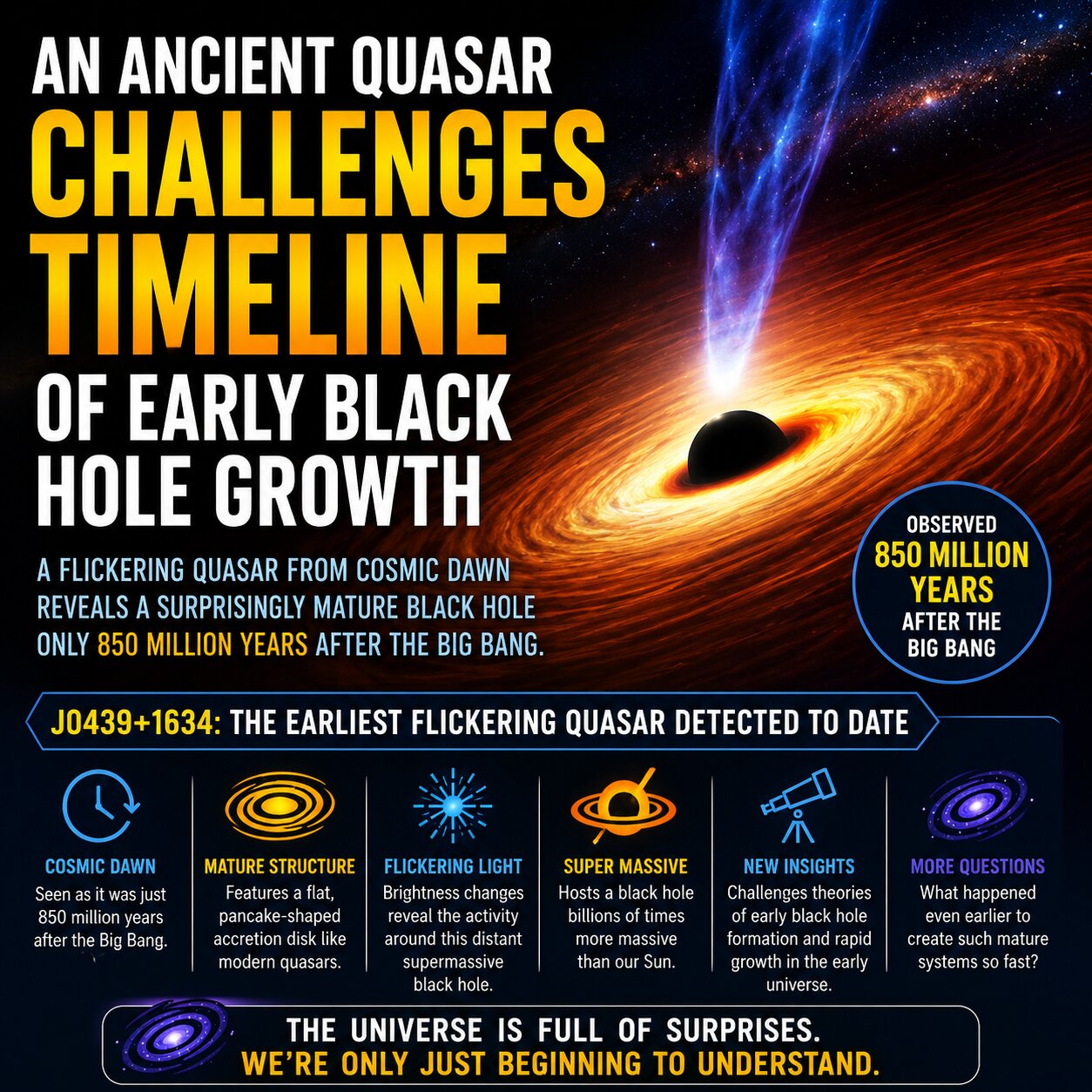

Astronomers have uncovered new evidence suggesting that supermassive black holes may have formed and matured far earlier than previously believed. A recent study focusing on a distant quasar observed during the Universe’s cosmic dawn has revealed behaviour that resembles much more mature systems seen billions of years later.
The quasar, known as J0439+1634, is observed as it existed roughly 850 million years after the Big Bang. At that stage, the Universe was still in its infancy, and many astronomers expected galaxies and their central black holes to be undergoing chaotic periods of rapid growth.
Instead, observations indicate that this ancient object displays characteristics associated with far more developed quasars. The discovery is prompting researchers to reconsider how quickly the first supermassive black holes formed.
Detecting A Flicker Across Billions Of Years
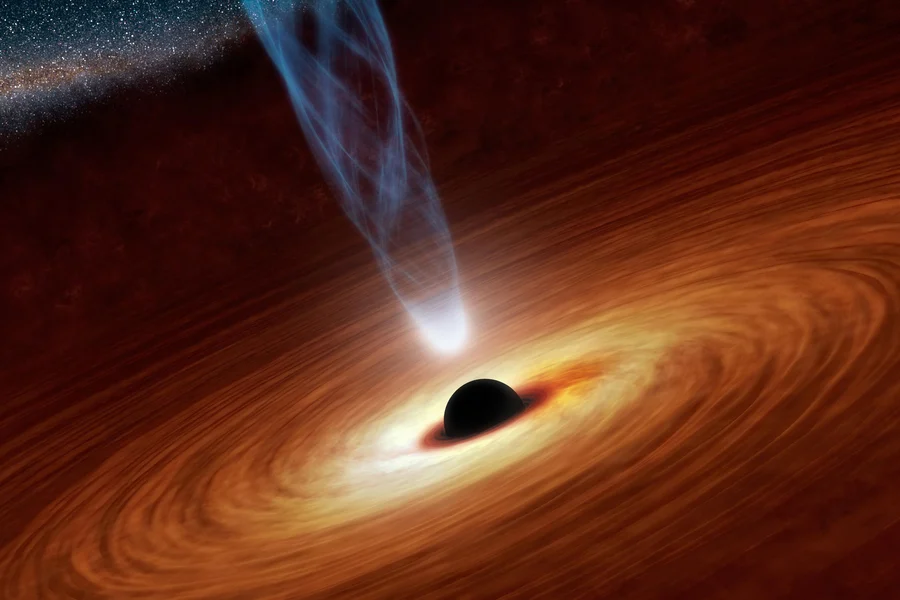
Quasars are among the brightest objects in the Universe. Powered by supermassive black holes consuming surrounding matter, they can outshine entire galaxies and be detected across immense cosmic distances.
Researchers analysed more than a decade of infrared observations to identify subtle changes in the quasar’s brightness. This flickering behaviour provides valuable information about the material orbiting the black hole and the structure of its accretion disk.
The study revealed that J0439+1634 experiences significant brightness variations despite being located nearly 13 billion light-years away. Detecting such fluctuations at this distance represents a major observational achievement.
More importantly, the flicker offers a rare glimpse into the conditions surrounding one of the earliest known supermassive black holes.
What Makes This Discovery So Important?
Several findings have captured the attention of astronomers:
- The quasar existed only 850 million years after the Big Bang.
- Its central black hole appears to be billions of times more massive than the Sun.
- The accretion disk resembles those found around modern quasars.
- The system exhibits measurable brightness fluctuations.
- Its mature appearance challenges existing formation models.
- The discovery suggests black hole growth may occur faster than expected.
Together, these observations indicate that many critical stages of black hole development may have occurred even earlier than astronomers currently understand.
Rethinking The Formation Of Supermassive Black Holes
One of the biggest mysteries in cosmology involves explaining how supermassive black holes reached enormous sizes so quickly. Traditional models suggest that black holes grow over extended periods through mergers and continuous accretion of matter.
The existence of a highly developed system so early in cosmic history implies that alternative growth mechanisms may have been at work. Some researchers suggest that massive “seed” black holes may have formed directly from collapsing primordial gas clouds.
Others propose that the earliest galaxies created unusually favourable conditions for rapid black hole feeding. Regardless of the explanation, discoveries like J0439+1634 highlight significant gaps in our understanding of the young Universe.
Future observations using next-generation telescopes may help reveal how these enormous objects evolved so rapidly.
Looking Further Back Into Cosmic History
Every new observation of the early Universe provides another piece of the puzzle surrounding galaxy formation and black hole evolution. The discovery of a mature, flickering quasar during cosmic dawn suggests that the first billion years of cosmic history may have been far more dynamic than previously imagined.
Astronomers will continue searching for even earlier quasars in hopes of identifying the processes responsible for creating these massive cosmic engines. By studying objects closer to the beginning of time, researchers may uncover how the first galaxies and supermassive black holes grew together.
For now, J0439+1634 stands as another reminder that the Universe often develops in ways that challenge our expectations, forcing us to rethink some of our most fundamental theories about cosmic evolution.