When you look up at the night sky from a dark location, you may be able to spot a faint, elongated smudge of light that does not look like a star. That soft glow is the Andromeda galaxy, the closest large galaxy to our own Milky Way and the most distant object visible to the naked eye.
This guide to the Andromeda galaxy is written for beginners. We explore what it is, how it compares to the Milky Way, where it is located, and why it plays such an important role in our understanding of the universe.
What is the Andromeda galaxy?
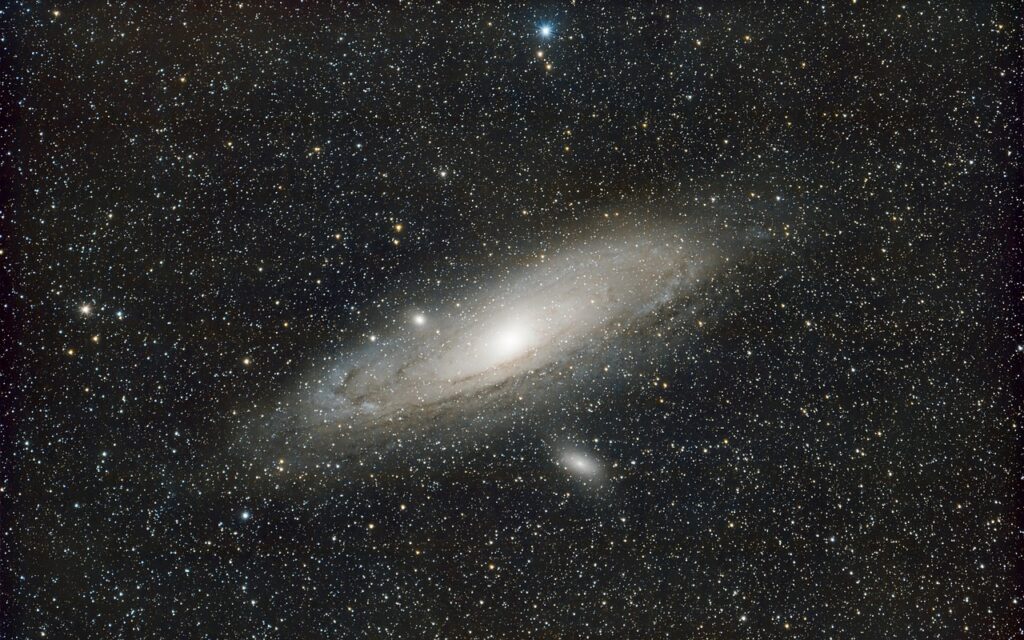
The Andromeda galaxy, also known as Messier 31 or M31, is a massive spiral galaxy located about 2.5 million light-years away from Earth. It is the largest galaxy in our local group of galaxies, which also includes the Milky Way, the Triangulum Galaxy, and dozens of smaller dwarf galaxies.
Like our own galaxy, Andromeda is a spiral system made up of stars, gas, dust, and dark matter. It formed more than 10 billion years ago and continues to evolve through star formation and gravitational interactions with nearby galaxies.
Because it is relatively close by cosmic standards, the Andromeda galaxy serves as a crucial reference point for astronomers studying how spiral galaxies form and change over time.
The structure of the Andromeda galaxy
The Andromeda galaxy is not a simple disk of stars. It is a complex system with several distinct components that mirror, and in some cases exceed, those of the Milky Way.
Its most prominent feature is a bright central bulge packed with older stars. Surrounding this is a vast spiral disk containing star-forming regions, dust lanes, and stellar clusters. Andromeda also possesses an extensive halo filled with globular clusters and streams of stars left behind by past galactic mergers.
At its core lies a supermassive black hole, similar to Sagittarius A* in the Milky Way, but significantly more massive. This central region helps astronomers study how black holes and galaxies grow together.
Where is Andromeda in the sky?
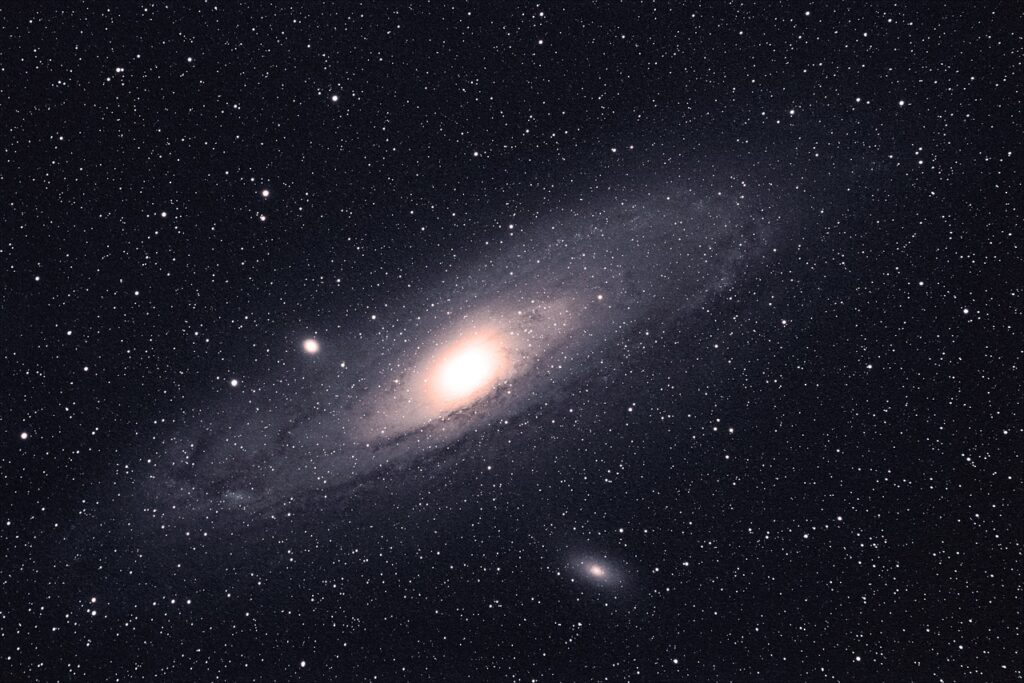
From Earth, the Andromeda galaxy appears in the constellation Andromeda in the northern sky. It is best observed during autumn months in the Northern Hemisphere, though it can also be seen from many parts of the Southern Hemisphere under good conditions.
Despite its enormous size, Andromeda looks small because of its distance. In reality, its disk spans over 200,000 light-years, making it larger than the Milky Way. If we could see it in full brightness, it would appear several times wider than the full Moon.
This contrast between appearance and reality is one of the most striking lessons Andromeda teaches us about scale in the universe.
How Andromeda compares to the Milky Way
The Andromeda galaxy and the Milky Way are often compared because of their similar spiral structures. However, Andromeda is likely more massive and contains a larger number of stars.
Both galaxies are surrounded by dark matter halos and accompanied by smaller satellite galaxies. Both also show evidence of having grown through mergers with smaller systems over billions of years.
One key difference is their future. Astronomers have determined that Andromeda and the Milky Way are moving toward each other and are expected to collide in about 4 to 5 billion years. This event will not be a catastrophic crash of stars, but a slow gravitational dance that will eventually form a new, larger galaxy.
Stars, planets, and star formation
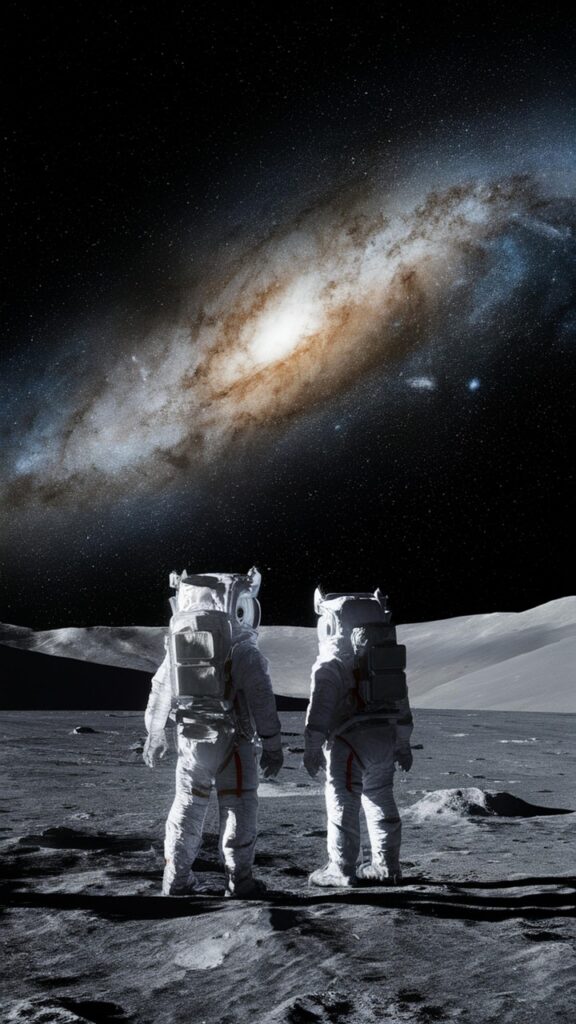
The Andromeda galaxy contains hundreds of billions of stars, many of them similar to those found in the Milky Way. Within its spiral arms, clouds of gas collapse to form new stars, while older populations populate the bulge and halo.
Observations have revealed numerous star clusters and nebulae within Andromeda, providing insight into how stars form under different conditions. While individual exoplanets are difficult to detect at such distances, astronomers believe that planetary systems are likely abundant throughout the galaxy.
Studying these regions helps scientists understand whether the processes that shaped our own Solar System are common elsewhere.
Dark matter and Andromeda
Like most large galaxies, the Andromeda galaxy is dominated by dark matter. The visible stars and gas account for only a small fraction of its total mass.
By measuring how stars orbit within Andromeda, astronomers have been able to map its dark matter halo. These observations were among the earliest and strongest pieces of evidence that dark matter plays a fundamental role in galaxy formation and stability.
Without dark matter, Andromeda would not rotate or hold together as it does.
How astronomers study the Andromeda galaxy
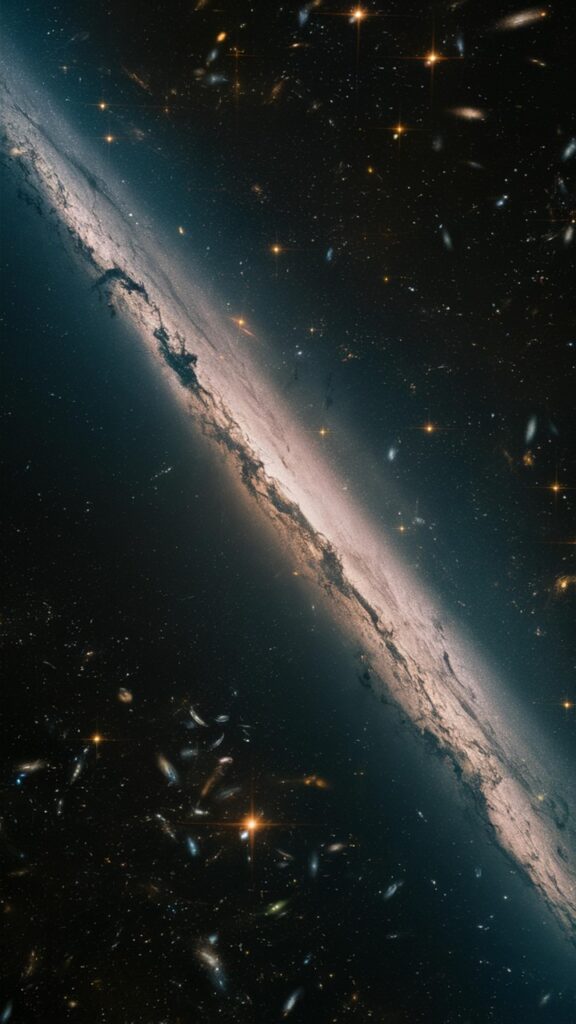
Because Andromeda is external to the Milky Way, astronomers have a unique advantage when studying it. We can observe the entire galaxy at once, rather than piecing together a map from within.
Scientists use optical telescopes, infrared surveys, and space-based observatories to study its stars, dust, and motion. Data from missions supported by NASA and other space agencies have allowed astronomers to trace stellar streams, measure distances, and reconstruct Andromeda’s merger history.
In many ways, Andromeda serves as a mirror that helps us better understand our own galaxy.
Why the Andromeda galaxy matters
The Andromeda galaxy is more than just a neighbour. It is a key laboratory for understanding spiral galaxies, dark matter, and galactic evolution on a grand scale.
By comparing Andromeda to the Milky Way, astronomers gain insight into how typical our galaxy is and what its future may hold. For beginners in astronomy, Andromeda offers a powerful reminder that the universe is vast, structured, and deeply interconnected.
When you observe Andromeda, you are not just seeing another galaxy. You are glimpsing the future of our own.
A neighbour in a vast universe
The Andromeda galaxy reminds us that galaxies are not isolated islands. They move, interact, and evolve over cosmic time. One day, long after Earth is gone, Andromeda and the Milky Way will become one.
Studying Andromeda is not only about distant stars and light-years. It is about understanding our place in a universe that is dynamic, ancient, and still full of mysteries waiting to be explored.