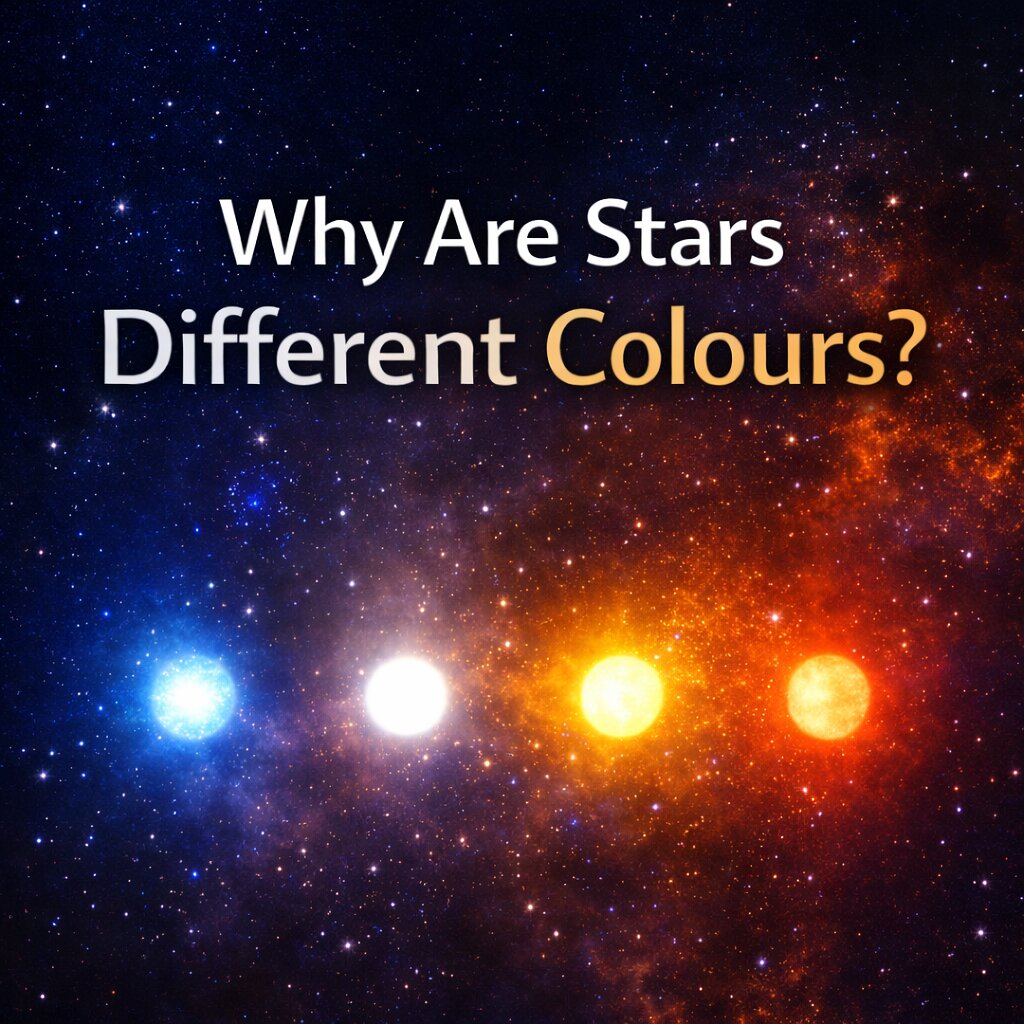

When we look up at the night sky, most stars appear white to the naked eye. But in reality, stars come in a spectacular range of colours: red, orange, yellow, white, and blue. These colour differences are not cosmetic. They reveal deep truths about a star’s temperature, size, lifespan, and the kind of planetary systems that can form around it.
Understanding why stars have different colours helps us understand the environments of alien worlds, and even why Earth orbits a yellow star rather than a blue giant or a red dwarf.
Star Colour Is All About Temperature
A star’s colour is determined primarily by its surface temperature.
Hotter stars emit more high-energy blue light, while cooler stars emit more red light. This follows the physics of blackbody radiation: objects glow different colours depending on their temperature.
We can approximate this behaviour using Wien’s Law, which relates peak emission wavelength to temperature:λmax=b/T
Here, λ_max is the wavelength of peak light emission, T is temperature, and b is a constant. As temperature increases, the peak wavelength shifts toward shorter (bluer) wavelengths.
That is why:
- Blue stars are the hottest (above 10,000 K)
- White stars are moderately hot
- Yellow stars (like our Sun) sit around 5,500–6,000 K
- Orange stars are cooler
- Red stars are the coolest (around 2,500–3,500 K)
Colour is temperature made visible.
Stellar Classification: The OBAFGKM System
Astronomers classify stars using the spectral sequence:
O – B – A – F – G – K – M
(Often remembered as “Oh Be A Fine Girl/Guy, Kiss Me.”)
This sequence runs from hottest to coolest:
- O-type stars are blue and extremely hot
- B and A stars are blue-white
- F stars are white
- G stars are yellow (our Sun is a G-type star)
- K stars are orange
- M stars are red
Each class also corresponds to different stellar masses and lifespans. Massive blue stars burn through their fuel quickly, sometimes lasting only a few million years. Smaller red stars can live for hundreds of billions — even trillions — of years.
How Star Colour Affects Planets
The colour and temperature of a star dramatically affect the planets orbiting it.
1. Habitable Zone Distance
The habitable zone — where liquid water could exist — depends on stellar luminosity. Hot blue stars emit enormous energy, pushing their habitable zones far outward. Red stars emit less energy, so their habitable zones sit much closer.
This relationship follows the inverse square law of radiation:I=L/(4πr2)
Intensity (I) decreases with distance (r). So planets must sit at very different distances depending on the star’s brightness.
Around red dwarfs, habitable planets may orbit extremely close — sometimes closer than Mercury orbits the Sun.
2. Radiation Environment
Blue stars emit intense ultraviolet radiation. Even if a planet sits in the habitable zone, the high radiation levels may strip atmospheres or damage potential biological molecules.
Red dwarfs, while cooler, often produce strong stellar flares. A planet in close orbit may experience frequent radiation bursts.
Yellow stars like our Sun offer a relatively stable environment — one reason Earth has had billions of years to evolve life.
3. Planet Formation Differences
Massive blue stars form and die quickly. Their short lifespans may not allow complex life enough time to develop.
Red dwarfs, on the other hand, burn slowly and steadily for incredibly long periods. This gives potential life far more time — though tidal locking and flare activity present challenges.
In multiple-star systems, different coloured stars can create complex gravitational dynamics, affecting planetary orbits and climate stability.
Why Our Sun’s Colour Matters
Our Sun is a G-type yellow star: not too hot, not too cool.
It provides:
- Stable energy output
- Moderate ultraviolet radiation
- A habitable zone at a comfortable orbital distance
- A lifespan of roughly 10 billion years
This balance may be one of the reasons Earth has sustained life for over 3.5 billion years.
If the Sun were a blue giant, Earth would never have had enough time.
If it were a highly active red dwarf, our atmosphere might have been stripped away.
Star colour is not just aesthetic; it shapes destiny.
The Universe in Technicolour
Different coloured stars are natural outcomes of physics. Mass determines temperature. Temperature determines colour. Colour determines radiation output. And radiation output determines planetary environments.
When astronomers study exoplanets, one of the first questions they ask is: What type of star does it orbit?
Because before we can understand alien worlds, we must first understand the colour of their suns.