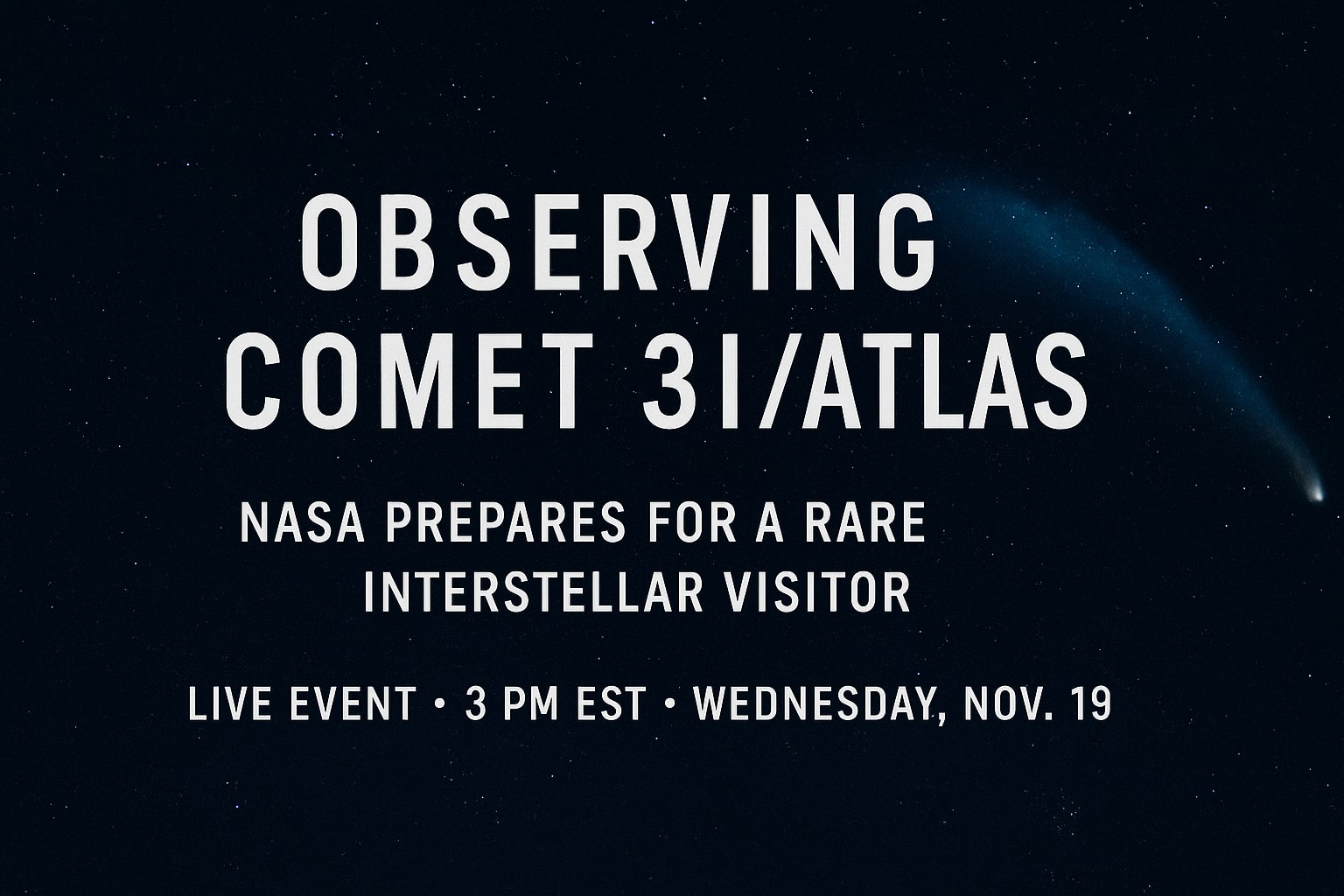

Comet 3I/ATLAS is only the third known interstellar object ever detected passing through our Solar System, a category so rare that each discovery reshapes our understanding of the cosmos. On Wednesday, 19 November, NASA will host a live event at 3 p.m. EST to reveal new imagery and data gathered from multiple missions. For astronomers, educators and casual skywatchers alike, this is a moment worth marking on the calendar.
You can watch it live on NASA’s site! Or you can watch it here below:
A comet from another star system
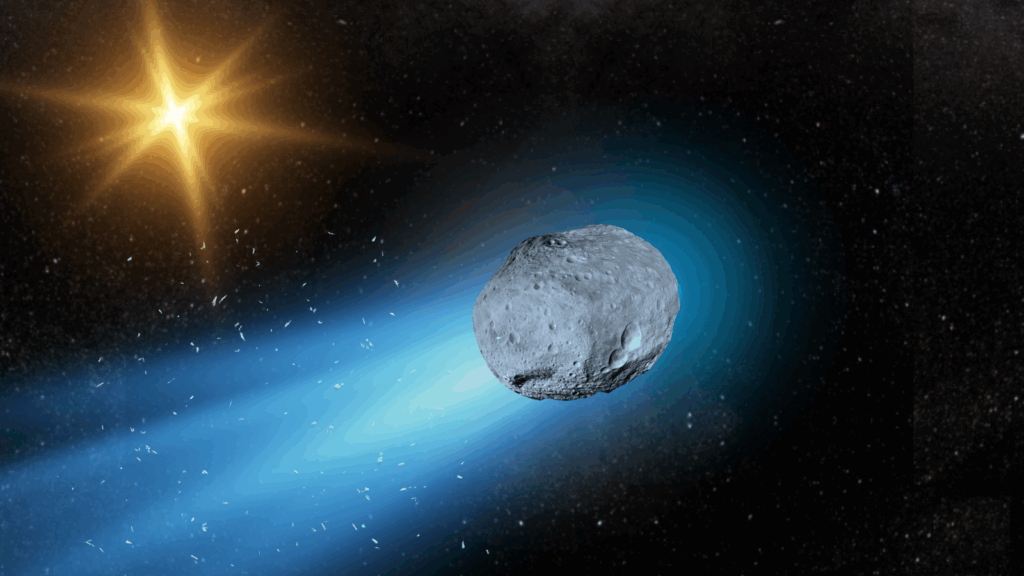
Interstellar objects are extraordinary because they do not originate from our Sun. Instead, they were formed around distant stars and ejected into deep space before drifting into our neighbourhood. Comet 3I/ATLAS, discovered on 1 July by the NASA-funded ATLAS observatory, follows in the footsteps of 1I/ʻOumuamua and 2I/Borisov, the only other interstellar visitors ever confirmed.
Unlike traditional comets tied to the Sun’s gravity, interstellar comets have unusual trajectories and unpredictable behaviours. 3I/ATLAS is no exception. Its path, speed and composition offer clues about the environments where other stars are born. Every observation helps scientists compare our Solar System to those scattered across the galaxy.
What NASA’s new imagery will reveal
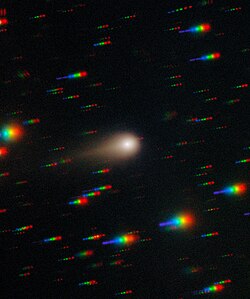
The upcoming NASA event is expected to showcase high-resolution imagery and data captured by a suite of spacecraft, observatories and solar-monitoring missions. Because 3I/ATLAS is travelling through the inner Solar System, it has been observed across different wavelengths — from visible light to infrared — allowing scientists to analyse the comet’s structure and outgassing activity in detail.
One of the biggest goals is understanding its composition. Interstellar comets carry material that predates our Sun, offering a glimpse into the chemistry of distant stellar nurseries. NASA’s imagery will also help refine models of how these objects behave as they encounter solar radiation for the first time. Even subtle changes in brightness or tail formation can reveal how foreign ices react under our Sun’s influence.
How skywatchers can prepare to observe 3I/ATLAS
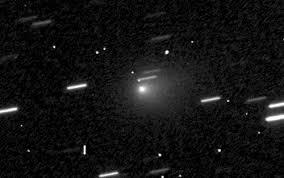
Although Comet 3I/ATLAS is faint and still emerging from the Sun’s glare, skywatchers with access to dark skies and proper equipment may soon get the chance to spot it. Large amateur telescopes are ideal, but even smaller instruments may catch it as it brightens over the coming weeks. Pre-dawn observations offer the clearest window, as the comet slowly becomes more visible above the horizon.
For those without a telescope, NASA’s broadcast provides the perfect opportunity to see the comet up close through mission imagery. Viewers will also hear expert commentary explaining how the comet was detected, what makes its interstellar origin certain and why events like this are so scientifically significant. It’s a chance to witness a cosmic traveller most humans will never see again.
Why interstellar visitors matter
Interstellar objects like 3I/ATLAS are more than astronomical curiosities; they are messengers from beyond our Solar System. Each one carries clues about the diversity of planetary systems that populate the Milky Way. By studying these visitors, scientists gain perspective on how common, or uncommon, our own system might be.
The NASA showcase on 19 November offers an extraordinary opportunity to learn more about this rare celestial visitor and to appreciate just how vast and interconnected our galaxy truly is.