The James Webb Space Telescope has captured one of the most intricate cosmic structures ever observed around a massive star system. Known as Apep, this rare triple-star system produces spiralling dust shells that expand outward over centuries. Webb’s observations have now revealed not one, but four distinct shells, giving astronomers a detailed look at how massive stars eject material and evolve over time.
A rare look at Wolf-Rayet stars in action
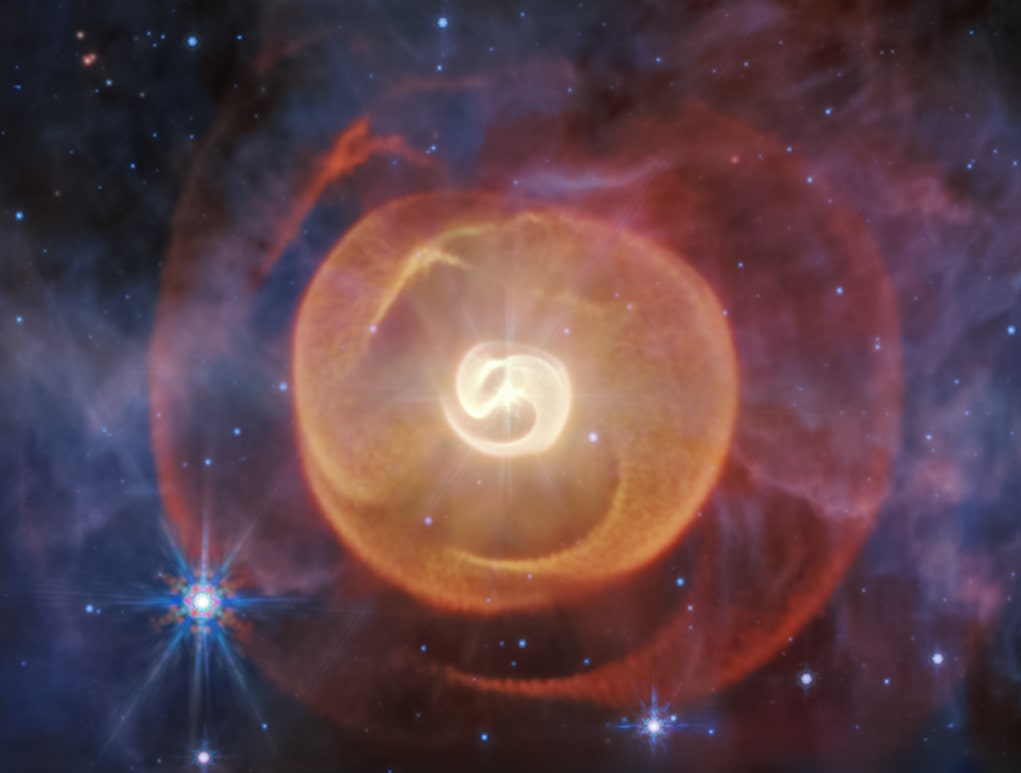
At the heart of Apep lie two Wolf-Rayet stars. These are extremely hot, massive, evolved stars known for blasting powerful stellar winds into space. When the winds from both stars collide, they compress into dense, carbon-rich dust. Webb’s mid-infrared eyes are uniquely sensitive to this cool dust, allowing astronomers to see structures that are invisible in regular light.
Wolf-Rayet binaries with such long orbital periods are incredibly rare. In Apep, the stars take roughly 190 years to orbit one another, so the dust is created in long, spaced-out episodes. Each dust shell seen by Webb corresponds to a past period of intense dust formation.
Four spiralling shells revealed for the first time
Before Webb, astronomers had detected hints of one large dust shell. Webb’s MIRI instrument changed everything by unveiling four nested shells, each shaped like a spiralling coil. These shells trace centuries of dust production, giving scientists a time-lapse of Apep’s past activity.
The spirals form because the stars rotate while ejecting dust. As the dust expands outward at high speeds, the rotation twists it into a coil, similar to water sprayed from a rotating sprinkler.
The dust in Apep is moving at astonishing speeds between 2 000 and 3 000 kilometres per second, driven by the fierce winds of the Wolf-Rayet pair.
A third massive star reshaping the dust
Apep is not just a binary system. A third star, a massive supergiant, orbits further out and interacts with the expanding shells. Webb’s images show that each dust shell has a cavity carved into it, almost like a hollow funnel. This is caused by the gravitational influence and stellar wind of the companion star cutting pathways through the dust.
This three-star choreography creates a complex, layered structure that astronomers rarely get to study in such detail. The presence of the third star helps explain why the shells are not perfectly symmetrical.
What this discovery means for astronomers
Apep offers a real-time laboratory for understanding the final stages of massive stars before they explode as supernovae. The dust produced today may one day enrich nearby regions with carbon and other heavy elements that contribute to planet formation.
By observing multiple dust shells, astronomers can map changes in the stars’ wind strength, rotation and activity over centuries. This is something no previous telescope could do with such clarity.
Webb’s observations also help refine models of how Wolf-Rayet stars lose mass, how dust survives in harsh environments and how complex systems evolve when multiple massive stars interact.
Source: NASA Science
A cosmic dance revealed by Webb
Apep’s spiralling dust shells show how dynamic and dramatic the universe can be, even around stars that appear as a single point of light from Earth. Thanks to the James Webb Space Telescope, astronomers can now watch centuries of stellar history unfolding in a single image. As Webb continues to explore massive star systems like Apep, we can expect even more discoveries that shed light on how stars live, change and shape the cosmos around them.