Astronomers have identified the largest planet-forming disk ever observed with the Hubble Space Telescope, a colossal structure of gas and dust surrounding a young star that is reshaping how scientists understand planet formation. Often described as a cosmic “sandwich” because of its layered appearance, this protoplanetary disk is far larger than anything previously studied and offers a rare look at planetary systems in their earliest stages.
The discovery provides an unprecedented opportunity to examine how planets may form under extreme conditions and challenges long-held assumptions about the size limits of planet-forming environments.
Hubble reveals a record-breaking planet nursery
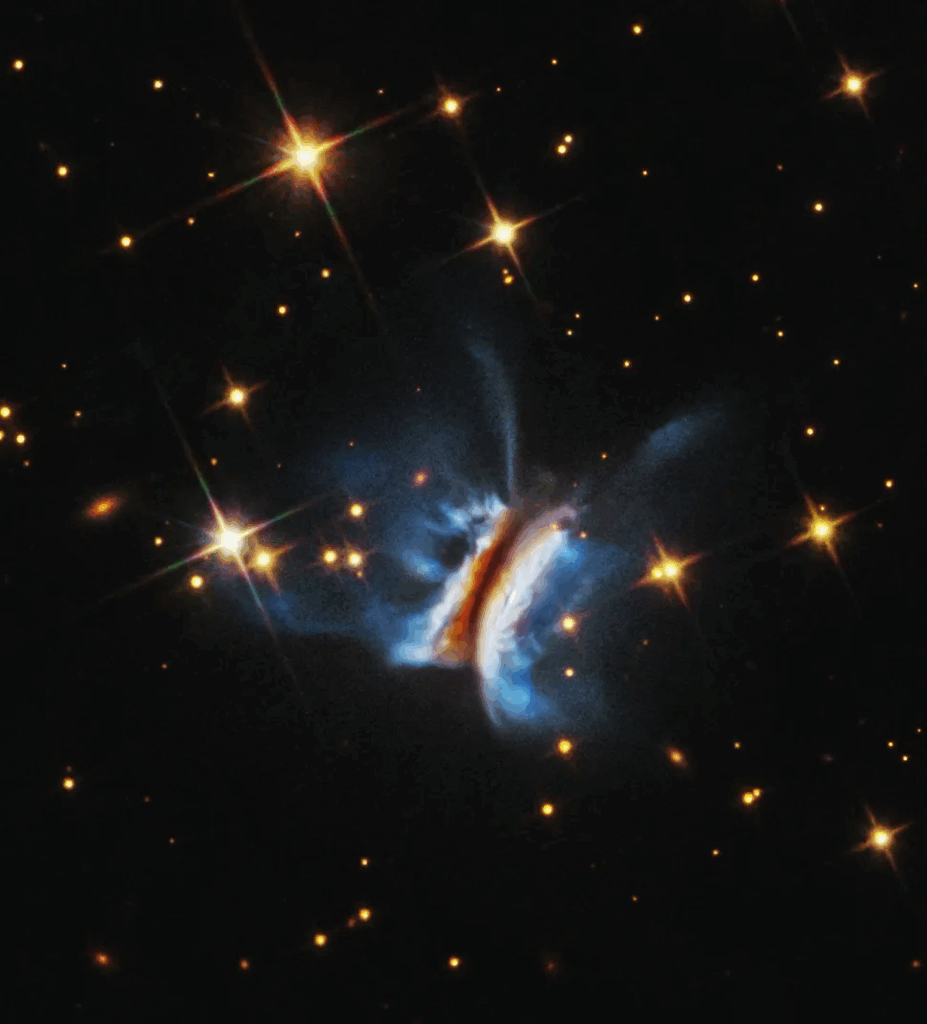
The Hubble Space Telescope has captured a striking new image of the largest and most unusual protoplanetary disk ever observed around a single star. Officially designated IRAS 23077+6707, the object has been nicknamed “Dracula’s Chivito” due to its layered, sandwich-like appearance and the backgrounds of its discoverers in Transylvania, Romania, and Uruguay.
Protoplanetary disks are rich reservoirs of gas and dust where planets form, ranging from rocky Earth-like worlds to gas giants similar to Jupiter. In this case, the disk’s immense size suggests it could theoretically give rise to a vast planetary system. Astronomers estimate that the structure spans nearly 400 billion miles (about 640 billion kilometres), making it more than 100 times wider than the inner region of our Solar System where all known planets orbit.
The findings, published in The Astrophysical Journal, confirm that the object is a massive planet-forming disk viewed almost perfectly edge-on from Earth. First identified in 2016, the new Hubble observations reveal extraordinary detail, including bright, vertically stretched wisps of gas extending far above and below the disk on one side, while the opposite side appears sharply defined.
“This level of detail is rare in protoplanetary disk imaging,” said Kristina Monsch, lead author of the study. She noted that the images show planet-forming environments can be far more active and chaotic than previously thought. Co-investigator Joshua Bennett Lovell added that the disk’s strong asymmetry was unexpected, with Hubble offering an unprecedented view of the turbulent processes shaping young planetary systems.
These observations challenge existing models of disk stability and planet formation, suggesting that enormous, chaotic structures like this can persist long enough to begin building new worlds.
What is a planet-forming disk?
Planet-forming disks, also known as protoplanetary disks, are vast, rotating clouds of gas and dust that surround young stars. Over time, material within these disks clumps together through gravity and collisions, eventually forming planets, moons, asteroids, and comets.
Most known protoplanetary disks span a few hundred astronomical units, already massive by Solar System standards. This newly observed disk, however, dwarfs typical examples, extending many times farther than expected and containing enormous amounts of raw material for planet formation.
Why this disk is so extraordinary
What sets this disk apart is not just its size, but its structure. Observations reveal a thick central dust layer sandwiched between upper and lower gas-rich regions. This layered configuration helps astronomers trace how material settles and moves within the disk, a key process in forming planets.
Its immense scale suggests that planet formation may occur in environments far more extreme than previously believed. The disk’s size also raises questions about stability, as such massive structures were once thought to break apart before planets could form.
How astronomers observed it
The disk was detected using advanced infrared and submillimetre observations, which allow scientists to see through dense dust clouds that block visible light. By viewing the disk nearly edge-on, researchers could clearly distinguish its layers and measure its full extent.
This viewing angle is rare and valuable, offering a natural cross-section of a planet-forming disk and revealing details that are usually hidden when disks are viewed face-on.
What this means for planet formation theories
The discovery challenges existing models of how planets form and how large disks can grow before becoming unstable. If such massive disks can survive long enough to form planets, it suggests that planetary systems across the galaxy may be far more diverse than previously imagined.
It also raises the possibility that some planetary systems may produce planets at much greater distances from their host stars than those seen in our own Solar System.
News Source: Live Science
Why this matters for future research
This record-breaking disk will become a key target for future observations, helping astronomers refine theories about disk evolution, planet formation timescales, and the role of gravity and turbulence in shaping young systems.
For astronomers and sky enthusiasts alike, the discovery is a reminder that planet formation is still full of surprises. Each new observation adds another piece to the puzzle of how worlds like our own come into existence.