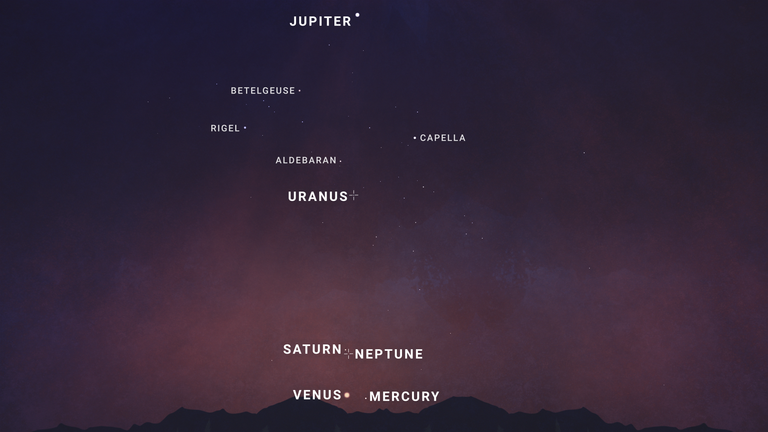
February delivers one of the most visually striking sky events of the year as six planets appear together in the evening sky, forming a rare and memorable planetary parade. For several nights toward the end of the month, observers will be able to trace a chain of worlds stretching across the twilight sky shortly after sunset.
This is not a true alignment in space, but a perspective effect caused by the planets lining up along the same orbital plane as seen from Earth. Still, seeing so many planets at once is uncommon and always exciting, especially for casual stargazers who don’t often need telescopes to enjoy celestial events.
What exactly is a planet parade?
A planet parade occurs when multiple planets become visible in the sky at the same time, following the ecliptic, the apparent path the Sun and planets take across the sky. Because the planets orbit in roughly the same plane, there are moments when several of them appear above the horizon together after sunset or before sunrise.
In February, Mercury, Venus, Saturn, Jupiter, Uranus, and Neptune all occupy favourable positions, creating a long arc of planets rather than a tight cluster. Some shine brightly to the naked eye, while others reward those using binoculars or small telescopes.
News Source: NASA
Which planets will be visible?
Venus and Jupiter will be the standouts of the parade. Venus will glow low in the western sky soon after sunset, while Jupiter will appear higher and brighter as the sky darkens. Saturn and Mercury will sit closer to the horizon and may require a clear view west and good timing.
Uranus and Neptune will also be present but are much fainter. These distant worlds are not visible to the naked eye for most observers and are best spotted with binoculars or a telescope, especially once the sky becomes fully dark.
Will South Africa see the same planet parade?
Yes, South Africa will be able to see this planetary parade, although the exact appearance differs slightly from the Northern Hemisphere. Planetary parades are global events, but latitude affects how high the planets appear above the horizon and how long they remain visible after sunset.
From South Africa, Venus and Jupiter will be easy to spot, while Saturn and Mercury will appear lower and may be lost quickly to twilight if your western horizon is obstructed. Uranus and Neptune will still require optical aid. A clear, open horizon and minimal light pollution will significantly improve the experience.
How to get the best view
The best time to observe the planet parade is about 30 to 60 minutes after sunset, once the Sun is fully below the horizon but before the lowest planets set. Choose a location with a wide, unobstructed view to the west and allow your eyes time to adjust to the fading light.
Even without equipment, spotting four or five planets in a single sky sweep is a rewarding experience. With binoculars, the parade becomes even more impressive, revealing faint worlds that normally go unnoticed.
A reminder of how dynamic our Solar System really is
Events like this planet parade are a powerful reminder that the night sky is always changing. The planets are constantly on the move, and moments when they come together in our view are brief and special.
Whether you catch all six planets or only a few, February’s planetary parade offers a chance to step outside, look up, and reconnect with the wider Solar System. Some celestial events are subtle. This one invites you to notice them all at once. 🌌