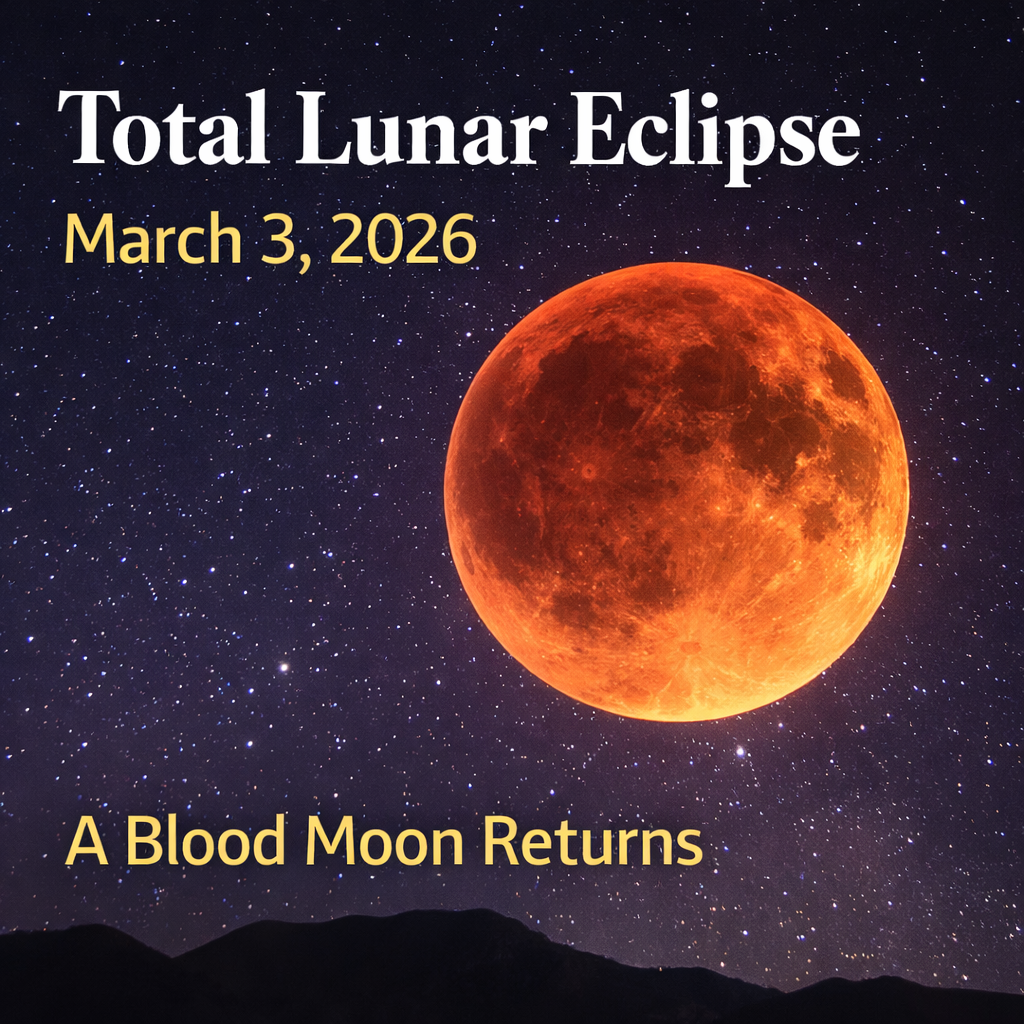

On March 3, 2026, the world will witness a total lunar eclipse, often referred to as a “blood moon.” During this celestial event, the Moon will pass fully into Earth’s shadow, taking on a deep red or copper glow instead of its usual silvery brightness.
While the eclipse will be most clearly visible across North and South America, Australia, New Zealand, East Asia, and parts of the Pacific region, South Africans should still keep an eye on the skies. Depending on timing and atmospheric conditions, parts of the eclipse may be visible locally.
What is a total lunar eclipse?

A total lunar eclipse occurs when the Earth moves directly between the Sun and the Moon. As sunlight passes through Earth’s atmosphere, shorter blue wavelengths scatter, allowing only the longer red wavelengths to reach the Moon’s surface.
This filtered light causes the Moon to glow red, hence the term “blood moon.”
Unlike solar eclipses, lunar eclipses are completely safe to view with the naked eye. No special equipment or protective glasses are required. The entire event unfolds slowly over several hours, making it accessible even for casual skywatchers.
Why the Moon turns red
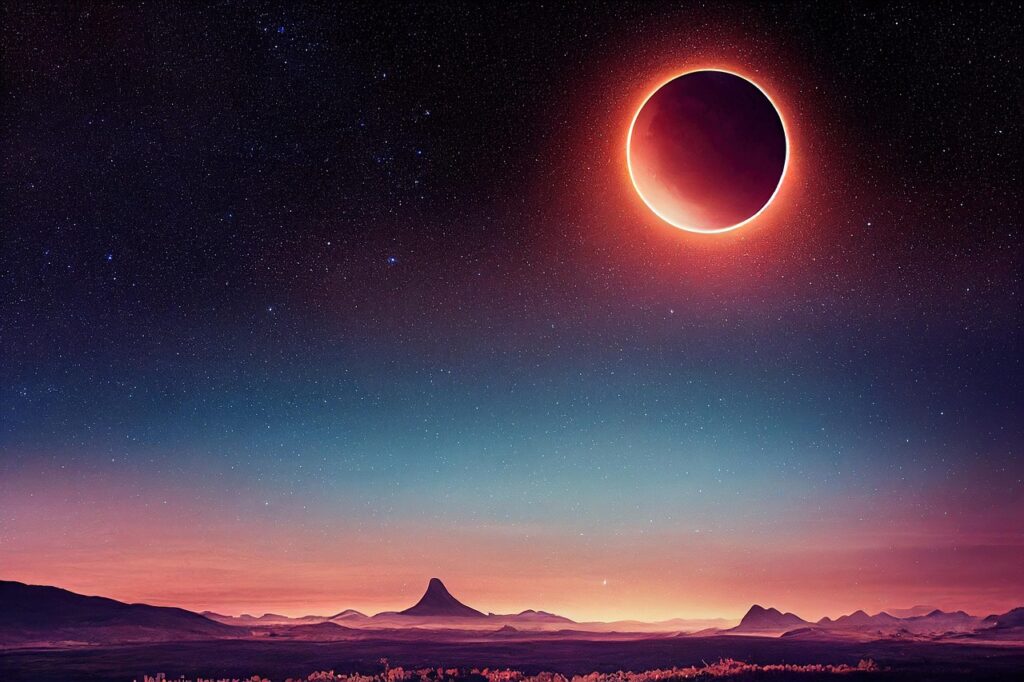
The red colour is caused by a phenomenon known as Rayleigh scattering, the same effect that makes sunsets appear orange and red. Earth’s atmosphere bends and filters sunlight, projecting a faint reddish glow onto the Moon even while it sits in Earth’s shadow.
The exact shade of red can vary. Factors such as atmospheric dust, pollution, or recent volcanic activity can deepen the colour. A clear atmosphere may produce a brighter copper tone, while heavy particles in the air can create a darker, more dramatic red.
This variability makes every total lunar eclipse slightly unique.
Will South Africa see the March 3, 2026 blood moon?
The eclipse’s prime visibility zone lies across the Americas and parts of the Pacific region. However, South African observers should still monitor updated timing charts as the date approaches.
Depending on the precise alignment and local horizon position, portions of the penumbral or partial phases could be visible either before moonset or after moonrise. Coastal regions with clear eastern or western horizons may have better viewing opportunities.
Even if full totality is not perfectly positioned for Southern Africa, the event remains worth watching. Lunar eclipses often produce subtle changes in brightness long before totality begins.
How to prepare for viewing
You do not need a telescope to enjoy a total lunar eclipse. In fact, binoculars or even the naked eye provide a wide and satisfying view.
To improve your experience:
- Choose a location with minimal light pollution
- Find a clear view of the horizon in the direction of moonrise or moonset
- Check local weather forecasts in advance
- Allow your eyes time to adjust to darkness
Photographers may wish to use a tripod and longer exposure settings to capture the deep red hues during totality.
Why lunar eclipses matter
Beyond their beauty, lunar eclipses remind us of the precise mechanics governing our solar system. They demonstrate Earth’s spherical shadow and the predictable orbital dance between Earth, Moon, and Sun.
Unlike rare astronomical events that require special instruments, lunar eclipses are shared global experiences. Entire continents can watch simultaneously, creating a sense of planetary connection.
The March 3, 2026 total lunar eclipse may favour other regions of the world, but South Africans should not ignore it. Clear skies and good timing could still offer a glimpse of this striking blood moon.
Keep your calendar marked — and your eyes on the horizon. 🌕