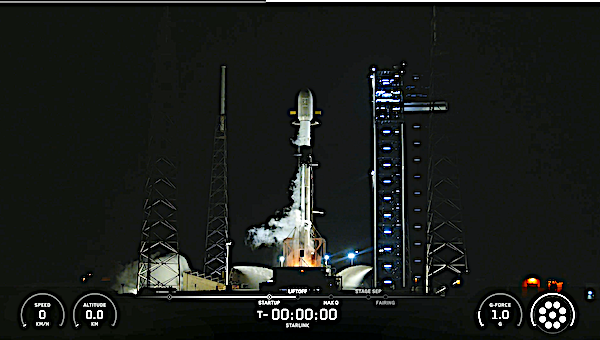
On 5 November 2025, SpaceX’s Falcon 9 rocket blasted off from Cape Canaveral Space Force Station in Florida at 20:31 EST (01:31 UTC), carrying 29 Starlink internet-satellites into low Earth orbit (LEO). The launch marks the 141st Falcon 9 flight of the year and the company’s 146th overall mission in 2025, further extending its single-year launch record.
As satellite internet demand surges, this mission underscores both SpaceX’s operational tempo and its ambition to expand the Starlink megaconstellation rapidly.
You can watch SpaceX launch 29 Starlink satellites on the Falcon 9 rocket from Cape Canaveral here in this video:
Launch Profile and Technology

The mission, designated Starlink 6-81, used first stage booster B1094 on its fifth flight, one of the company’s repeatedly-flown boosters.
After stage separation, B1094 conducted a deceleration and landing burn before touching down on the droneship Just Read the Instructions in the Atlantic Ocean about 8.5 minutes after liftoff. The Falcon 9 upper stage continued on to deploy the 29 satellites about an hour after liftoff, integrating them into Starlink’s already vast constellation.
SpaceX’s mastery of rapid re-use of its rockets is on full display here: the firm’s pace of launches this year is unprecedented, showing the scalability of its launch system and satellite deployment strategy.
Significance for the Starlink Constellation
With this launch, Starlink continues to build toward its target of providing global broadband coverage via thousands of satellites. The 29 newly-deployed satellites join more than 8,800 already in orbit.
The increase helps meet growing demand for low-latency internet connectivity in remote and underserved regions, and further cements Starlink’s role as a major global communications infrastructure player.
Moreover, the record-setting launch cadence signals that SpaceX is not just operating launches but scaling the business of space. It raises questions around orbital congestion, regulatory oversight and the long-term sustainability of mega-constellation deployment.
Challenges and Future Outlook
Deploying large numbers of satellites, such as in this 29-satellite batch, creates both opportunity and complexity. SpaceX must manage orbital traffic, space-debris mitigation, and regulatory compliance across multiple jurisdictions.
Additionally, as the constellation grows, competition intensifies. Other operators, such as Amazon’s Project Kuiper and various national programmes, are racing to deliver similar broadband-satellite services. The pace of Starlink launches places pressure on these rivals and heightens the need for robust ground-infrastructure, user-terminals and network integration.
Looking ahead, SpaceX has more Starlink launches queued for November and beyond, continuing its push toward deploying thousands more satellites in the coming years.
Setting the Pace in Satellite Internet
SpaceX’s 29-satellite launch from Cape Canaveral marks not only another operational milestone, but a statement of intent in the satellite internet era. The company’s ability to launch, land and reuse hardware, while rapidly building a global communications network, positions it as a dominant force in both space and telecoms.
As the constellation grows, so too will the scrutiny, from regulators, orbit managers and competitors. But for now, the message is clear: space is becoming an infrastructure frontier, and SpaceX is sprinting to build the roads.
Keep an eye on Casual Astronomy for updates as SpaceX executes its next Starlink missions and the broader landscape of satellite broadband evolves.