Astronomers have observed the most powerful flare ever recorded from a supermassive black hole, releasing energy equivalent to roughly ten trillion suns. The event, detected in a distant galaxy about ten billion light-years away, has astonished scientists and challenged existing models of how black holes feed and emit light.
This extraordinary outburst, first captured by NASA’s Neil Gehrels Swift Observatory and the European XMM-Newton telescope, lasted several weeks, far longer and brighter than typical black-hole flares. Researchers believe the phenomenon occurred as the black hole consumed a large amount of surrounding material, possibly the remnants of a disrupted star, creating an enormous shockwave of light and radiation.
A Cosmic Beacon from the Early Universe
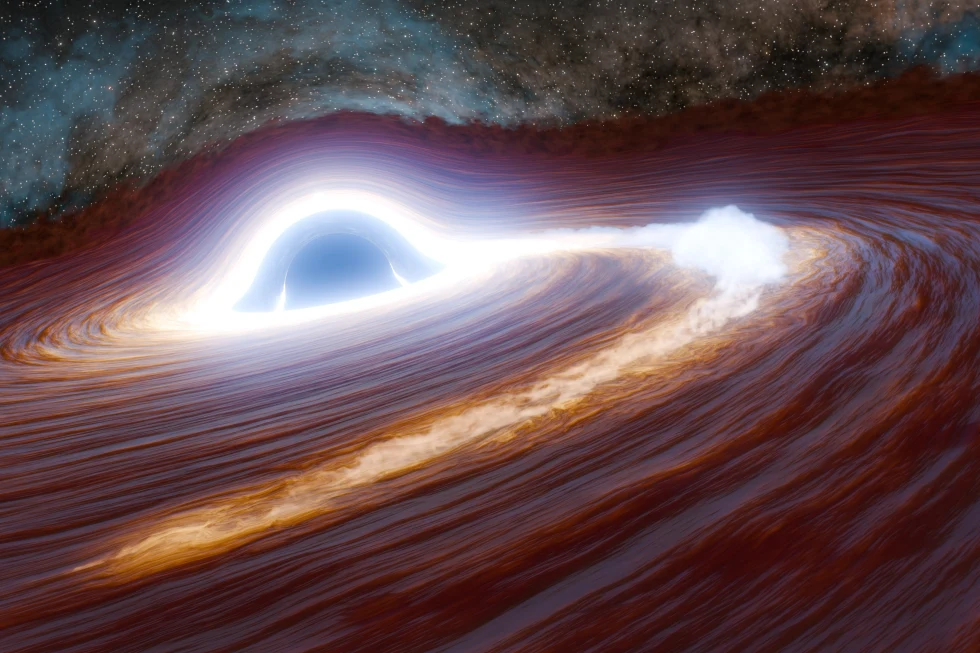
What makes this flare particularly fascinating is its distance. The black hole lies in a galaxy that formed less than four billion years after the Big Bang, meaning astronomers are effectively witnessing a powerful event from the universe’s youth. Its brightness, nearly ten times greater than similar flares, provided telescopes with a rare opportunity to study early black-hole activity in unprecedented detail.
According to lead researchers, the flare’s energy output and duration defy conventional understanding. Normally, black holes emit brief, irregular flashes as they accrete gas and dust. In this case, the flare persisted and intensified, hinting that an unusually large amount of matter fell into the accretion disc at once. It’s a discovery that could reshape how scientists model black-hole feeding behaviour in the young cosmos.
Instruments Working in Sync
The detection involved an impressive collaboration between multiple observatories. Swift first identified the flare’s rise in the X-ray spectrum, triggering follow-up observations by ground-based telescopes across several continents. Radio and optical data later confirmed a significant energy release expanding through surrounding space.
Researchers at NASA, the European Space Agency, and institutions including Caltech and MIT are continuing to analyse the data. Early findings suggest that magnetic instabilities or extreme relativistic effects near the event horizon may have amplified the brightness. Whatever the mechanism, it represents one of the most luminous, long-lasting flares ever seen from a supermassive black hole.
A Window into the Heart of a Galaxy
Every black-hole flare tells a story about what happens when gravity and energy collide at cosmic extremes. This latest event gives scientists a powerful new lens through which to study accretion physics, the process by which black holes gather and emit matter. The light from this flare travelled billions of years to reach us, offering a glimpse into how massive galaxies evolved and how their central black holes influenced that growth.
As new instruments like the James Webb Space Telescope and Vera Rubin Observatory continue scanning the skies, astronomers expect to catch more of these outbursts. Each observation adds another piece to the puzzle of how galaxies, and the titans at their cores, shaped the universe we see today.
A Record-Breaking Glimpse into the Unknown
The brightest flare ever seen from a supermassive black hole is more than just a spectacular cosmic display. It’s a scientific milestone. By pushing the limits of observation, astronomers are uncovering new insights into the forces that govern galaxy formation and evolution.
For now, this flare stands as both a mystery and a marvel: a signal from the deep past that challenges our understanding of gravity, light, and time itself. As telescopes grow ever more powerful, the universe continues to remind us how much there still is to learn, and how brilliant its surprises can be.