
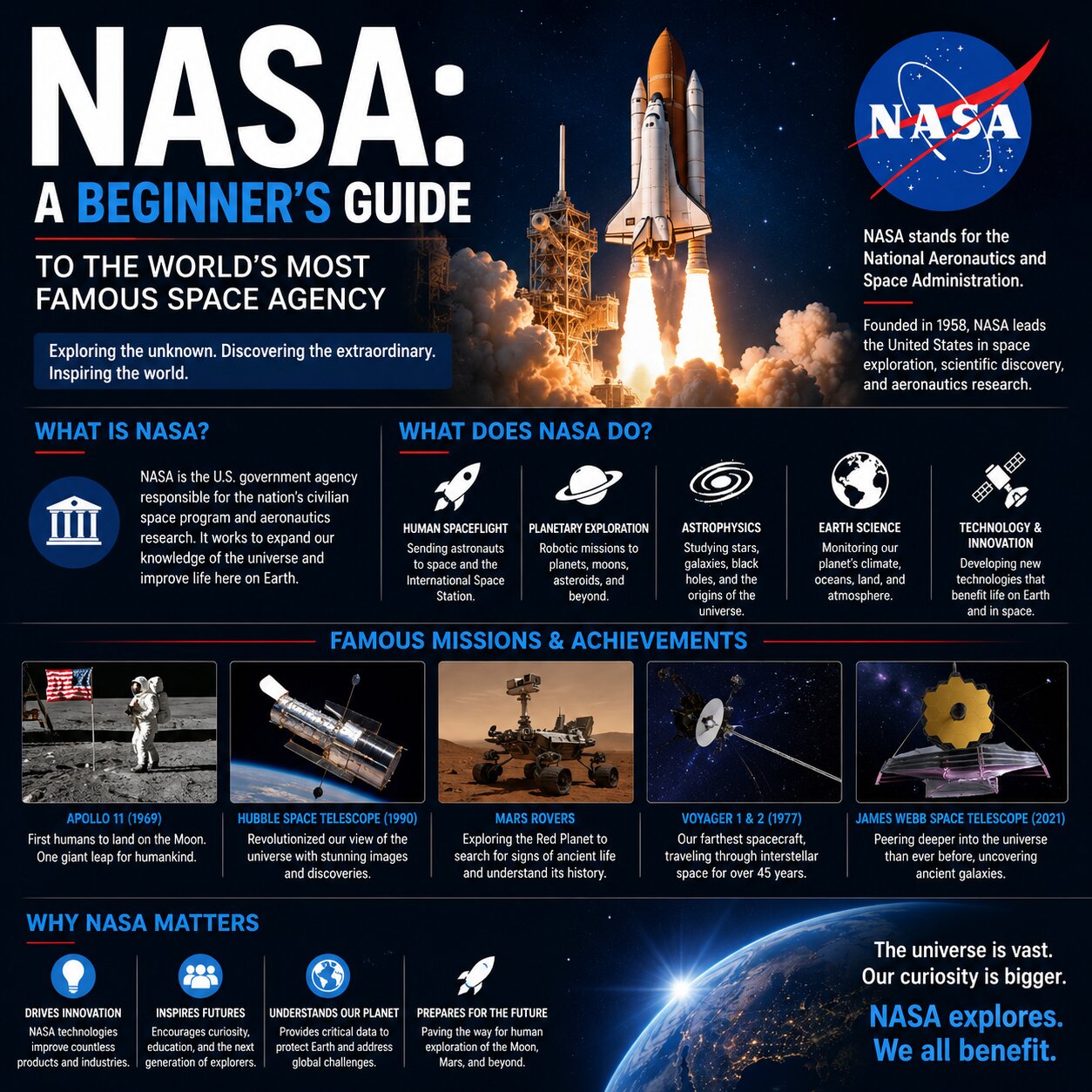

Few organisations have shaped humanity’s understanding of space as much as NASA. From landing humans on the Moon to exploring distant planets and studying Earth from orbit, NASA has become one of the most recognisable names in science and space exploration around the world.
For beginners entering the world of astronomy and space science, NASA often serves as the gateway into understanding rockets, astronauts, telescopes, satellites, and deep space missions. The agency’s discoveries and technologies continue to influence not only astronomy but also modern technology, climate science, aviation, and international cooperation.
This guide explores what NASA is, what it does, and why it remains one of the most important organisations in the history of space exploration.
What is NASA?
NASA stands for the National Aeronautics and Space Administration. It was officially established in 1958 by the United States government during the early years of the Space Race between the United States and the Soviet Union.
NASA was created to oversee America’s civilian space programme and aeronautics research. Before NASA existed, much of the United States’ rocket and space development was handled through military programmes and smaller research organisations.
Over the decades, NASA expanded into one of the world’s leading scientific agencies. Today, it operates across multiple fields including human spaceflight, robotic planetary exploration, astrophysics, Earth observation, satellite technology, and aviation research.
NASA also works closely with international partners, universities, private companies, and other space agencies around the world to support scientific discovery and technological advancement.
NASA’s most famous space missions
NASA has conducted hundreds of important missions throughout its history. Some of these have become legendary milestones in human achievement and scientific exploration.
The Apollo programme remains NASA’s most iconic accomplishment. In 1969, the Apollo 11 mission successfully landed astronauts on the Moon for the first time in human history. Astronauts such as Neil Armstrong and Buzz Aldrin became global symbols of space exploration.
NASA also launched the Hubble Space Telescope, which transformed astronomy by capturing breathtaking images of galaxies, nebulae, and distant cosmic phenomena. More recently, the James Webb Space Telescope has begun exploring the early universe in extraordinary detail.
Robotic missions such as the Mars rovers have also become major achievements for NASA. Missions including Spirit, Opportunity, Curiosity, and Perseverance have helped scientists study the surface and history of Mars in ways once thought impossible.
NASA’s Voyager spacecraft continue travelling through interstellar space decades after launch, making them among humanity’s most distant objects ever created.
The different areas NASA studies
NASA’s work extends far beyond astronauts and rockets. The agency studies many different aspects of science, technology, and space exploration.
- Human spaceflight and astronaut missions
- Planetary exploration across the Solar System
- Astronomy and deep space observation
- Earth science and climate monitoring
- Satellite and communication technology
- Rocket and propulsion research
- Space robotics and artificial intelligence
- Aeronautics and aircraft development
- International space cooperation
These areas often overlap, allowing NASA to contribute to scientific research that impacts both space exploration and life on Earth.
NASA’s role in modern space exploration
NASA continues playing a major role in the modern era of space exploration. While private companies such as SpaceX and Blue Origin have become increasingly involved in spaceflight, NASA remains a central scientific and exploratory leader.
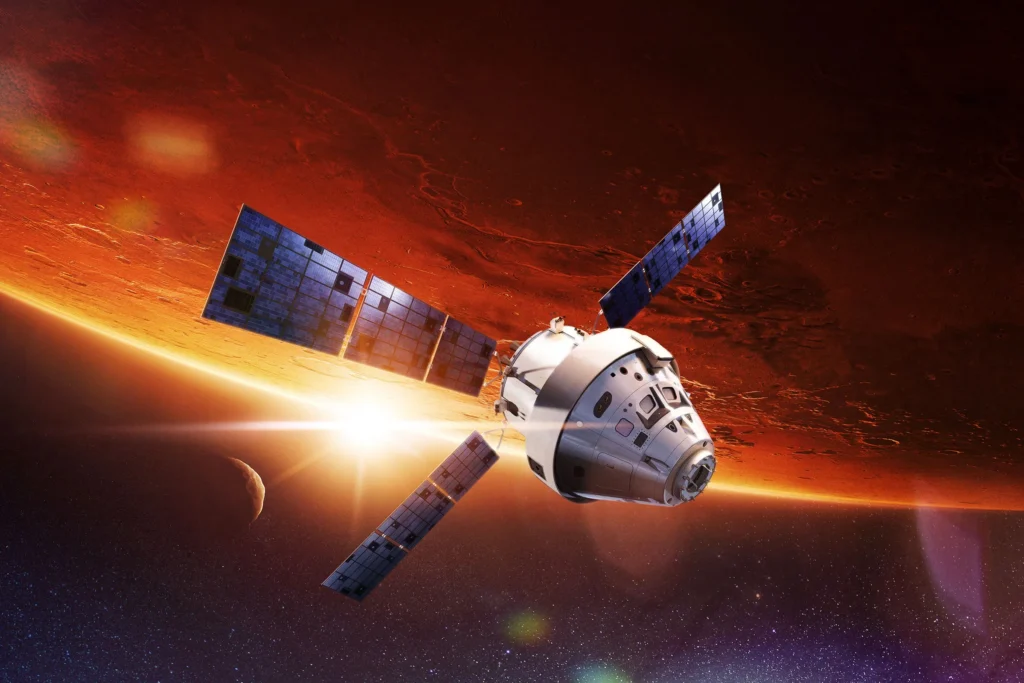
The Artemis programme aims to return humans to the Moon and eventually establish long-term lunar exploration systems. These missions are expected to prepare humanity for future crewed missions to Mars.
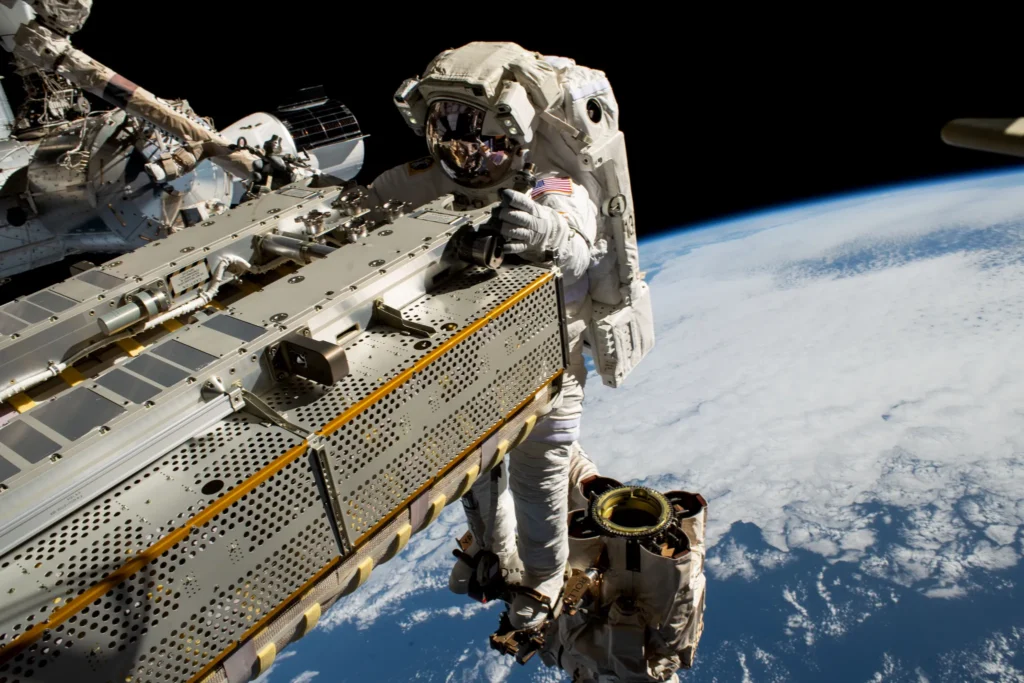
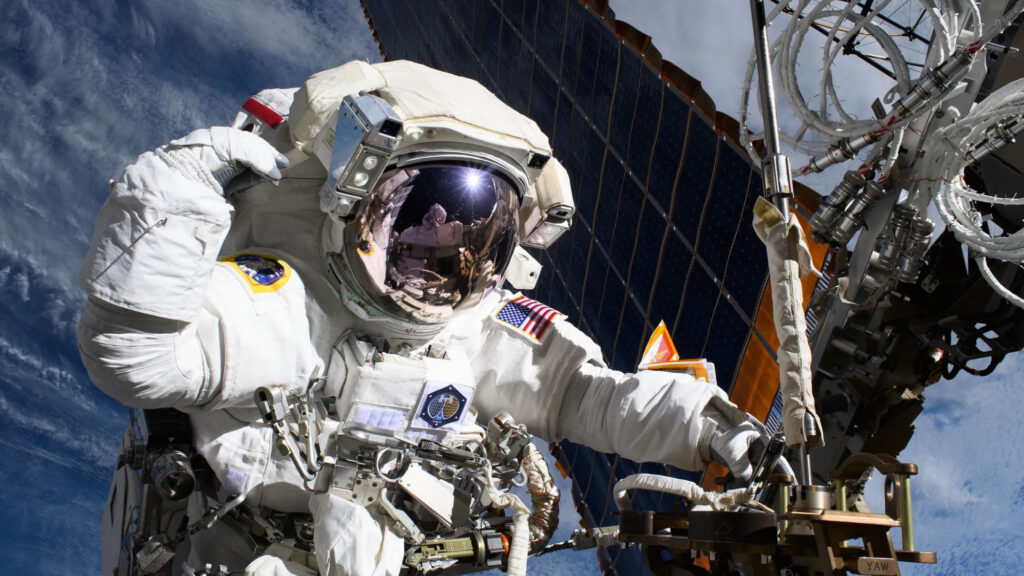
NASA also supports the International Space Station alongside multiple international partners. The ISS serves as a laboratory for scientific experiments and long-duration human spaceflight research.
Beyond human missions, NASA continues launching powerful telescopes, planetary probes, and Earth-monitoring satellites that help scientists better understand the universe and our changing planet.
The agency’s educational outreach programmes also inspire millions of students, amateur astronomers, and science enthusiasts worldwide.
Inspiring Humanity Beyond Earth
NASA represents far more than rockets and astronauts. It symbolises humanity’s curiosity, ambition, and desire to explore the unknown. Through decades of missions, discoveries, and scientific breakthroughs, NASA has helped expand our understanding of the universe while inspiring generations of scientists, engineers, and dreamers.
Whether studying distant galaxies, searching for signs of ancient life on Mars, or preparing for future lunar missions, NASA continues pushing the boundaries of exploration and discovery.
For anyone interested in astronomy, space science, or the future of humanity beyond Earth, learning about NASA is an exciting first step into one of the greatest adventures ever undertaken by humankind.

