Black holes are among the most extreme and fascinating objects in the universe. Formed through the collapse of massive stars or the merging of enormous quantities of matter, black holes generate gravitational fields so powerful that not even light can escape once it passes a critical boundary known as the event horizon.
For decades, black holes existed primarily as mathematical predictions derived from Albert Einstein’s theory of general relativity. Today, however, black holes are directly studied through advanced telescopes, gravitational wave observatories, X-ray astronomy, and radio imaging systems such as the Event Horizon Telescope.
Black holes do not function like cosmic vacuum cleaners that endlessly consume everything nearby. Instead, their gravitational influence behaves according to the same physical principles governing stars and planets. Objects can orbit black holes safely if they remain outside the event horizon.
Despite major scientific advances, black holes still represent one of the greatest unresolved challenges in modern astrophysics, especially regarding quantum mechanics, singularities, and the nature of spacetime itself.
How black holes form
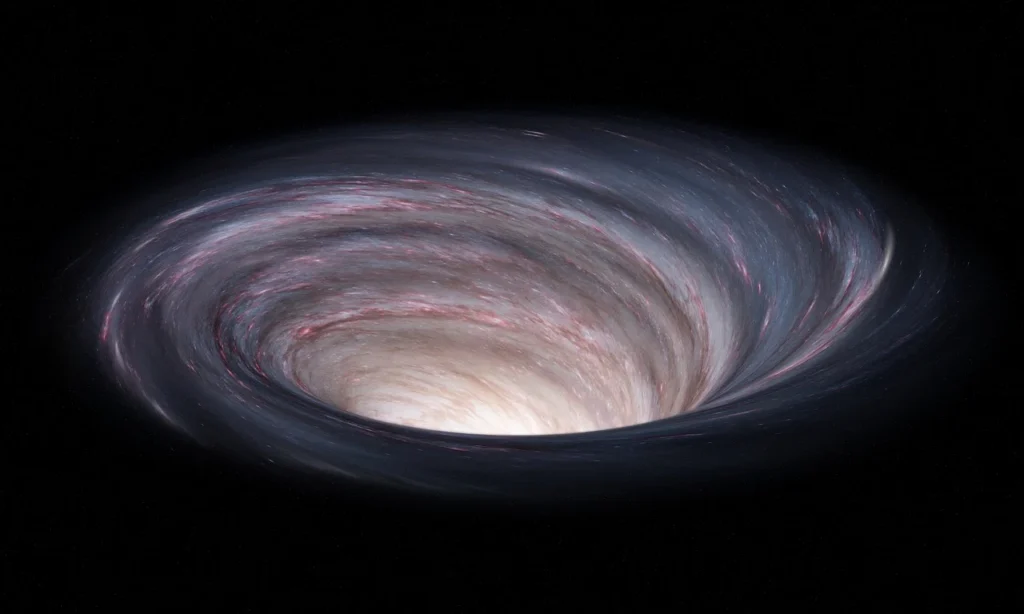
Most stellar black holes form when massive stars exhaust their nuclear fuel and undergo catastrophic gravitational collapse. During a supernova explosion, the outer layers of the star are violently expelled into space while the remaining core collapses inward under its own gravity.
If the remaining core contains sufficient mass, gravity overwhelms all known forces capable of resisting collapse. The matter becomes compressed into an extraordinarily dense region where spacetime curves dramatically.
Scientists classify black holes into several categories based on mass:
- Stellar black holes
- Intermediate-mass black holes
- Supermassive black holes
- Primordial black holes (hypothetical)
Supermassive black holes are particularly important in galactic astronomy. These enormous objects, often containing millions or billions of solar masses, exist at the centres of most large galaxies, including the Milky Way.
The supermassive black hole at the centre of our galaxy is known as Sagittarius A*, located approximately 26,000 light-years from Earth.
Event horizons, singularities, and spacetime distortion
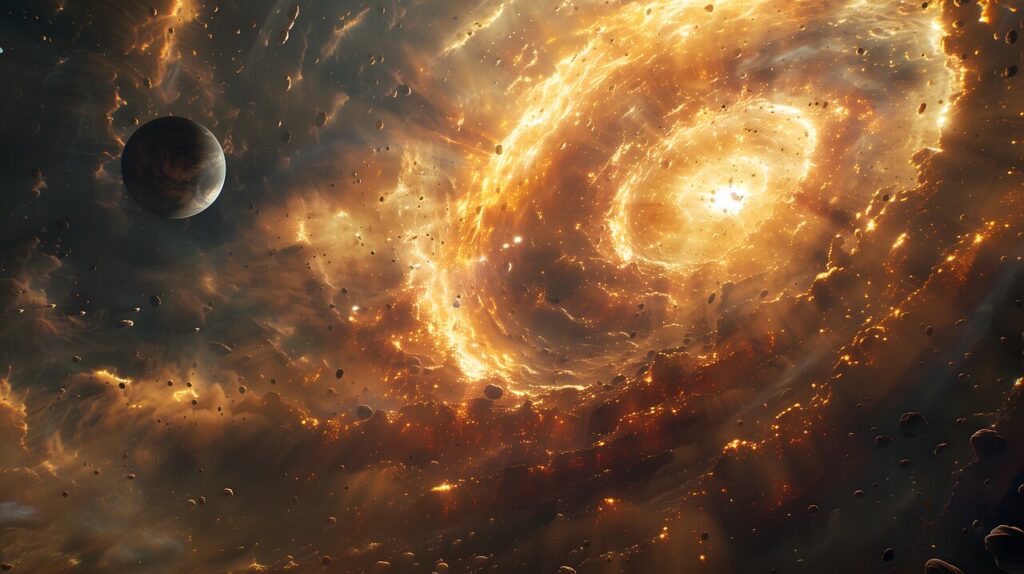
The defining boundary of a black hole is the event horizon. This region marks the distance at which escape velocity exceeds the speed of light. Once matter or radiation crosses the event horizon, it cannot return to the observable universe.
Beyond the event horizon lies the singularity, a theoretical point where density and spacetime curvature become effectively infinite according to general relativity. However, modern physics suggests that our current understanding breaks down under such extreme conditions.
One of the most remarkable aspects of black holes is their effect on spacetime itself. General relativity predicts that massive objects distort spacetime, but black holes warp it to extraordinary levels.
This distortion produces several important phenomena:
- Gravitational time dilation
- Light bending and gravitational lensing
- Accretion disk heating
- Relativistic jets
- Tidal forces near the event horizon
Time dilation near black holes becomes especially extreme. To a distant observer, time appears to slow dramatically for objects approaching the event horizon due to intense gravitational effects.
How scientists study black holes
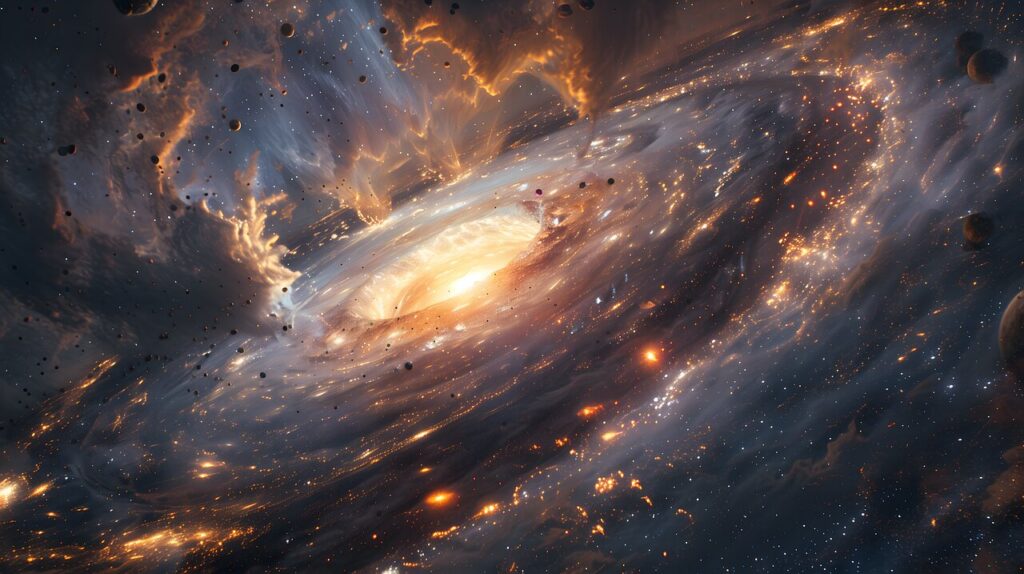
Black holes cannot be observed directly because they emit no visible light. Instead, astronomers detect black holes by studying their effects on surrounding matter and radiation.
One major observational method involves accretion disks. Gas and dust spiralling toward a black hole become heated to enormous temperatures through friction and gravitational compression, producing powerful X-ray emissions detectable by space telescopes.
Another breakthrough came through gravitational wave astronomy. Facilities such as LIGO and Virgo detect ripples in spacetime generated when black holes collide and merge. These observations confirmed major predictions of Einstein’s theory and opened an entirely new field of astrophysical research.
In 2019, the Event Horizon Telescope collaboration produced the first direct image of a black hole’s shadow surrounding the supermassive black hole in galaxy M87. This historic achievement provided some of the strongest observational evidence supporting black hole physics.
Modern university research continues exploring how black holes influence galaxy formation, dark matter distribution, high-energy particle acceleration, and the evolution of the early universe.
Black holes and the future of astrophysics
Black holes remain central to some of the most important unanswered questions in modern science. Physicists are still attempting to reconcile general relativity with quantum mechanics under the extreme conditions present inside black holes.
Theoretical concepts such as Hawking radiation suggest that black holes may slowly evaporate over immense timescales through quantum effects near the event horizon. If confirmed fully, these processes could reshape our understanding of information, entropy, and the long-term fate of the universe.
Future observatories and next-generation space telescopes will continue improving our ability to study black holes across multiple wavelengths and gravitational signals. These discoveries may eventually reveal how gravity behaves at quantum scales and whether singularities truly exist.
Black holes are no longer just theoretical curiosities hidden within equations. They are now recognised as fundamental components of cosmic evolution, influencing galaxies, spacetime, and some of the deepest mysteries in astrophysics.