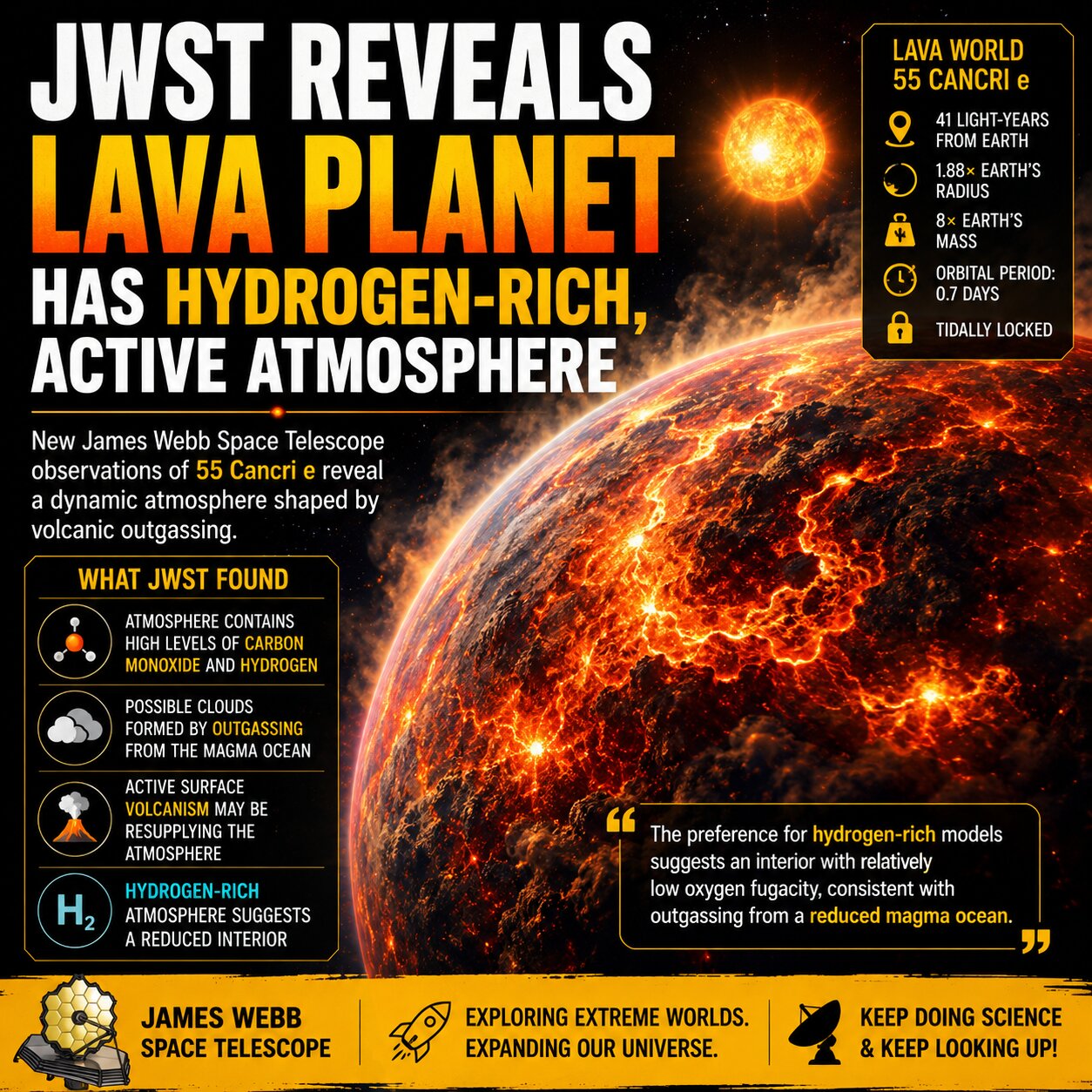

Astronomers have uncovered compelling new evidence that the famous lava exoplanet 55 Cancri e possesses a dynamic, hydrogen-rich atmosphere that may be actively interacting with its molten surface. Using observations from the James Webb Space Telescope (JWST), researchers have gained fresh insights into one of the most extreme worlds ever discovered, revealing a planet that may be far more complex than previously believed.
Located approximately 41 light-years from Earth, 55 Cancri e has long fascinated astronomers because of its extraordinary environment. Classified as a super-Earth, the planet is nearly twice Earth’s radius and about eight times more massive. It orbits its Sun-like star in less than a single Earth day, exposing its surface to temperatures hot enough to melt rock.
A World Of Fire And Molten Rock
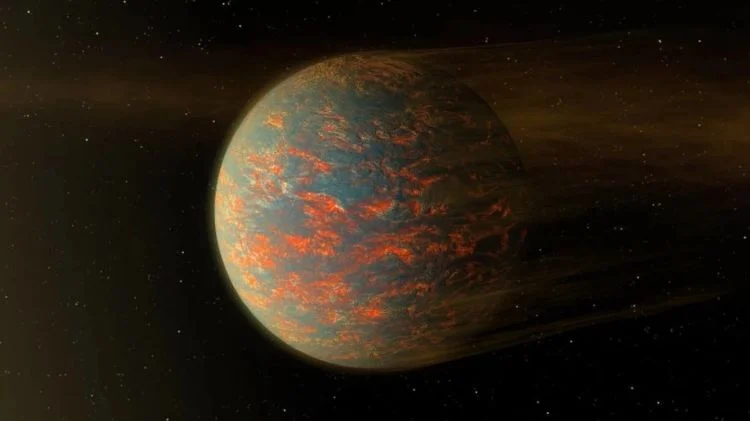
Unlike the rocky planets in our own Solar System, 55 Cancri e exists in conditions that push planetary science to its limits. The exoplanet is tidally locked, meaning one side permanently faces its host star while the opposite side remains in perpetual darkness.
This extreme proximity to its star has led scientists to conclude that portions of the planet’s surface are likely covered by vast oceans of molten rock. Temperatures on the day side are so intense that rock behaves much like liquid lava on Earth.
For years, astronomers have debated whether such a world could retain an atmosphere. The latest JWST observations suggest not only that an atmosphere exists, but that it may be actively changing over time.
Evidence Of A Hydrogen-Rich Atmosphere
Researchers analysed multiple eclipses of 55 Cancri e using JWST’s advanced instruments. Their findings indicate an atmosphere dominated by carbon monoxide, smaller amounts of carbon dioxide, and surprisingly large quantities of hydrogen.
The presence of hydrogen is particularly significant because it may reveal important clues about the planet’s interior composition. Scientists believe the atmosphere could be replenished by ongoing volcanic activity and outgassing from the molten surface below.
Variations observed during different eclipses may also suggest temporary cloud formation. These clouds could briefly cool portions of the surface before being dispersed by additional volcanic emissions and atmospheric circulation.
What Makes Lava Planets Unique?
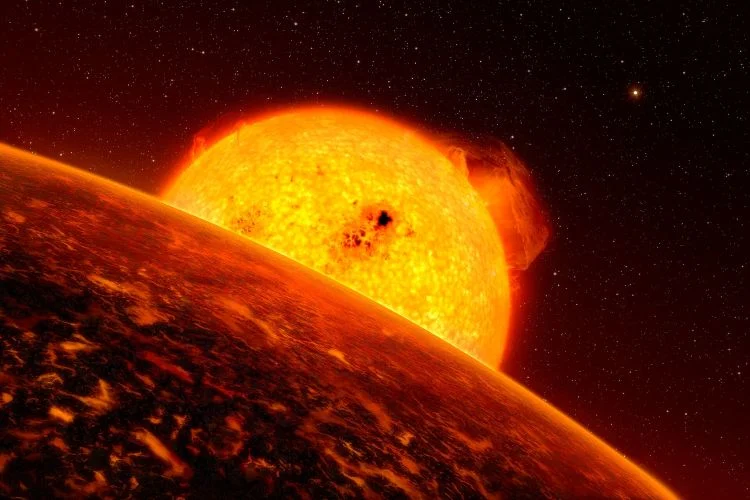
Lava planets represent one of the most extreme classes of exoplanets known to science. These worlds orbit so close to their stars that their surfaces partially or completely melt under relentless stellar heating.
Unlike Jupiter’s moon Io, where volcanism is driven primarily by tidal forces, lava planets such as 55 Cancri e experience volcanism due to intense temperatures generated by their nearby stars. The result is a landscape unlike anything found in our Solar System.
Several other lava planets have been identified in recent years, but 55 Cancri e remains one of the best-studied examples due to its relative proximity and favourable observing conditions.
Why This Discovery Matters
The new findings provide researchers with valuable information about how rocky planets evolve under extreme conditions. By studying worlds such as 55 Cancri e, astronomers can test theories about planetary formation, atmospheric chemistry, and geological activity beyond our Solar System.
Understanding how molten worlds interact with their atmospheres may also help scientists interpret observations of other rocky exoplanets discovered by future missions. Every new piece of data brings researchers closer to understanding the incredible diversity of planets that exist throughout our galaxy.
As the James Webb Space Telescope continues its mission, 55 Cancri e will likely remain a prime target for further study. The possibility of an active atmosphere above a molten surface demonstrates just how surprising and diverse the universe can be.