Scientists may have identified another important piece of one of solar physics’ longest-running mysteries: why the Sun’s outer atmosphere is dramatically hotter than its visible surface.
High-resolution observations from the Daniel K. Inouye Solar Telescope (DKIST) have revealed tiny vortex-like structures developing around concentrations of magnetic fields on the solar surface. Researchers believe these structures are produced by Kelvin-Helmholtz instability (KHI) and could contribute to the process that transports energy upwards into the Sun’s extremely hot corona.
The findings don’t necessarily solve the coronal heating problem on their own, but they reveal a previously difficult-to-observe mechanism that could continuously disturb and twist solar magnetic fields.
Why Is the Sun’s Corona So Hot?
The visible surface of the Sun, known as the photosphere, has a temperature of roughly 5,800 Kelvin. Travel farther away from the solar interior into the corona, however, and temperatures can exceed one million Kelvin.
At first glance, that seems backwards.
Scientists have consequently spent decades investigating how energy moves from the lower solar atmosphere into the corona.
Magnetic fields are widely believed to play a major role. The challenge has been understanding the small-scale processes continually feeding energy into those magnetic structures.
The latest observations suggest tiny vortices could be one of those processes.
What Is Kelvin-Helmholtz Instability?
Kelvin-Helmholtz instability occurs when neighbouring layers of fluid or gas move at different velocities.
The difference creates shear along their boundary, potentially producing distinctive swirling vortices.
This isn’t unique to the Sun.
Similar structures can appear in Earth’s atmosphere, particularly in unusual wave-like cloud formations. Kelvin-Helmholtz processes have also been observed in planetary atmospheres and around magnetospheres interacting with the solar wind.
On the Sun, however, these tiny vortices could have a much more energetic consequence.
Twisting the Sun’s Magnetic Fields
The Sun’s visible surface constantly bubbles through a process known as granulation. Hot plasma rises, cools and sinks again, creating an ever-changing landscape of convection cells.
DKIST’s extraordinary resolving power allowed researchers to examine what happens where this moving plasma encounters concentrated magnetic structures.
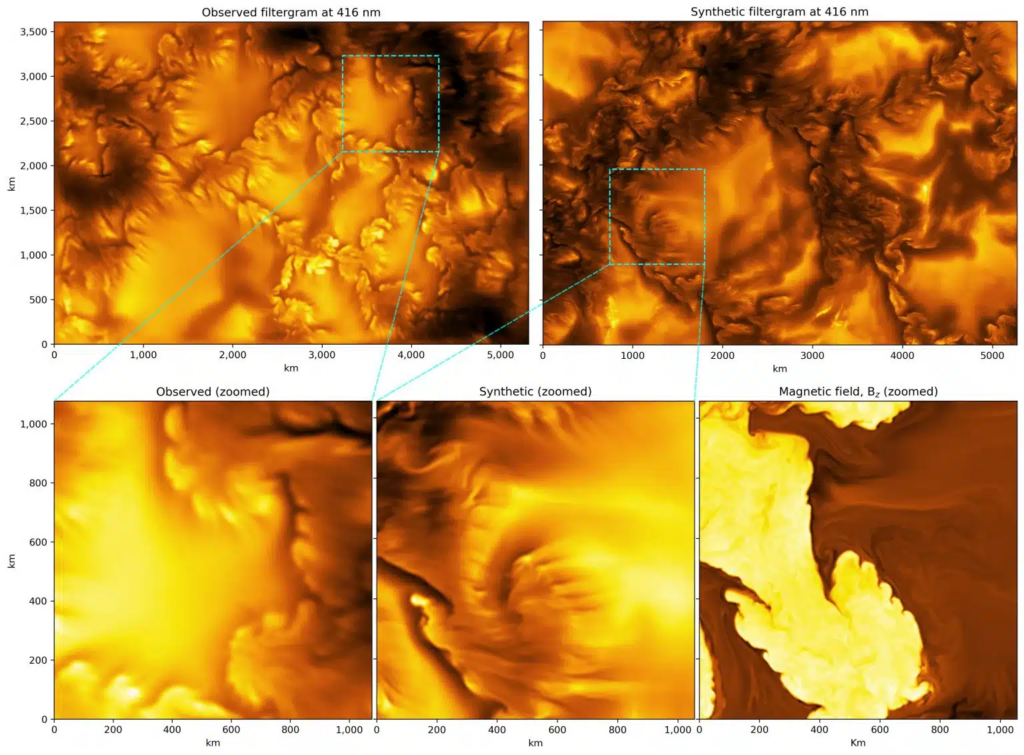
They discovered dozens of vortex-like features forming along their boundaries.
These vortices could continually bend and distort magnetic fields.
Over time, magnetic field lines can become increasingly twisted and braided together. Eventually, stressed magnetic structures may rearrange through magnetic reconnection, releasing stored energy.
That energy can then contribute to heating plasma higher in the solar atmosphere.
Observations Meet Computer Simulations
One particularly important aspect of the research was the comparison between actual DKIST observations and advanced computer simulations.
Researchers created simulated representations of the solar photosphere using magnetohydrodynamic models that combine the behaviour of electrically conducting plasma with magnetic fields.
The vortex structures appearing within those simulations closely resembled features detected by the telescope.
This agreement gives scientists greater confidence that they are seeing Kelvin-Helmholtz instability operating at extremely small scales on the real Sun rather than simply observing unrelated structures that happen to look similar.
A Constant Source of Magnetic Disturbance?
The potential importance of the discovery comes down to frequency.
Magnetic braiding requires continual movement to keep twisting and stressing magnetic fields. The Sun’s constantly moving surface provides plenty of energy, but researchers have been searching for the physical mechanisms capable of transferring that motion into magnetic structures.
Kelvin-Helmholtz vortices could provide one such mechanism.
If these tiny disturbances occur continuously across magnetic regions, they could repeatedly deform magnetic field boundaries and help sustain the chain of processes eventually releasing energy into the atmosphere.
Researchers will now need to determine exactly how much energy this mechanism can transport.
Why DKIST Makes a Difference
Located on Maui in Hawai’i, the four-metre Daniel K. Inouye Solar Telescope was specifically designed to reveal exceptionally small structures on the Sun.
That’s important because many processes responsible for large-scale solar behaviour begin at scales previous generations of telescopes couldn’t resolve clearly.
By combining increasingly detailed observations with sophisticated computer simulations, solar physicists can begin connecting these tiny processes with much larger phenomena.
Future DKIST observing campaigns should allow researchers to study the vortices in greater detail and estimate how much energy they contribute to heating the solar atmosphere.
Small Vortices Could Help Solve a Huge Solar Mystery
The Sun’s corona isn’t likely heated by one simple mechanism. Waves, magnetic reconnection and numerous interacting plasma processes may all contribute.
Kelvin-Helmholtz instability now appears to be another potentially important part of that system.
If these tiny vortices continually twist magnetic structures until stored energy is released, something occurring across incredibly small regions of the photosphere could ultimately help explain temperatures extending millions of kilometres into the Sun’s atmosphere.
And understanding those processes isn’t only about solving a solar mystery.
The same magnetic activity ultimately influences the solar environment surrounding Earth and the rest of the Solar System. Discovering how energy begins moving through the Sun’s atmosphere can therefore improve our broader understanding of the star that controls our local space environment.