


Supermassive black holes have a reputation for destruction, but new research suggests their influence extends much farther than the material disappearing beyond their event horizons. Powerful plasma jets launched from active supermassive black holes may reach hundreds of thousands of light-years into their surroundings, disrupting the gas galaxies need to produce future generations of stars.
The discovery could help astronomers understand a longstanding mystery: why do some massive galaxies stop forming stars even though enormous reservoirs of potential star-forming material surround them?
A study led by researchers Sanchayeeta Borthakur of Arizona State University (ASU) and Namrata Roy of the Raman Research Institute provides evidence that black hole jets may be part of the answer. The research was published in The Astrophysical Journal Letters. ASU News
How Does a Galaxy “Die”?
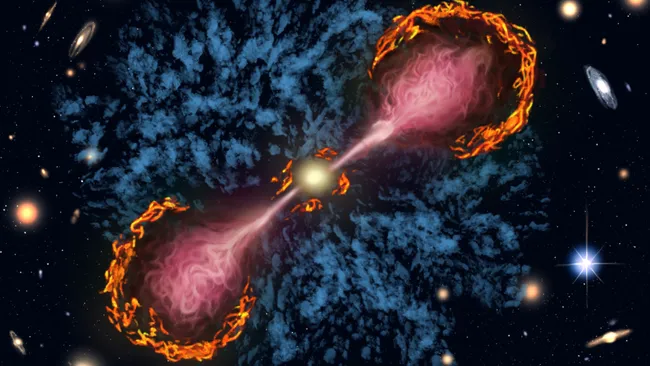
Calling a galaxy “dead” doesn’t mean its existing stars suddenly disappear.
Instead, astronomers generally use the term to describe galaxies where the formation of new stars has largely ceased. Stars form when sufficiently cool gas becomes dense enough to collapse, eventually producing new stellar systems.
Large galaxies are surrounded by vast reservoirs of gas called the circumgalactic medium, or CGM. This material extends far beyond the visible stars of a galaxy — potentially around 10 to 20 times farther than the visible galaxy itself. Some of that gas can cool, move inward and eventually provide fresh material for star formation. ASU News
That creates a puzzle.
If so much potential fuel exists around galaxies, why doesn’t it continue producing stars?
Something appears to prevent enough of the gas from cooling and collapsing.
The Murder Weapon: Enormous Plasma Jets
The new research points towards jets generated by actively feeding supermassive black holes.
Matter falling towards a black hole doesn’t necessarily disappear immediately. Material can form an accretion disc around the black hole, and the extreme environment can produce tremendous amounts of energy.
Some active galactic nuclei also generate enormous jets of plasma.
These narrow streams can travel far beyond the visible boundaries of their host galaxies, carrying energy from the comparatively tiny region surrounding a supermassive black hole into the enormous galactic environment.
The extraordinary difference in scale is part of what makes the discovery fascinating.
A supermassive black hole may occupy a region comparable with the scale of our Solar System while its host galaxy can contain around 100 billion similarly sized stellar systems.
Yet its influence can extend across an enormous portion of the surrounding galaxy and beyond.
DESI and LOFAR Reveal the Evidence
To investigate the effect, researchers combined observations from hundreds of galaxies containing active jets.
They used information gathered by the Dark Energy Spectroscopic Instrument (DESI) together with radio observations from the LOFAR Two-metre Sky Survey (LoTSS). ASU News
The researchers searched for H-alpha emission associated with ionised hydrogen along the directions travelled by the jets.
Something interesting appeared.
When observations were considered in all directions around the galaxies, the researchers didn’t detect a significant signal. When they specifically examined regions aligned with the plasma jets, however, a strong signal emerged.
This suggests the jets aren’t affecting the surrounding gas uniformly.
Instead, they’re leaving a directional fingerprint through the CGM.
Black Holes Can Reach Beyond Their Galaxies
The strongest effects appeared in two particularly interesting locations.
One was near the outer edge of the visible galaxy, where the jet begins interacting with the circumgalactic environment. Another appeared farther out, around the regions associated with the radio structures produced by the jets.
The observations indicate that energy from the jets can heat, ionise or otherwise disturb gas along their paths.
That’s important because cooler gas is necessary for forming stars.
If black hole activity keeps portions of the circumgalactic gas hot or disrupts its ability to cool and collapse, less material may eventually reach the galaxy and participate in star formation.
In other words, a supermassive black hole doesn’t need to destroy the stars already inside a galaxy to help determine its fate.
It can interfere with the supply needed to make new ones.
A Cosmic Influence Hundreds of Thousands of Light-Years Away
Perhaps the most extraordinary aspect of the research is simply the scale involved.
Roy explained that the influence of a black hole’s jet can extend hundreds of thousands of light-years into a galaxy’s outer environment.
That gives astronomers new observational evidence for a process known as AGN feedback, where energy produced by an active galactic nucleus influences the evolution of its host galaxy.
Astronomers have long suspected that supermassive black holes play an important role in regulating galaxies. The new observations provide a clearer indication of how some of that energy reaches the vast gas reservoirs surrounding them.
Importantly, the study doesn’t establish that every black hole jet permanently shuts down star formation throughout its galaxy. Rather, it provides evidence that jets can physically affect cool CGM gas at enormous distances and in preferred directions. T
Tiny Black Hole, Enormous Consequences
We tend to imagine black holes as cosmic monsters devouring everything unfortunate enough to venture too close.
Their real relationship with galaxies appears considerably more complicated.
A supermassive black hole sits at the heart of its host galaxy, yet the activity surrounding it can potentially influence material extending far beyond the galaxy’s visible stars.
That connection may ultimately help determine whether a galaxy continues producing new generations of stars or gradually becomes quiet.
The discovery therefore gives astronomers another important piece of the galaxy-evolution puzzle.
Supermassive black holes don’t merely consume matter.
Through their colossal plasma jets, they may help decide whether their galaxies continue creating stars at all.



Leave a Reply