Astronomers have captured a spectacular sight deep within the Cygnus constellation: a glowing ring of gas and dust that looks strikingly like a massive celestial diamond ring suspended in space. Located around 4,500 light-years from Earth, this luminous structure sits within the star-forming region known as Cygnus X, one of the most active stellar nurseries in our galaxy.
This breathtaking formation has quickly gained attention not only for its beauty, but also for the scientific insight it offers into how massive stars shape their environments through radiation, shockwaves and powerful stellar winds.
What Exactly Is the “Diamond Ring” in Cygnus?
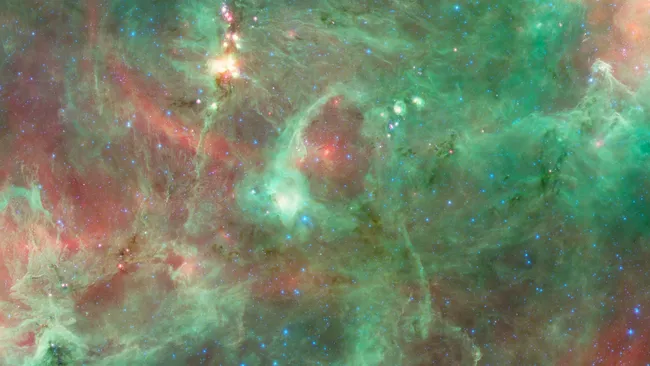
The structure consists of a bright, compact central source surrounded by an almost perfect circular arc of glowing gas, creating the appearance of a ring with a shining “gem” at its core. The illumination comes from energetic processes tied to young, massive stars embedded within the region, which emit intense ultraviolet radiation.
When this radiation collides with surrounding dust and gas, the material becomes energised and begins to glow. The result is a luminous loop that stands out clearly against the darker backdrop of the surrounding nebulae.
Inside Cygnus X: A Turbulent Stellar Nursery
Cygnus X is one of the richest star-forming complexes in the Milky Way, filled with dense clouds, protostars, molecular gas and powerful stellar clusters. It is home to regions where stars are born in rapid bursts, creating a chaotic mix of shock fronts, expanding shells and sculpted gas structures.
The “diamond ring” appears to be part of this ongoing drama. Astronomers believe it may have formed through a combination of stellar winds from massive stars, past supernova events or energetic outflows carving circular cavities into surrounding material. These processes can create bubble-like structures that glow brightly when illuminated from within.
Why This Observation Matters
Discoveries like this help astronomers understand how high-mass stars influence their surroundings. Massive stars may be rare, but they play an outsized role in shaping galactic ecosystems. Their radiation can both trigger new star formation and tear apart nearby clouds, halting it.
A structure as cleanly defined as this ring allows scientists to study:
- How radiation pressure sculpts interstellar material
- How shockwaves propagate through star-forming regions
- The relationship between nearby young stars and gas cavities
- The chemical and physical composition of the surrounding nebula
For the general astronomy enthusiast, it is also a powerful reminder of the beauty and complexity hidden inside familiar constellations.
How Astronomers Captured the Image
The glowing ring was revealed using infrared observations capable of cutting through the thick dust that normally obscures star-forming regions. Infrared wavelengths allow scientists to see structures invisible to optical telescopes, making them essential tools for studying stellar nurseries.
Infrared maps of Cygnus X often reveal intricate arcs, filaments and pockets of heated dust. The newly highlighted “diamond ring” is one of the most striking examples to emerge from recent observations.
News Source: Live Science
A Celestial Jewel in a Turbulent Region
The “diamond ring” in Cygnus offers both scientific intrigue and visual wonder. As telescopes continue to map the Milky Way’s most dynamic regions, more features like this will likely emerge — each revealing new clues about how stars shape the galaxy around them.
For now, this glowing cosmic ring stands as one of the most captivating snapshots of the week, reminding us just how much beauty lies hidden among the stars.