Planet Earth is the only known world in the universe that supports life, making it a remarkable and complex subject of study for astronomers, geologists and atmospheric scientists. From its protective atmosphere to its dynamic geology and ever-changing ecosystems, Earth stands out as a uniquely active planet.
Understanding how it formed, how it functions and how it evolves helps us not only appreciate our place in the solar system but also recognise the delicate balance required to sustain life.
Table of Contents
Quick Stats: Planet Earth
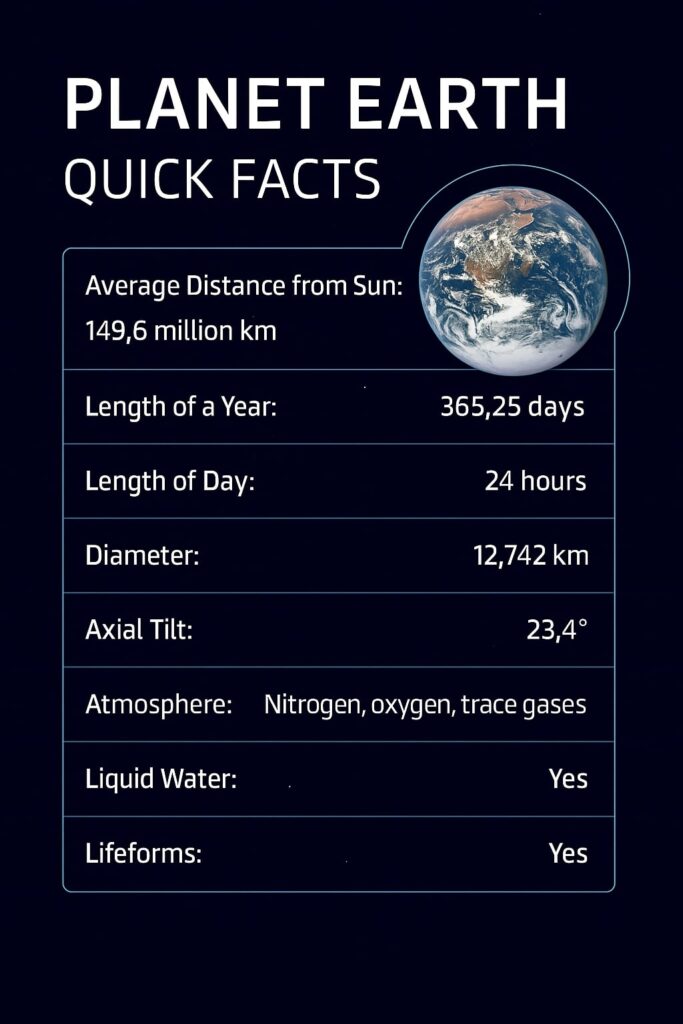
| Feature | Value |
|---|---|
| Distance from the Sun | 149.6 million km |
| Length of a Year | 365.25 days |
| Length of a Day | 24 hours |
| Diameter | 12,742 km |
| Moons | 1 (The Moon) |
| Average Surface Temperature | 14°C (global average) |
| Atmosphere | Nitrogen, oxygen, trace gases |
| Liquid Water | Yes |
| Lifeforms | Yes |
| Axial Tilt | 23.5° |
| Rotation Direction | West to East (prograde) |
| Surface Gravity | 9.8 m/s² |
| Core Composition | Iron–nickel alloy |
| Crust Composition | Silicate-based rocks |
| Magnetic Field | Strong, internally generated |
| Orbital Speed | 29.8 km/s |
| Estimated Age | 4.54 billion years |
Earth’s Position in the Solar System
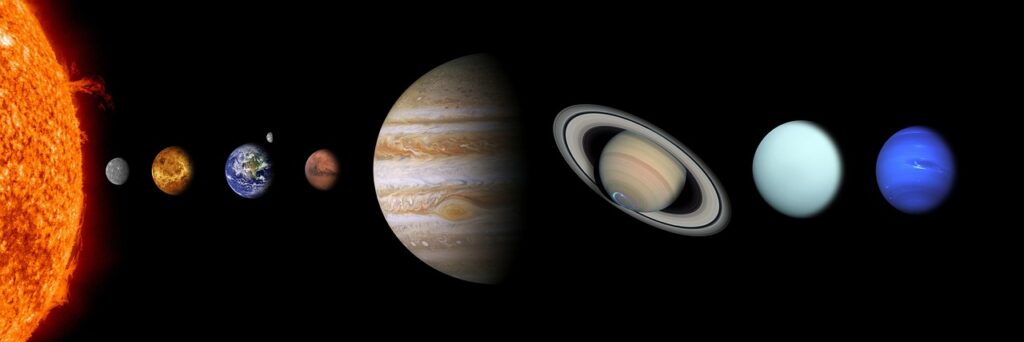
Planet Earth is the third planet from the Sun between Venus and Mars, placed within the region known as the habitable zone. This is the distance at which temperatures allow liquid water to exist on a planet’s surface. Earth orbits at just the right position for water to remain stable, neither boiling away nor freezing permanently.
Earth completes one orbit around the Sun in roughly 365 days. Its orbital speed of about 29.8 km per second helps maintain this comfortable distance, while its slightly elliptical orbit contributes to the natural variation of seasons.
The Moon plays a vital stabilising role. Its gravitational influence reduces variations in Earth’s axial tilt, preventing chaotic climate swings and helping create tides that support life along coastal regions.
Surface Features: Continents, Oceans and Dynamic Landscapes
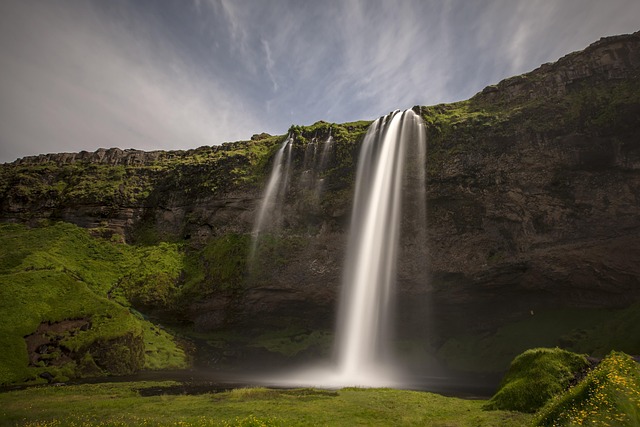
Planet Earth’s surface is incredibly diverse. About 71 percent of the planet is covered in water, with oceans acting as heat regulators and oxygen producers. Plate tectonics constantly reshape the continents. Mountains rise and erode, volcanoes build new land, and earthquakes shift entire regions.
Key surface features include:
- Seven continents with varied terrains
- Deep ocean trenches such as the Mariana Trench
- Massive mountain ranges like the Himalayas
- Active volcanoes that recycle materials from the mantle
- Deserts, forests, polar regions and rainforests
- Shifting tectonic plates responsible for earthquakes and volcanoes
Planet Earth is the only terrestrial planet with active plate tectonics. This process helps regulate carbon dioxide levels over geological timescales, stabilising long-term climate and creating the nutrient cycles essential for life.
A Living Atmosphere: Protection and Climate Regulation
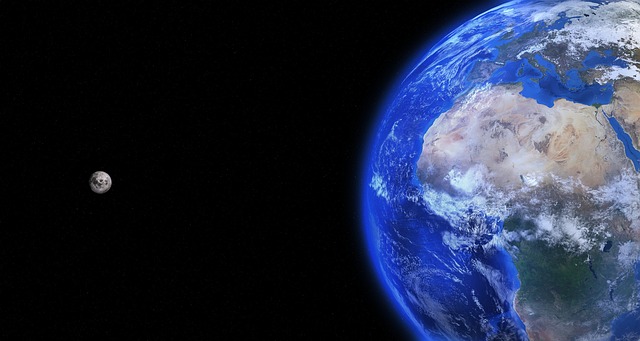
Earth’s atmosphere is a protective blanket of gases. Nitrogen and oxygen dominate, with carbon dioxide, methane and other trace gases playing important roles in temperature control.
The atmosphere serves several essential functions:
- Shields from harmful radiation by absorbing UV rays in the ozone layer
- Regulates global temperatures through the natural greenhouse effect
- Supports weather systems that distribute heat and moisture
- Allows complex life to breathe through oxygen-rich composition
Clouds, storms and winds create a constantly changing environment. Unlike Venus’s toxic clouds or Mars’s thin, dust-filled air, Planet Earth has a balanced atmosphere capable of supporting ecosystems ranging from tropical jungles to frozen tundra.
Inside Earth: Layers That Shape Our Planet
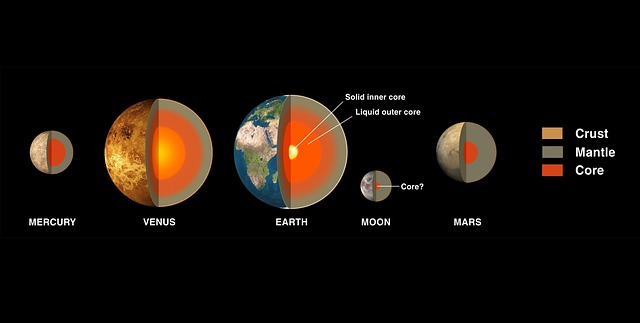
Beneath Planet Earth’s surface lies a dynamic and layered interior:
- Crust: Thin outer shell of solid rock.
- Mantle: Hot, slow-moving rock that drives plate tectonics.
- Outer Core: A molten layer of iron and nickel that generates Earth’s magnetic field.
- Inner Core: A solid sphere of iron under extreme pressure.
The magnetic field created by the outer core extends far into space, forming the magnetosphere. This invisible shield protects Earth from solar radiation and solar wind, preventing the atmosphere from being stripped away. Without this magnetic field, Earth’s surface could end up as barren as Mars.
Earth’s Water: Oceans, Ice and the Hydrological Cycle
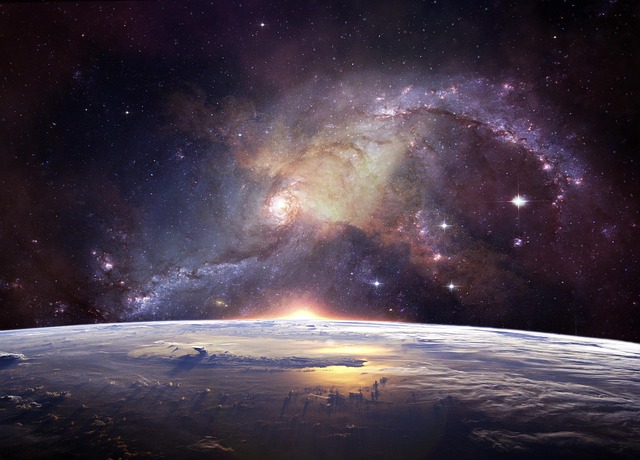
One of Planet Earth’s defining features is the presence of abundant liquid water. No other planet in the solar system has oceans that span thousands of kilometres or water cycling naturally through evaporation, condensation and precipitation.
Earth’s water exists in three main forms:
- Liquid in oceans, lakes and rivers
- Solid as ice caps, glaciers and snow
- Gas as atmospheric vapour
The hydrological cycle supports weather, stabilises temperatures and sustains life.
Exploring Earth: From Ancient Observations to Modern Satellites
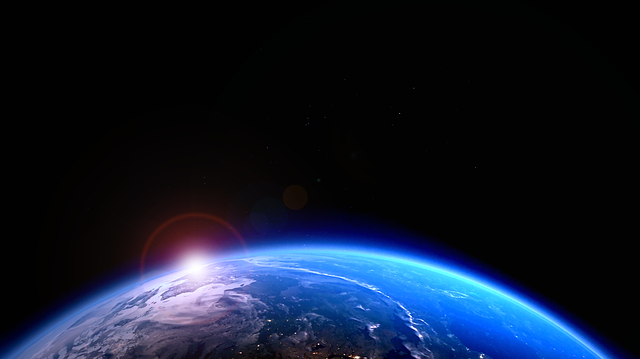
Humans have studied Earth since ancient times, but today’s tools allow us to observe the planet in incredible detail. Modern Earth science includes:
- Weather satellites monitoring storms and climate patterns
- Earth-observing missions tracking sea levels and land changes
- Seismographs mapping Earth’s internal structure
- Ocean buoys measuring currents and temperatures
- High-resolution imaging from the ISS and other spacecraft
Key space-based Earth missions include NASA’s Terra, Aqua, Landsat series, ESA’s Sentinel satellites and Japan’s Himawari weather satellites.
These technologies help scientists study climate change, natural disasters, biodiversity and atmospheric shifts.
Why Planet Earth Remains One of Astronomy’s Greatest Subjects
Earth is not simply our home. It is a benchmark for understanding life-bearing worlds. By studying Earth’s climate, geology and atmosphere, scientists can compare other planets and identify whether they might be capable of supporting life.
Earth shows that life requires:
- Liquid water
- A stable atmosphere
- A protective magnetic field
- Moderate temperatures
- Chemical diversity
These criteria guide the search for habitable exoplanets.
As we learn more about other worlds, Earth continues to stand out as an extraordinary, complex and precious planet.