Astronomers have released a new Hubble Space Telescope image of N159, a vast star-forming cloud located in the Large Magellanic Cloud. Spanning more than 150 light-years, this glowing region is filled with dense gas, young stars and powerful shockwaves that shape its dramatic appearance. Stellar nurseries like N159 offer a rare window into the chaotic and beautiful environments where stars are born, and Hubble’s latest snapshot brings this cosmic landscape into sharper focus than ever before.
Where N159 Lives in the Universe
N159 lies in the Large Magellanic Cloud, a satellite galaxy orbiting the Milky Way about 160,000 light-years away. This galaxy is packed with active star-forming regions, and N159 is one of its most energetic. Because the Large Magellanic Cloud is relatively close by, Hubble’s instruments can capture intricate details of the gas clouds, dust filaments and bright young stars that fill this region.
A Turbulent Birthplace for New Stars
Stellar nurseries are crowded environments where stars form from collapsing clouds of gas and dust. In N159, massive young stars pump out intense radiation and stellar winds, carving out cavities, shock fronts and glowing arcs. These forces compress surrounding material, triggering new waves of star formation. This feedback cycle creates the chaotic beauty visible in Hubble’s latest image.
The result is a landscape filled with glowing gas, sculpted ridges and knots where gravity is pulling material together to create new stars.
Why Hubble’s View Matters
Hubble’s powerful imaging capabilities reveal the fine structure of N159 in exquisite detail. By studying these features, astronomers can better understand:
- How massive stars influence their environment
- How turbulence affects star formation
- How stellar feedback shapes the evolution of galaxies
The clarity of Hubble’s image provides a rare opportunity to observe the different stages of early star life in one place, from dense gas clouds to fully formed, radiant young stars.
A Closer Look at the Colourful Cloudscape
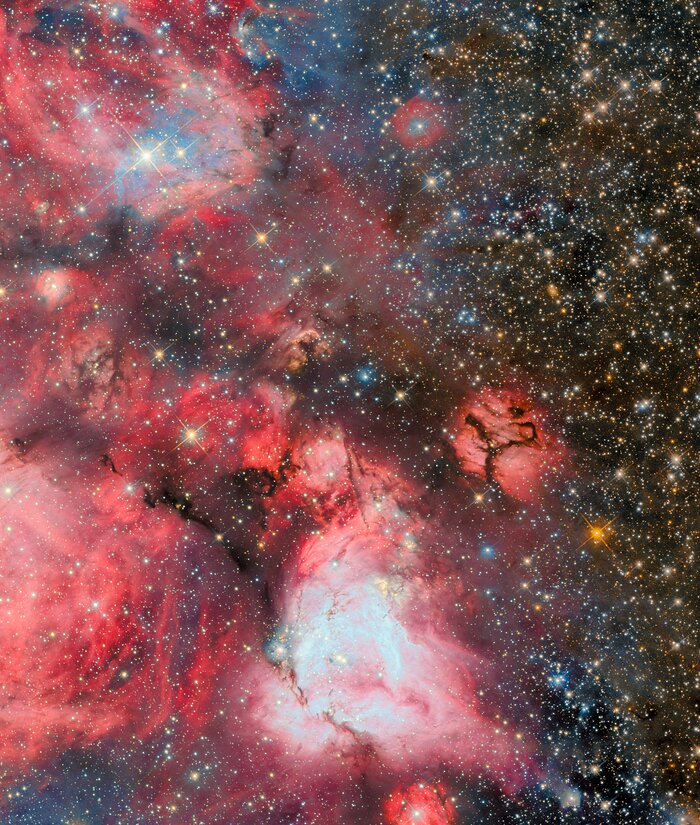
Different colours in the image represent different types of ionised gas.
- Red regions mark areas rich in hydrogen, lit up by nearby stars
- Blue and green areas indicate oxygen and other excited elements
- Dark patches show thick dust clouds that block visible light
This colour coding helps scientists map the temperature, composition and activity levels within N159. It also gives the image its vibrant, almost painterly appearance.
What N159 Reveals About Star Formation
Observing N159 gives researchers a clearer picture of how stars form in clusters and how they interact with their surroundings. The presence of both vast empty cavities and bright, dense cores shows how star formation unfolds in waves. Large stars form first, then their energy sculpts the environment, triggering smaller generations of stars nearby.
These processes play a huge role in shaping galaxies over billions of years, and regions like N159 serve as natural laboratories for studying them.
News and image source: ESA Hubble
A Cosmic Window Into the Earliest Stages of Star Life
Hubble’s new snapshot of N159 offers an extraordinary look at the forces and structures that shape star formation in our universe. From glowing ionised gas to clusters of newborn stars, this stellar nursery demonstrates how dynamic and complex these regions truly are. As astronomers continue to analyse the details captured in this image, N159 will help deepen our understanding of how stars form, evolve and influence the galaxies that contain them.