Over the past few days, space agencies have been closely monitoring a surge in solar storm activity, as the Sun enters a more active phase of its current solar cycle. Observations from NASA and other international space weather centres have confirmed several powerful solar flares and associated eruptions, prompting renewed discussion around how space weather affects Earth.
While solar storms are a natural part of the Sun’s behaviour, periods of heightened activity can have noticeable effects on modern technology and, in rare cases, everyday life on Earth.
What is a solar storm?
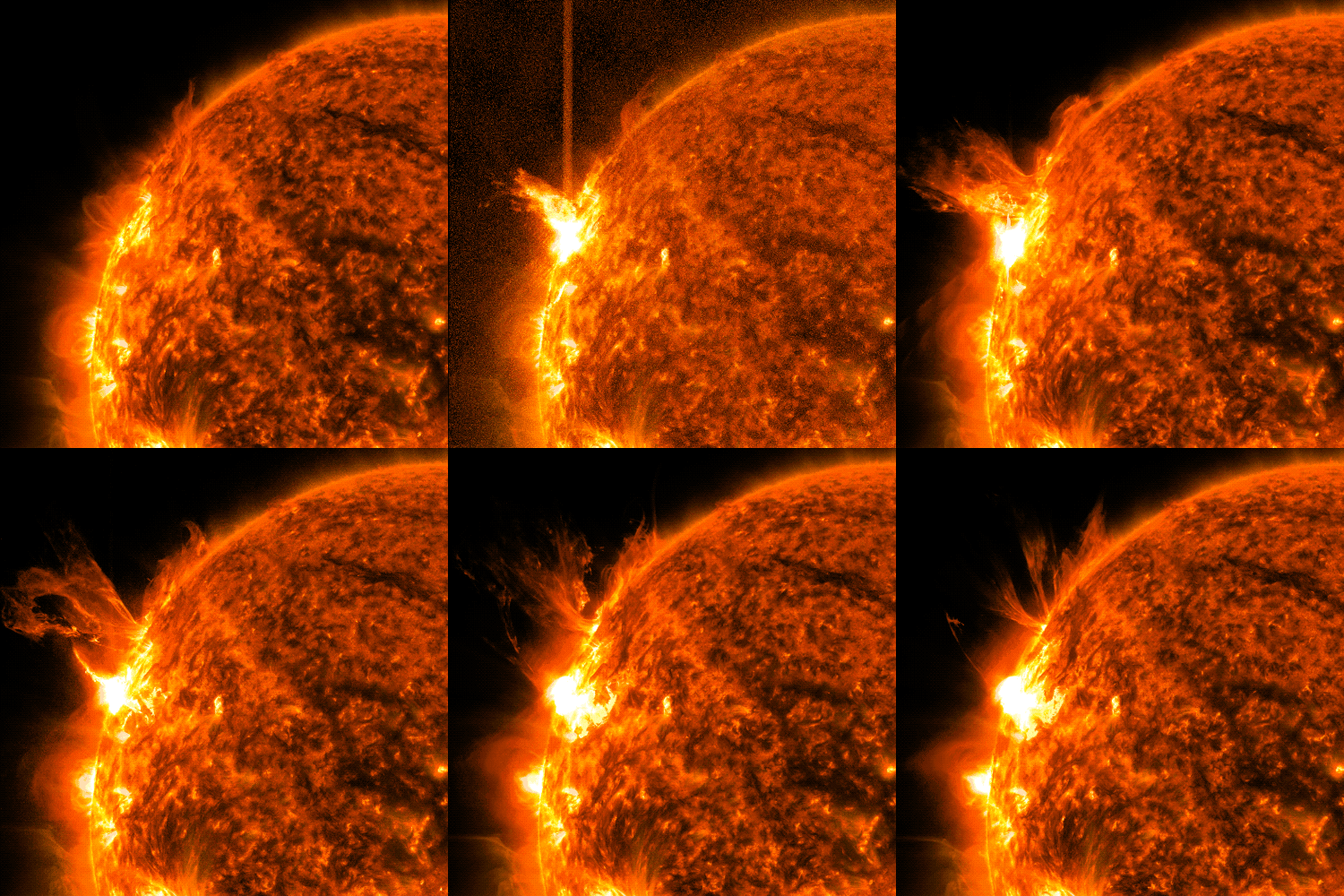
A solar storm occurs when the Sun releases large bursts of energy in the form of solar flares or coronal mass ejections, often referred to as CMEs. These events send streams of charged particles and magnetic fields racing through space at millions of kilometres per hour.
When these particles reach Earth, they interact with our planet’s magnetic field. This interaction can trigger geomagnetic storms, which vary in strength depending on the size, speed, and magnetic orientation of the solar eruption.
Recent observations show that several strong flares have erupted from active regions on the Sun’s surface, with some directed toward Earth, increasing the likelihood of short-term space weather effects.
Why scientists are paying close attention right now
The Sun follows an approximately 11-year activity cycle, moving between quieter and more active phases. We are currently approaching solar maximum, the period when sunspots, flares, and solar storms become more frequent.
During this phase, clusters of sunspots can produce repeated flares over days or weeks. Space weather forecasters have noted that the recent activity fits this pattern, with multiple eruptions originating from the same active solar regions.
Although most solar storms are moderate, scientists track them closely because even smaller events can disrupt sensitive systems in space and on the ground.
How solar storms can affect Earth
When a solar storm reaches Earth, its effects depend on intensity. Mild geomagnetic storms may go completely unnoticed by most people, while stronger ones can cause temporary disruptions.
Possible impacts include interference with satellite communications, GPS accuracy issues, and disruptions to high-frequency radio signals used by aviation and maritime services. Power grids can also experience fluctuations during severe geomagnetic storms, although modern infrastructure is designed to reduce these risks.
One of the more visible effects of solar storms is the aurora. Increased solar activity can push auroras farther from the poles, sometimes making them visible at lower latitudes than usual.
Are solar storms dangerous to people?
For people on the ground, solar storms pose very little direct risk. Earth’s atmosphere and magnetic field provide strong protection against harmful solar radiation.
Astronauts aboard the International Space Station and satellites in orbit are more vulnerable, which is why space agencies carefully monitor solar activity. Airlines also track space weather, as strong storms can affect polar flight routes and onboard communication systems.
In most cases, the effects of solar storms are temporary and managed through early warnings and operational adjustments.
How space weather is monitored
Solar storms are detected using a combination of space-based observatories and ground-based monitoring systems. Satellites continuously observe the Sun, tracking sunspots, flare intensity, and particle emissions.
When a significant eruption is detected, space weather agencies issue alerts and forecasts, estimating when solar particles may reach Earth and how strong the impact could be. This early warning system allows satellite operators, power companies, and aviation services to take precautionary measures if needed.
Recent alerts related to current solar activity are part of this routine monitoring process, reflecting increased vigilance rather than immediate danger.
What to expect in the coming months
As solar activity continues to rise, periods of increased space weather alerts are expected to become more common. Most events will remain minor to moderate, but occasional stronger storms are possible as solar maximum approaches.
For skywatchers, this can be an exciting time, as heightened solar activity increases the chances of vivid auroral displays. For scientists, it offers valuable opportunities to study how solar energy interacts with Earth’s magnetic environment.
Solar storms are a reminder that Earth exists within a dynamic solar system, constantly shaped by the activity of our nearest star.
A normal but fascinating phase of solar activity
The recent solar storms highlight a natural and well-understood aspect of solar behaviour. While they can briefly affect technology and space-based systems, they are closely monitored and rarely cause serious disruption.
As the Sun grows more active in the coming years, space weather alerts will become a regular feature of astronomy news. For now, they serve as both a scientific curiosity and a reminder of the powerful forces at work just beyond our planet.