
A spectacular new image released by the European Southern Observatory captures the Milky Way glowing above Chile’s Paranal Observatory, pierced by powerful green laser beams creating artificial “guide stars” in the night sky.
The image, taken by astrophotographer Alexis Trigo and released on February 9, 2026, showcases one of the most advanced ground-based observatories on Earth using cutting-edge adaptive optics to sharpen our view of the universe.
Lasers, Mirrors and the Milky Way
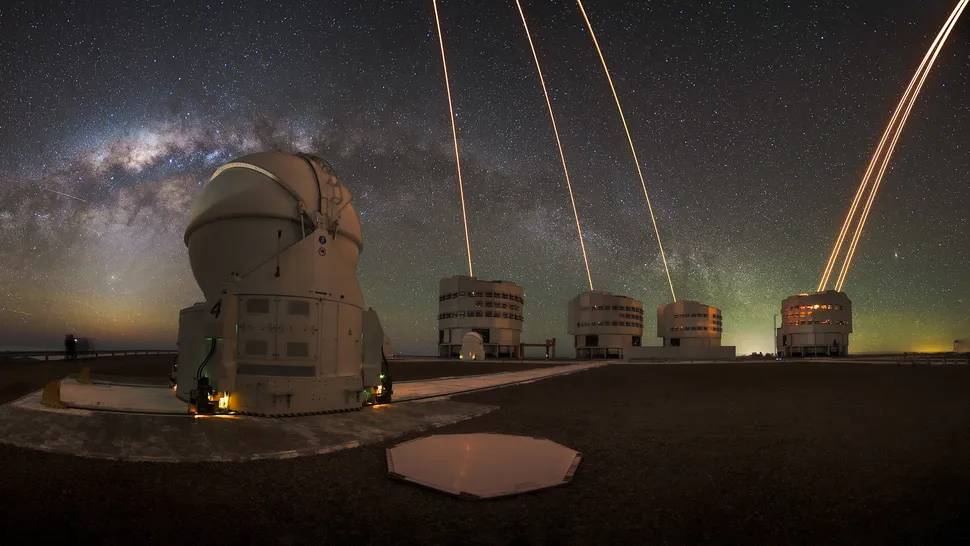
The photograph features the four 8.2-metre Unit Telescopes of the Very Large Telescope (VLT), standing beneath the sweeping arc of the Milky Way. These telescopes, named Antu, Kueyen, Yepun and Melipal, can operate independently or together as a single powerful interferometric system.
Each Unit Telescope houses a massive primary mirror capable of studying distant exoplanets, nebulae, galaxies and deep-space phenomena in remarkable detail. In the foreground sits a smaller 1.8-metre auxiliary telescope, which can move along rails to enhance the VLT’s combined light-gathering ability.
What makes this image particularly dramatic are the bright laser beams shooting skyward from UT-4 (Melipal). These are not decorative effects. They are essential scientific tools.
News source: Space.com
Why Astronomers Create Artificial Stars
The lasers fired from Melipal travel approximately 90 kilometres into Earth’s upper atmosphere. There, they strike a layer of sodium atoms, causing them to glow and create artificial “guide stars”.
These guide stars are tracked by adaptive optics systems mounted on the telescope mirrors. Earth’s atmosphere constantly distorts incoming starlight, causing the familiar twinkling effect we see with the naked eye. While beautiful, this distortion blurs astronomical observations.
By analysing how the artificial stars shimmer and shift, the telescope can rapidly adjust its mirrors in real time to compensate for atmospheric turbulence. The result is dramatically sharper images, approaching the clarity of space-based observatories.
Melipal has used guide star lasers since 2016. In December 2025, the remaining three Unit Telescopes were upgraded with their own laser systems to enhance the capabilities of the Very Large Telescope Interferometer and its advanced GRAVITY+ instrument suite.
A Veteran Observatory, Now Sharper Than Ever
With all four Unit Telescopes now equipped with laser guide star systems, the VLT has significantly improved its atmospheric correction capabilities. This upgrade strengthens its role in exoplanet detection, black hole research, and deep-universe observation.
Ground-based astronomy continues to evolve rapidly. While space telescopes capture headlines, facilities like the VLT demonstrate how innovation on Earth can rival orbital observatories in clarity and precision.
The image is more than a stunning nightscape. It represents the intersection of engineering, physics, and human curiosity — lasers turning the sky itself into a calibration tool.
Turning Earth’s Atmosphere Into an Ally
The Paranal Observatory lasers remind us that even the limitations of our planet can become advantages with the right technology. By creating artificial stars, astronomers effectively transform atmospheric distortion into measurable data.
For casual stargazers, the photo is a breathtaking reminder of how much effort goes into capturing those crisp cosmic images we admire. For scientists, it marks another step forward in refining our window into the universe.
And for anyone looking up at the Milky Way, it is proof that sometimes the stars we see are not just ancient suns, but carefully engineered beacons guiding our search for knowledge.