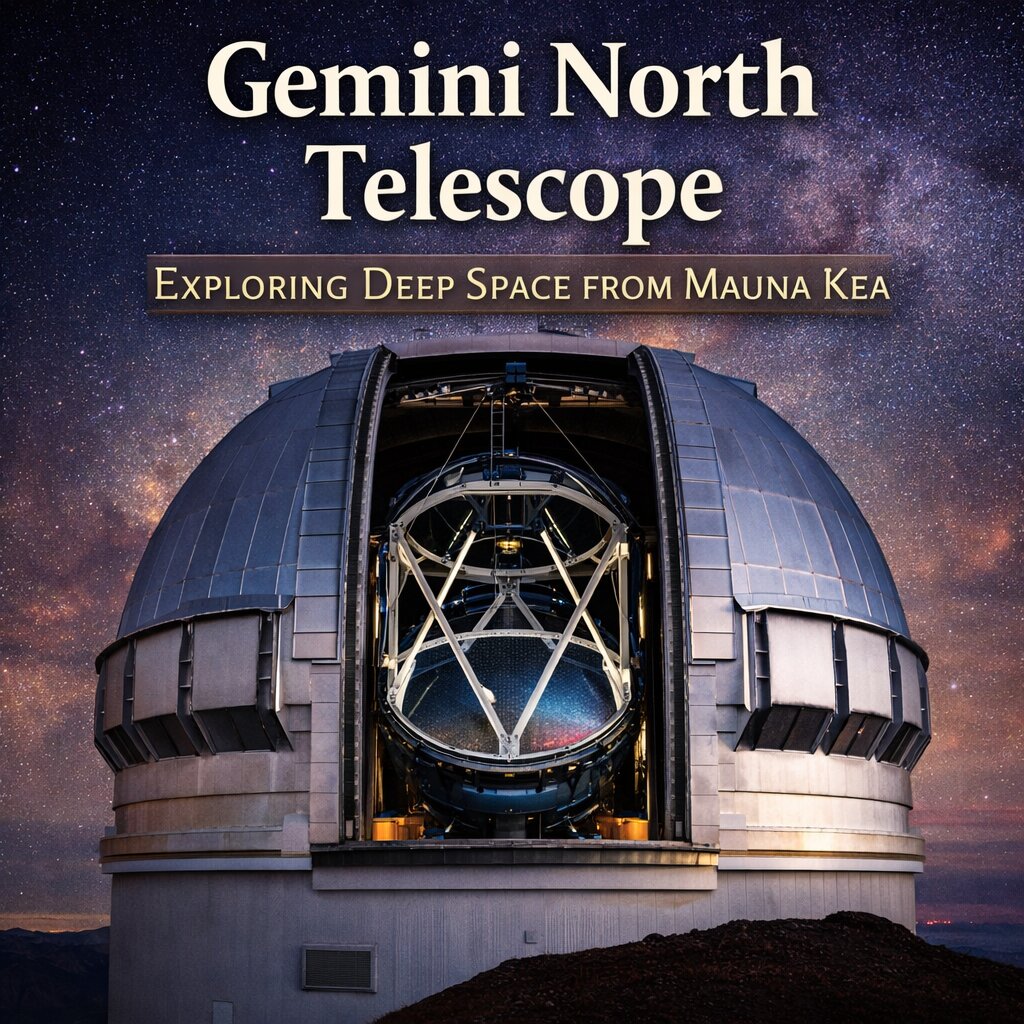

The Gemini North Telescope is one of the world’s most powerful optical and infrared observatories. Operated as part of the international Gemini Observatory, it allows astronomers to study everything from nearby planets to distant galaxies billions of light-years away.
Designed for precision imaging and spectroscopy, Gemini North plays a crucial role in modern astronomy, particularly in time-sensitive observations such as supernovae, exoplanets, and gravitational-wave follow-ups.
What is the Gemini North Telescope?
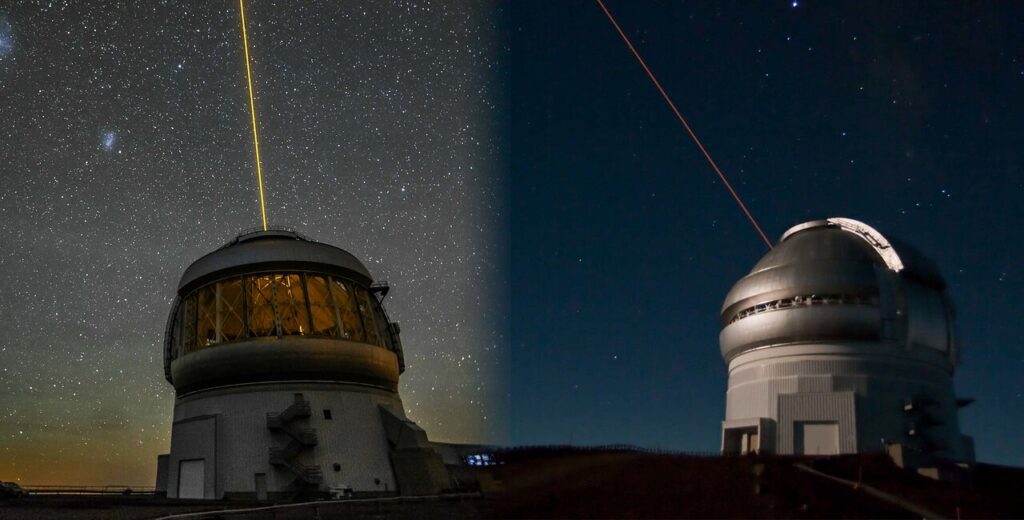
The Gemini North Telescope is an 8.1-metre optical/infrared telescope equipped with advanced adaptive optics systems that correct for atmospheric distortion in real time. This allows it to produce images with clarity comparable to, and sometimes exceeding, space-based observatories.
Gemini North Telescope’s large primary mirror collects vast amounts of light, enabling astronomers to observe extremely faint and distant objects. The telescope operates across visible and infrared wavelengths, making it especially valuable for studying:
- Star formation regions hidden by dust
- Exoplanet atmospheres
- Active galactic nuclei
- Supermassive black holes
- Early-universe galaxies
Where is Gemini North Located?
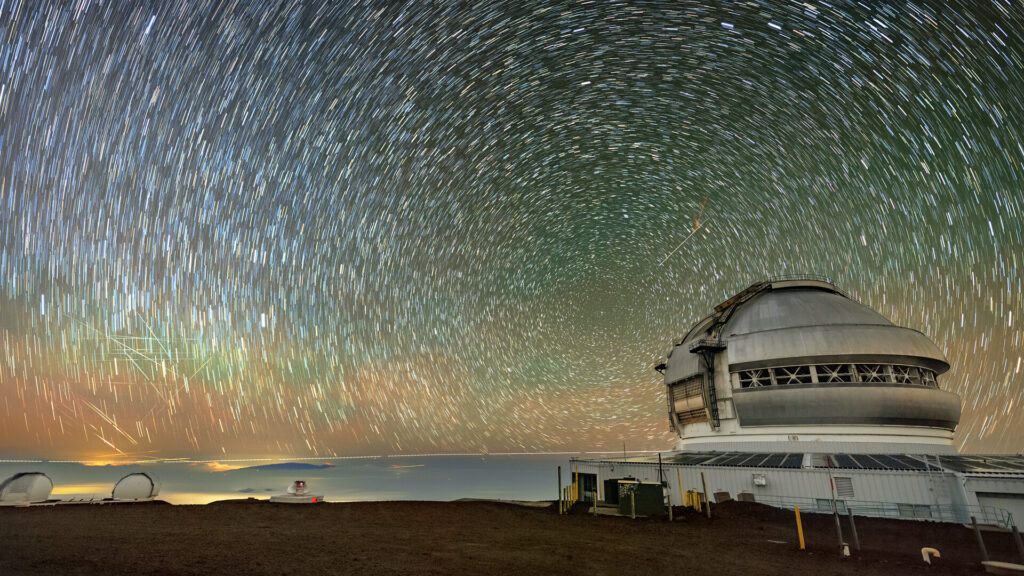
The Gemini North Telescope is situated on the summit of Mauna Kea in Hawai‘i at an altitude of approximately 4,200 metres above sea level.
Mauna Kea is one of the premier astronomical sites in the world due to:
- Extremely dry air
- Stable atmospheric conditions
- Minimal light pollution
- High elevation above much of Earth’s atmospheric water vapour
These conditions are especially important for infrared observations, where atmospheric moisture can interfere with data collection.
History and Development

The Gemini Observatory project was conceived in the late 20th century as a partnership between multiple countries to provide world-class observing capabilities in both hemispheres.
Gemini North achieved first light in 1999. Its southern counterpart, Gemini South Telescope, is located in Chile, allowing near-complete coverage of the night sky between the two facilities.
Over the years, Gemini North has undergone multiple instrument upgrades, including improvements in adaptive optics, spectrographs, and high-resolution imaging systems. These enhancements have kept it at the forefront of astronomical research.
Important Discoveries and Contributions
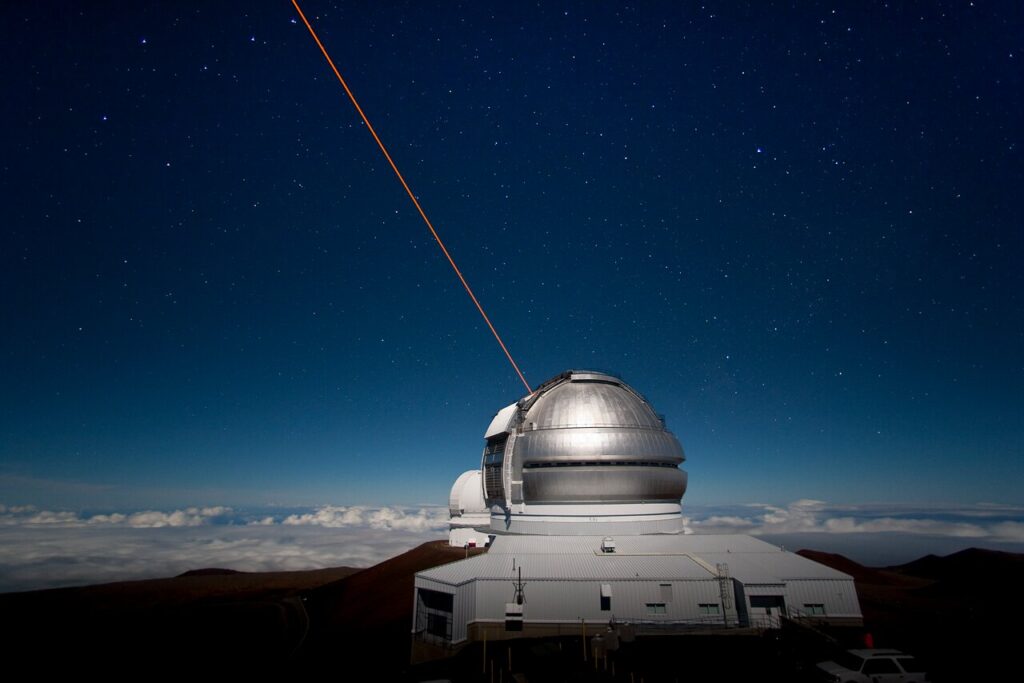
The Gemini North Telescope has contributed to numerous high-impact discoveries, including:
Exoplanet Research
Gemini has captured direct images of exoplanets and studied their atmospheric composition using infrared spectroscopy. These observations help scientists understand planetary formation and habitability.
Supermassive Black Holes
It has provided detailed measurements of black holes at the centres of distant galaxies, helping refine models of galaxy evolution.
Gravitational Wave Follow-Ups
After detections by facilities such as LIGO, Gemini North has played a key role in identifying optical counterparts to gravitational-wave events, including neutron star mergers.
Early Universe Galaxies
Its deep-field infrared imaging has allowed astronomers to observe galaxies from the early universe, shedding light on cosmic evolution.
Why Gemini North Still Matters
Even in the era of space telescopes like James Webb Space Telescope, ground-based observatories remain essential. Gemini North offers:
- Flexible scheduling for rapid-response events
- Instrument upgrades over time
- Complementary wavelength coverage
- High-resolution spectroscopy not always available from space
As astronomy moves into an era of multi-messenger observation — combining light, gravitational waves, and other signals — Gemini North continues to play a critical supporting and discovery role.