
For decades, astronomers believed they understood the basic blueprint of planetary systems. Rocky planets form close to their stars. Gas giants form farther away. Our own solar system follows this rule almost perfectly.
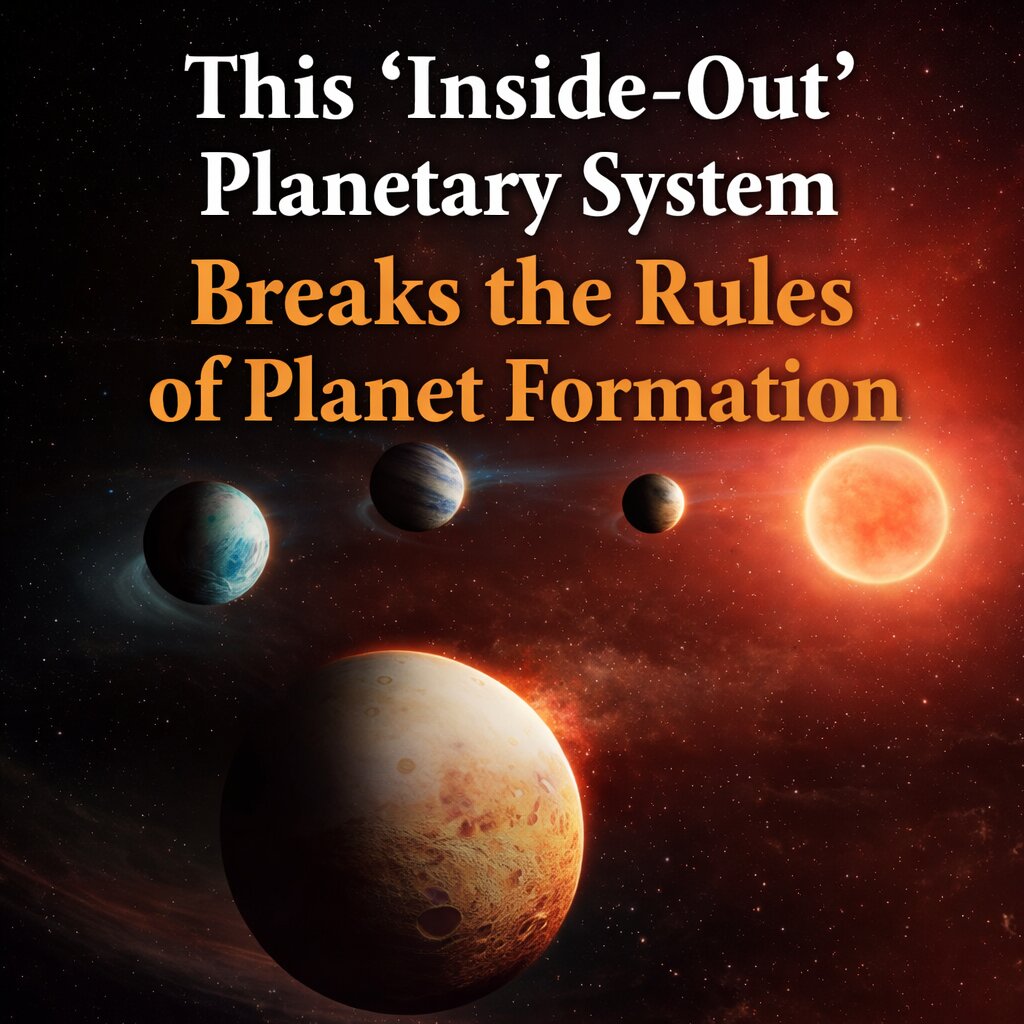
But a newly studied planetary system orbiting the small red star LHS 1903 appears to flip that structure inside out. Instead of a neat rocky-to-gas arrangement, scientists have found something far stranger: a rocky world sitting beyond gas giants.
And that should not happen.
A Familiar Pattern… At First
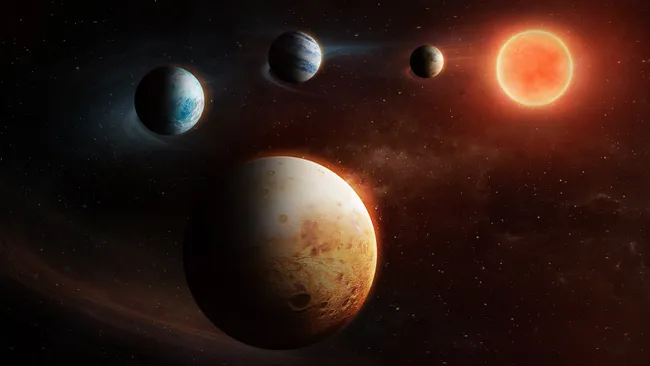
LHS 1903 is a cool M-dwarf star, much smaller and dimmer than our Sun. Using space- and ground-based telescopes, astronomers discovered four planets orbiting this faint red star.
The first three planets seemed to follow the usual cosmic rulebook:
- The innermost planet is rocky.
- The next two are gas giants.
That layout matches what astronomers expect to see across the Milky Way.
But then came the fourth planet.
The Planet That Shouldn’t Exist
Using the CHEOPS telescope from the European Space Agency, researchers took a closer look at the outermost planet.
Instead of another gas giant, they found something small and dense.
Likely rocky.
That means the system’s structure is:
Rocky – Gaseous – Gaseous – Rocky
This arrangement is extremely rare. Rocky planets are not supposed to form that far from their star. Traditional planet formation models suggest that intense stellar radiation near a star strips away light gases, leaving rocky cores behind. Farther out, cooler conditions allow gas giants to form.
Yet here we are.
News Source: Space.com
How Could This Happen?
Astronomers considered several explanations.
Could the planets have swapped positions through gravitational interactions?
Could the outer rocky planet have lost its atmosphere in a catastrophic collision?
After analysing the system, researchers ruled out these scenarios.
Instead, they propose something more intriguing: inside-out planet formation.
Inside-Out Planet Formation Explained
In this model, planets form one by one starting near the star and gradually moving outward.
Each planet that forms sweeps up surrounding dust and gas. By the time outer planets begin forming, much of the gas may already be gone.
In the case of LHS 1903, scientists believe the fourth planet formed in a gas-depleted environment. There simply was not enough hydrogen and helium left to build a gas giant.
So instead, it became a small, dense rocky world.
That would make this system one of the clearest examples yet of inside-out planetary formation in action.
Why This Matters
Planet formation has long been explained using fairly structured models. But systems like LHS 1903 remind us that the universe does not always follow simple patterns.
If rocky planets can form far beyond gas giants, then planetary architecture may be far more diverse than we thought.
This discovery suggests:
- Planet formation environments vary more than expected
- Gas availability plays a critical long-term role
- Some systems may evolve in completely different sequences
And if that is true, then there may be many more “rule-breaking” systems waiting to be discovered.
A Universe That Refuses to Be Simple
The study, published in Science, shows that even our most trusted cosmic assumptions can be overturned.
Every time astronomers think they have identified a universal rule, the universe seems to respond with something strange, rare, and wonderfully disruptive.
The inside-out system around LHS 1903 is not just unusual.
It is a reminder that planetary systems are more creative than we imagined.
And that is exactly why astronomy never gets boring. 🌌