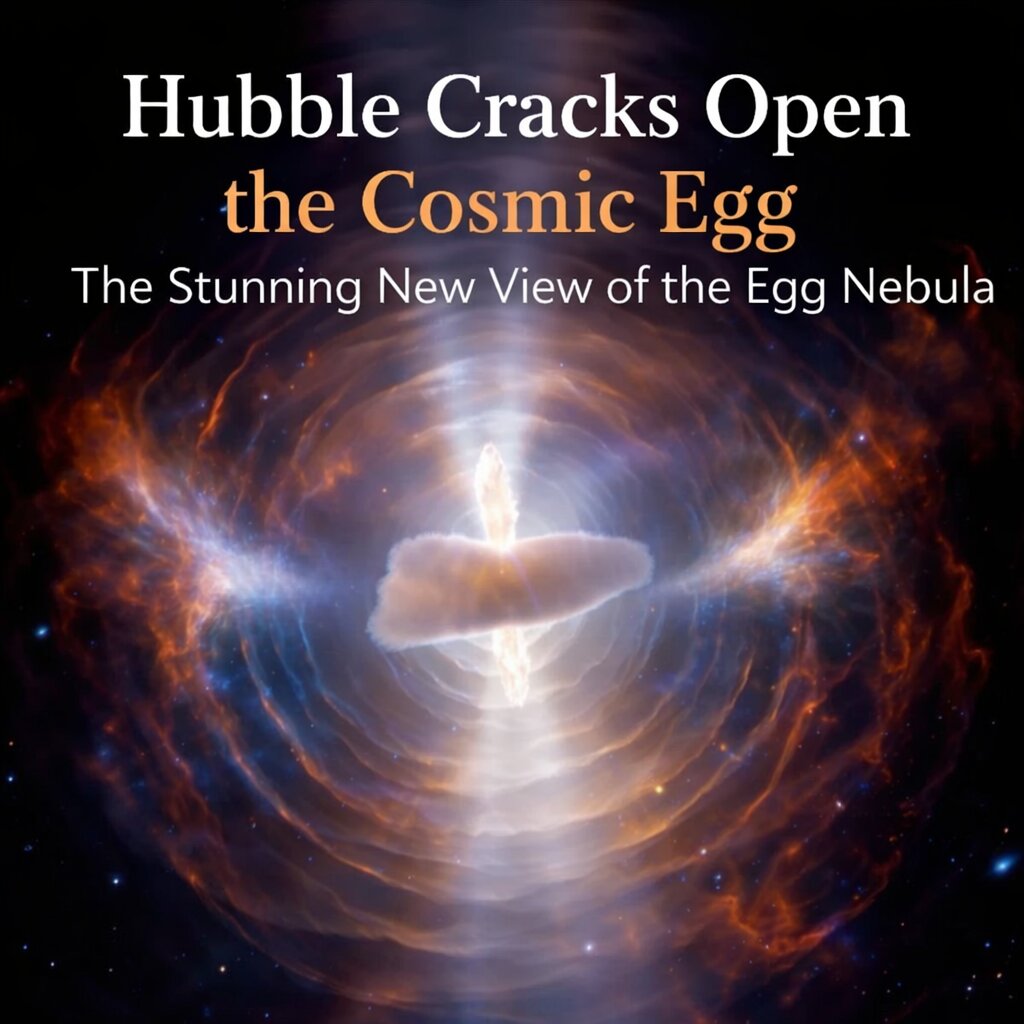

A thousand light-years away, a dying star is putting on one of the most beautiful light shows in the galaxy.
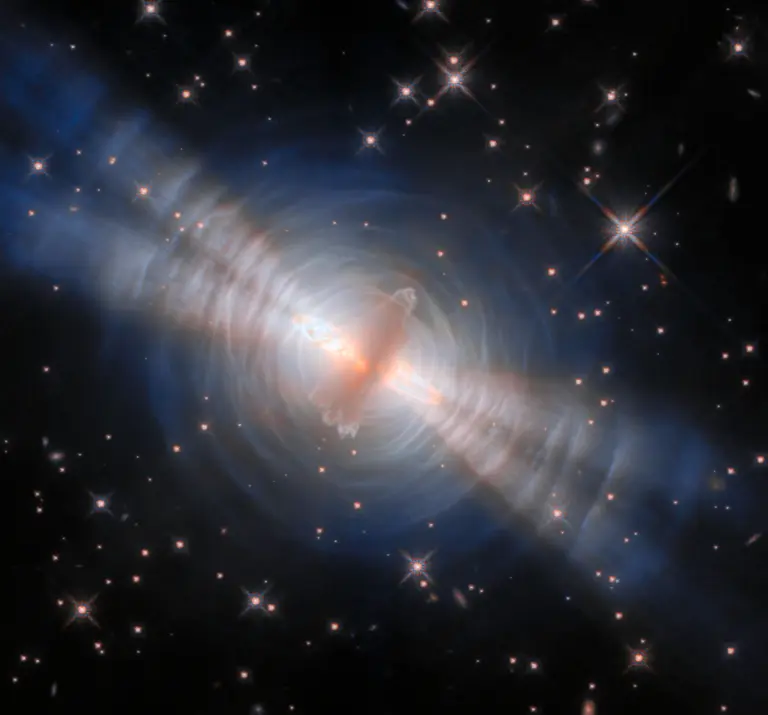
The Hubble Space Telescope has delivered the clearest image yet of the Egg Nebula, revealing intricate arcs, glowing lobes, and a central star hidden behind a dense cocoon of dust. Located in the constellation Cygnus, this extraordinary object offers astronomers a rare window into one of the most mysterious phases of stellar evolution.
And despite its dramatic appearance, this is not a supernova.
What Is the Egg Nebula?
The Egg Nebula is a pre-planetary nebula, a short-lived transitional phase between a red giant star and a fully formed planetary nebula.
At its centre lies a rapidly dying star, completely obscured by a thick cloud of dust. The name “Egg Nebula” comes from its visual structure: the central star acts like a hidden yolk, wrapped inside an opaque shell of gas and dust. Surrounding this core are luminous blue and orange arcs created as light from the star scatters through the dusty envelope.
At approximately 1,000 light-years from Earth, it is the closest known pre-planetary nebula, making it an invaluable laboratory for studying late-stage stellar evolution.
Why This New Hubble Image Matters
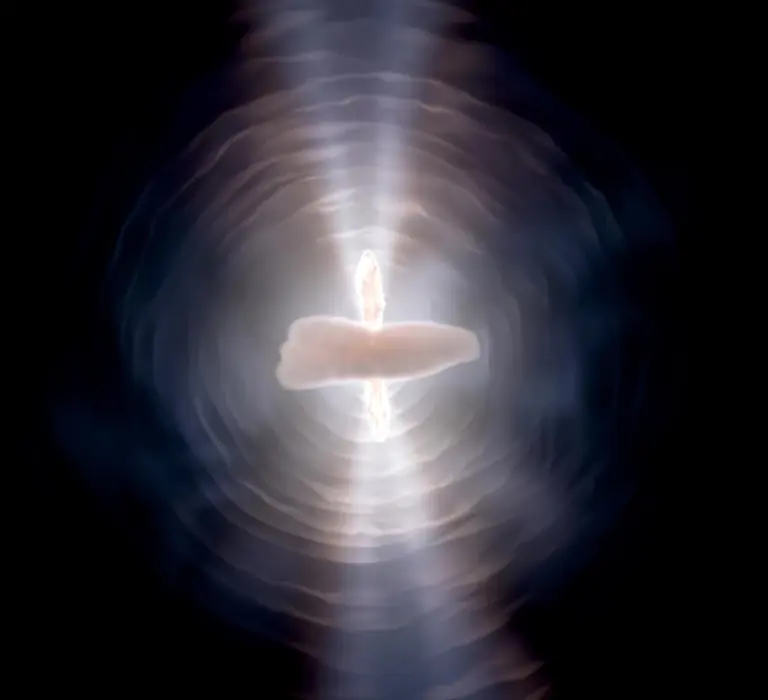
While the Egg Nebula has been studied before, this latest image combines earlier 2012 observations with new data to produce the most detailed view ever captured.
The improved clarity reveals symmetrical patterns that are surprisingly orderly. These arcs and lobes are far too structured to be the result of a violent stellar explosion.
Instead, scientists believe the shapes are produced by a coordinated series of mass ejections from the carbon-rich core of the dying star. These “sputtering” events release material in pulses, gradually sculpting the surrounding dust into the layered, glowing patterns we now see.
This challenges older assumptions that chaotic stellar death is always explosive.
Not a Supernova, But Something More Subtle
When massive stars die, they explode in brilliant supernovae. But the star at the heart of the Egg Nebula is taking a quieter, more intricate path.
Rather than detonating, it is shedding its outer layers gradually. Light escapes through thinner regions in the dust cloud, illuminating cavities and creating beams that carve through the surrounding gas.
This interplay of light and shadow produces the striking symmetrical arcs visible in Hubble’s image. It is a reminder that cosmic transformation does not always come through violence. Sometimes it unfolds through rhythm and structure.
A Rare Window Into Stellar Evolution
Pre-planetary nebulae exist for only a few thousand years — a blink in cosmic time. Catching one at this stage, and so relatively close to Earth, is extraordinarily valuable.
The Egg Nebula allows astronomers to test models of how stars like our Sun will eventually end their lives. Billions of years from now, our own star will expand into a red giant, shed its outer layers, and form a planetary nebula.
What we see in Cygnus today may resemble our distant solar future.
News Source: New York Post
The Beauty of a Star in Transition
The Egg Nebula is more than a striking image. It is a moment frozen in transition.
It shows us that stellar death is not always catastrophic. It can be layered, symmetrical, and unexpectedly graceful. The glowing arcs and dusty cocoon are not signs of destruction alone, but of transformation.
Through Hubble’s lens, we are reminded that even in its final stages, a star can create something breathtaking.
The universe does not simply end things. It reshapes them.