The James Webb Space Telescope has captured a striking new view of one of the largest and most productive star-forming regions in our galaxy: the Sagittarius B2 molecular cloud. The image, released in late 2025, showcases an enormous and chemically rich cloud of gas and dust glowing in vivid shades of pink, purple, and red.
Located roughly 26,000 light-years from Earth in the constellation Sagittarius, this immense cloud sits close to the Milky Way’s crowded and energetic galactic centre. Despite occupying only a small fraction of the region’s total gas supply, Sagittarius B2 is responsible for producing around half of the stars forming near the galaxy’s core — a puzzle astronomers are still trying to solve.
A stellar factory hidden behind cosmic dust
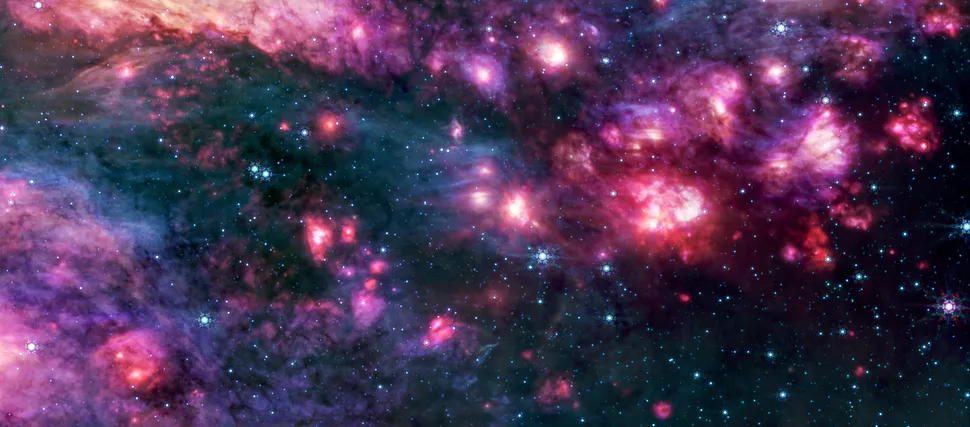
Stars are born inside molecular clouds, dense regions filled with cold gas and dust. Sagittarius B2 is one of the largest known examples, stretching nearly 150 light-years across and containing up to ten million times the mass of the Sun.
Using Webb’s Mid-Infrared Instrument (MIRI), astronomers were able to peer through thick dust that normally blocks visible light. In this mid-infrared view, warmer dust glows brightly, revealing clumps and filaments where new stars are forming. Darker patches in the image are not empty space but dense dust regions where light is absorbed before it can reach the telescope.
Why Webb sees what other telescopes cannot
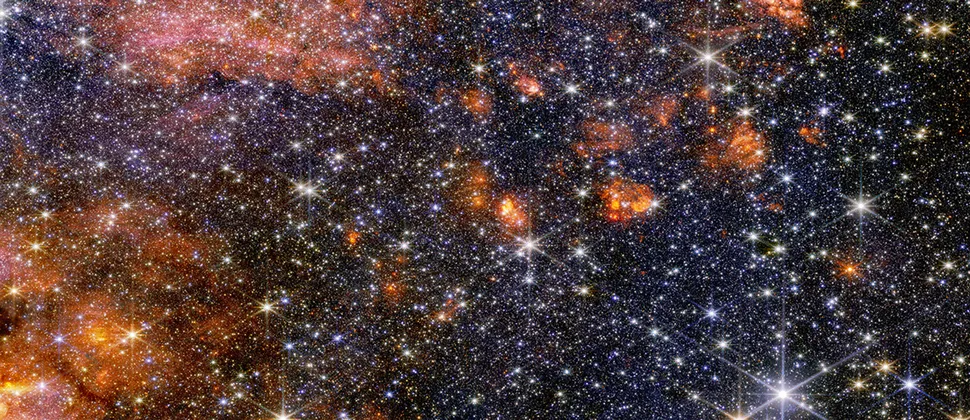
The James Webb Space Telescope observes the universe primarily in infrared light, allowing it to detect heat signatures rather than visible light alone. This capability is crucial when studying star-forming regions like Sagittarius B2, where thick dust clouds hide activity from traditional telescopes.
A second image of the same region, taken in near-infrared light, reveals countless stars scattered throughout the cloud. By comparing the two views, astronomers can distinguish between dense gas structures, warm dust, and emerging stars, offering a more complete picture of how stellar nurseries evolve.
A chemically rich and mysterious region
One area of Sagittarius B2, visible as a red-tinted clump on one side of the image, has drawn particular interest from scientists. Previous observations suggest this region contains some of the most complex molecules ever detected in space, including organic compounds linked to the chemistry of life.
Astronomers suspect this chemical richness may help explain why Sagittarius B2 forms stars so efficiently compared to surrounding regions. Further studies of the mass, age, and distribution of stars inside the cloud could shed new light on how star formation works near the Milky Way’s turbulent centre.
News Source: Live Science
Why this discovery matters
Understanding how stars form in extreme environments helps scientists refine models of galactic evolution and stellar life cycles. Regions like Sagittarius B2 may resemble the conditions in early galaxies, offering clues about how stars formed billions of years ago.
As Webb continues to observe dense and dusty regions across the universe, discoveries like this one are expected to reshape our understanding of how stars, planets, and galaxies come to life.