Neutron stars are among the most extreme objects in the known universe. Formed from the collapsed cores of massive stars, they represent a state of matter that cannot be recreated in laboratories on Earth. Studying these compact remnants allows astronomers to explore fundamental physics under conditions of immense gravity, pressure, and density.
This guide explains what neutron stars are, how they form, their physical properties, and why they are so important to modern astrophysics. The aim is to provide a clear, structured overview at an educational level similar to introductory material produced by major space agencies.
What is a neutron star?
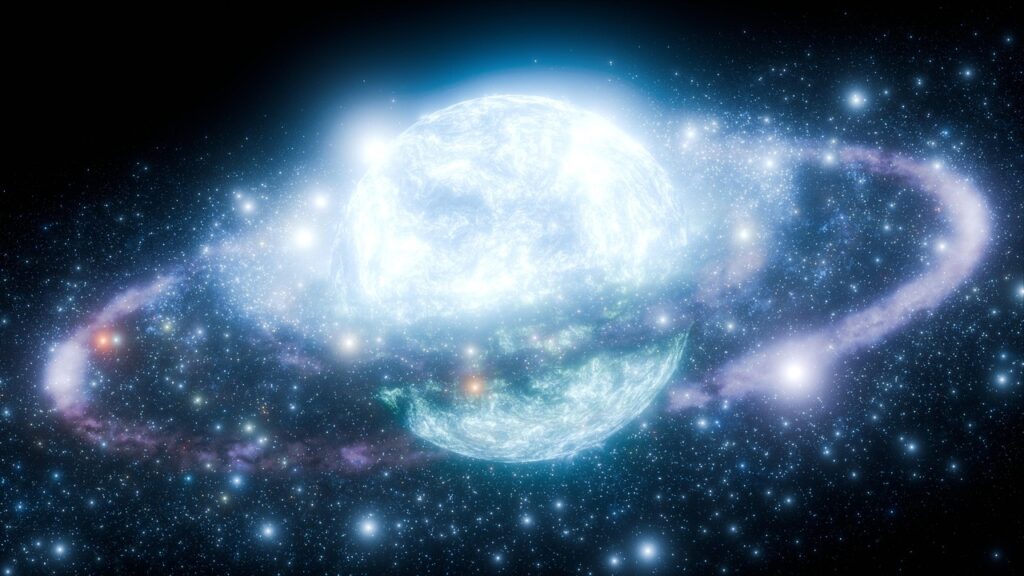
A neutron star is the collapsed core left behind after a massive star ends its life in a supernova explosion. When a star with an initial mass of roughly eight to twenty times that of the Sun exhausts its nuclear fuel, gravity overwhelms internal pressure and the core collapses rapidly.
During this collapse, protons and electrons are forced together to form neutrons. The result is an object composed almost entirely of tightly packed neutrons, supported not by thermal pressure but by neutron degeneracy pressure and strong nuclear forces. Although small in size, this remnant contains more mass than the Sun.
Formation through stellar collapse
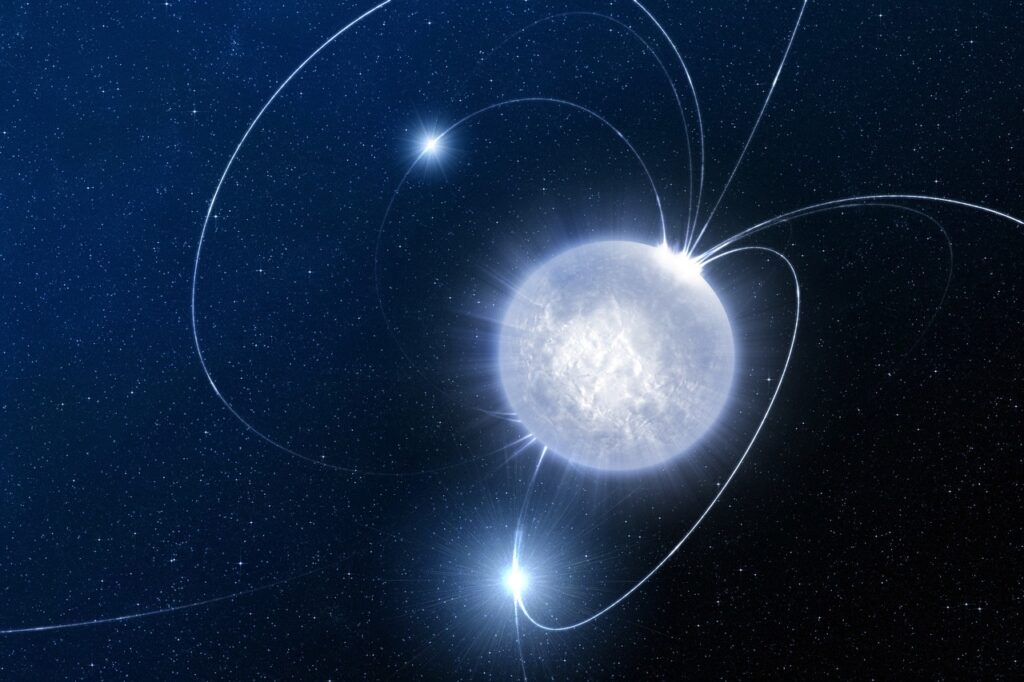
The formation process begins late in a massive star’s life. Once nuclear fusion in the core stops producing enough energy to counter gravity, the core collapses in a fraction of a second. The outer layers rebound off the newly formed dense core, producing a supernova explosion.
What remains depends on the mass of the original core. If it is too large, collapse continues into a black hole. If it falls within a specific mass range, the result is a stable neutron-rich object. This balance between gravity and quantum forces defines the boundary between neutron stars and black holes.
Size, mass, and density
Despite containing up to about two solar masses, a typical neutron star has a radius of only around ten to twelve kilometres. This makes it one of the densest known forms of matter. A single teaspoon of its material would weigh billions of tonnes on Earth.
The density increases dramatically toward the centre, where matter may exist in exotic states not yet fully understood. Scientists continue to study whether the core contains superfluid neutrons, hyperons, or even free quarks. These questions make such stellar remnants invaluable natural laboratories for nuclear physics.
Extreme gravity and magnetic fields
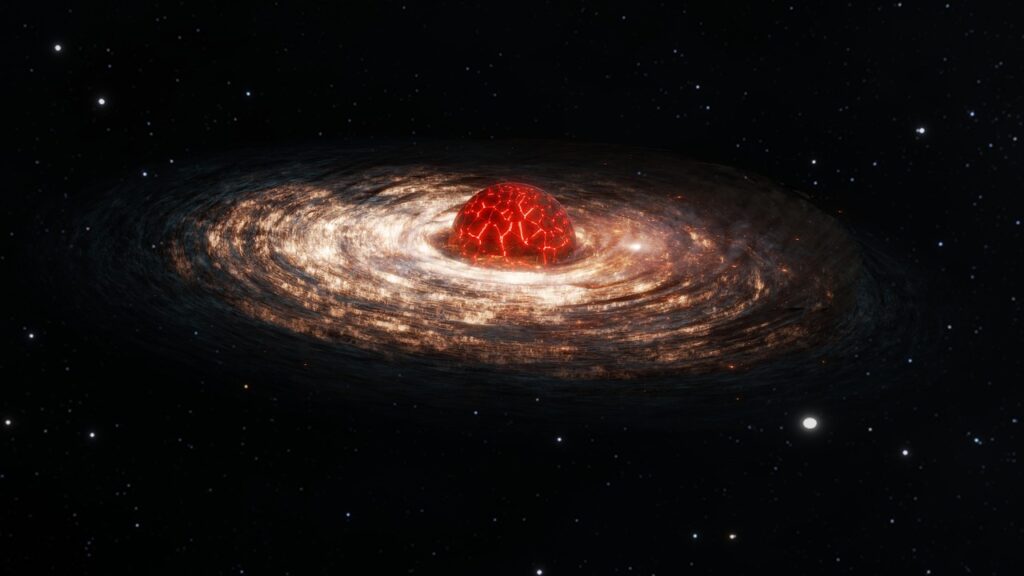
The gravitational field at the surface of a neutron star is extraordinarily strong. Objects falling onto it experience intense acceleration, and light emitted from the surface is measurably redshifted due to gravity. Time itself passes more slowly near the surface compared to distant observers.
Magnetic fields are also extreme. Some neutron stars possess magnetic fields trillions of times stronger than Earth’s. In certain cases, known as magnetars, these fields dominate the star’s behaviour and can trigger powerful bursts of high-energy radiation.
Rotation and pulsars
Many neutron stars rotate rapidly due to conservation of angular momentum during collapse. Some spin several hundred times per second. When their magnetic axis is misaligned with their rotation axis, beams of radiation sweep through space like a lighthouse.
If Earth lies in the path of these beams, astronomers observe regular pulses of radiation. Such objects are called pulsars. Pulsars serve as highly precise cosmic clocks and are used to test theories of gravity, study interstellar matter, and even search for low-frequency gravitational waves.
Binary systems and gravitational waves
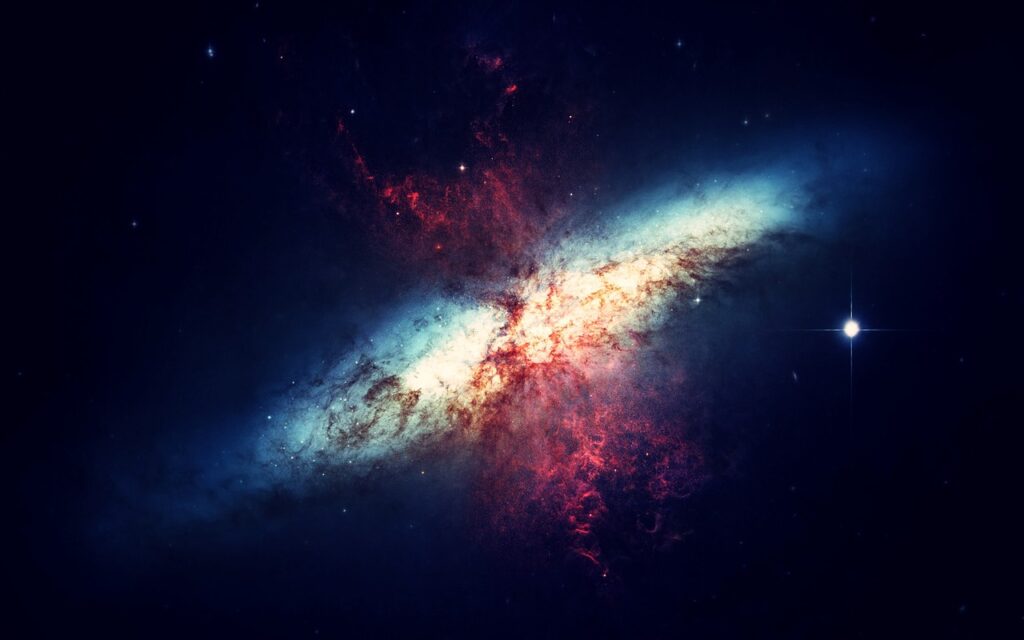
Neutron stars are often found in binary systems, orbiting another star or a second compact remnant. When two of these objects orbit each other closely, they gradually lose energy through gravitational wave emission.
The first direct detection of gravitational waves from a neutron star merger provided crucial confirmation of predictions made by general relativity. These events also revealed that heavy elements such as gold and platinum are produced during such collisions, linking stellar remnants to the chemical evolution of the universe.
Why neutron stars matter to astronomy
Neutron stars connect multiple areas of physics and astronomy. They help scientists study matter at nuclear densities, test Einstein’s theory of gravity, and understand how massive stars live and die. Observations across radio, optical, X-ray, and gamma-ray wavelengths provide complementary insights into their behaviour.
They also act as cosmic probes. Pulsars allow measurements of distance, magnetic fields, and interstellar gas, while mergers reveal how spacetime itself behaves under extreme conditions. Few objects contribute as broadly to our understanding of the universe.
Ongoing research and open questions
Despite decades of study, many questions remain unanswered. The exact composition of a neutron star’s core is still unknown. The maximum possible mass before collapse into a black hole is an active area of research. The origin of the strongest magnetic fields and the precise mechanisms behind certain high-energy emissions are also under investigation.
Future observatories, both ground-based and space-based, will continue to refine measurements and push theoretical models. Each new observation adds another piece to the puzzle of how matter behaves at its most extreme.
Final thoughts
Neutron stars are small in size but vast in scientific importance. They represent a bridge between stellar evolution, nuclear physics, and gravitational theory. By studying these extraordinary remnants, astronomers gain insight not only into the life cycles of stars but also into the fundamental laws that govern the universe itself.