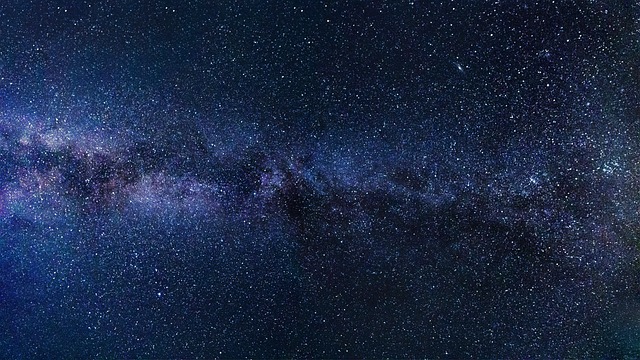
The Milky Way is the vast galaxy that contains our Solar System, billions of stars, countless planets, clouds of gas and dust, and mysteries we are still trying to understand. When you look up at the night sky and see a faint, glowing band stretching across the darkness, you are seeing our galaxy from the inside.
This guide to The Milky Way is designed for beginners, breaking down what our galaxy is, how it is structured, where we are located within it, and why it matters to modern astronomy.
What is the Milky Way?
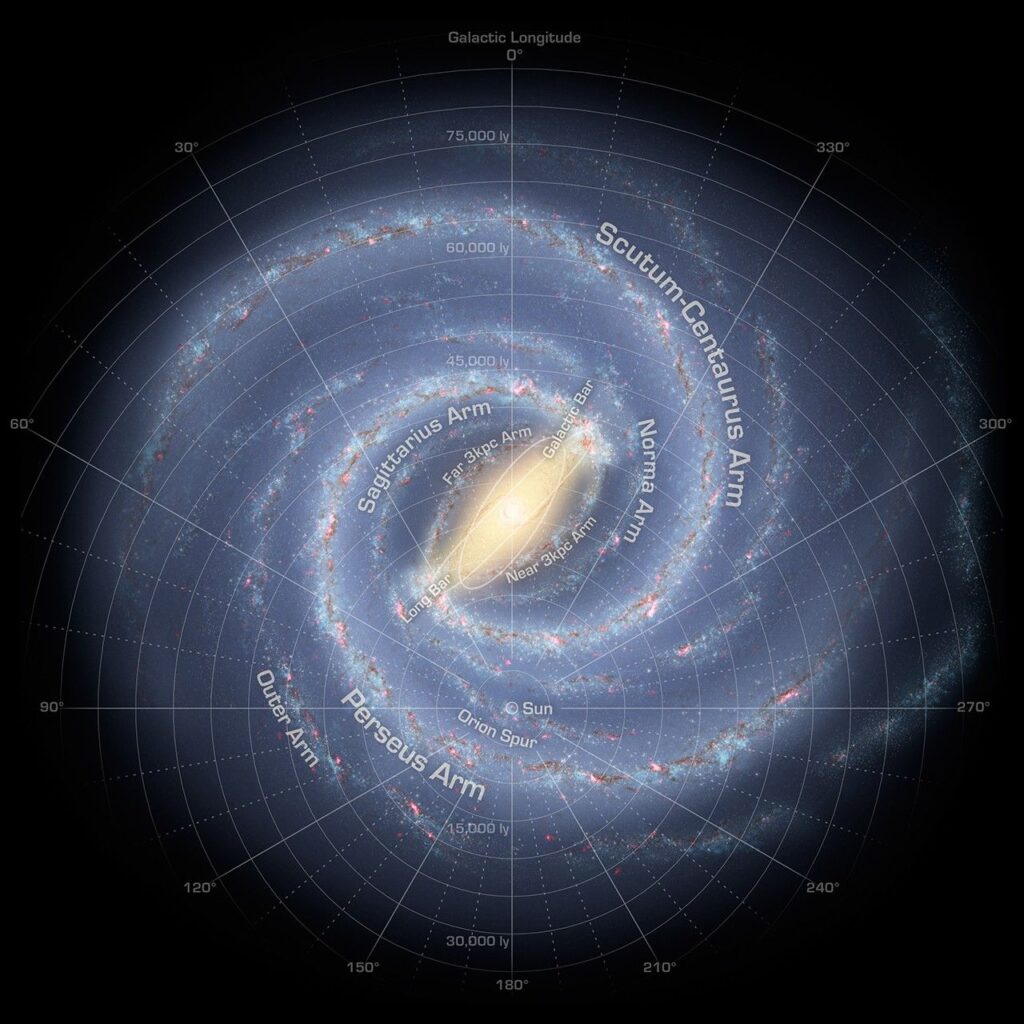
The Milky Way is a barred spiral galaxy containing an estimated 100 to 400 billion stars. It formed over 13 billion years ago and continues to evolve through star formation, stellar death, and gravitational interaction with nearby galaxies.
Unlike images of other galaxies taken from afar, we experience the Milky Way from within, which makes understanding its full shape and size more challenging. Astronomers rely on infrared observations, radio waves, and stellar mapping to piece together its structure.
The structure of the Milky Way
The Milky Way is not a flat disk. It is a complex, layered system made up of several major components:
- Galactic core – A dense central region packed with stars and gas
- Central bar – A long structure of stars extending from the core
- Spiral arms – Regions rich in gas, dust, and star formation
- Galactic disk – Where most stars, including the Sun, reside
- Galactic halo – A vast, faint region surrounding the galaxy, containing older stars and globular clusters
At the very centre lies Sagittarius A*, a supermassive black hole with a mass millions of times greater than the Sun.
Where is Earth in the Milky Way?

Earth is located in a relatively calm region called the Orion Arm, a minor spiral arm between two major ones. Our Solar System sits about 27,000 light-years from the galactic centre, far from the crowded and energetic core.
This position is important. It places us in a stable region with fewer violent stellar events, helping create conditions favourable for life to develop over billions of years.
How big is the Milky Way?
Our Milky Way measures roughly 100,000 to 120,000 light-years across. To put this into perspective, light travelling at 300,000 kilometres per second would still take over 100,000 years to cross the galaxy.
Even at this enormous scale, the Milky Way is just one of hundreds of billions of galaxies in the observable universe.
Stars, planets, and star-forming regions
The Milky Way is a dynamic galaxy. New stars are constantly forming in nebulae within its spiral arms, while older stars drift through the halo and core.
Astronomers have already identified thousands of exoplanets within our galaxy, and current estimates suggest that planets may outnumber stars. Many of these worlds orbit stars similar to our Sun, raising profound questions about life beyond Earth.
The Milky Way and dark matter
One of the most important discoveries about our Milky Way is that most of its mass is invisible. Dark matter surrounds the galaxy in a massive halo, influencing how stars move and how the galaxy holds together.
Without dark matter, the Milky Way would not rotate as it does, and its structure would be impossible to explain using visible matter alone.
How astronomers study our galaxy
Studying the Milky Way requires more than optical telescopes. Astronomers use radio telescopes, infrared observatories, space-based instruments, and precise stellar surveys to map our galaxy.
Missions and observatories supported by organisations like NASA have helped reveal the Milky Way’s structure, star populations, and central black hole in unprecedented detail. Modern surveys now track the motion and composition of millions of stars, allowing scientists to reconstruct the galaxy’s history.
Why the Milky Way matters
Understanding the Milky Way helps astronomers answer fundamental questions about how galaxies form, how stars and planets evolve, and how life might arise elsewhere in the universe. Our galaxy is both a laboratory and a home, offering insights that extend far beyond its spiral arms.
For beginners in astronomy, learning about the Milky Way is the first step toward understanding the wider cosmos. Every galaxy we observe elsewhere becomes clearer once we understand the one we live in.
Our place in a vast system
The Milky Way reminds us that Earth is part of something unimaginably large and ancient. We orbit a single star, within a spiral arm, inside a galaxy that has existed for billions of years and will continue long after we are gone.
By studying our home galaxy, we are not just learning astronomy. We are learning where we belong in the universe.