
The Whirlpool Galaxy is one of the most beautiful and well-known galaxies in the night sky. Famous for its clear spiral structure and interacting companion, it has become a favourite target for astronomers and astrophotographers alike.
Located millions of light-years away, the Whirlpool Galaxy offers a fascinating glimpse into how galaxies form, evolve, and interact. Its striking shape and active star-forming regions make it an important object of study.
In this guide, we explore the Whirlpool Galaxy, its structure, location, and why it continues to captivate observers around the world.
What Is the Whirlpool Galaxy?

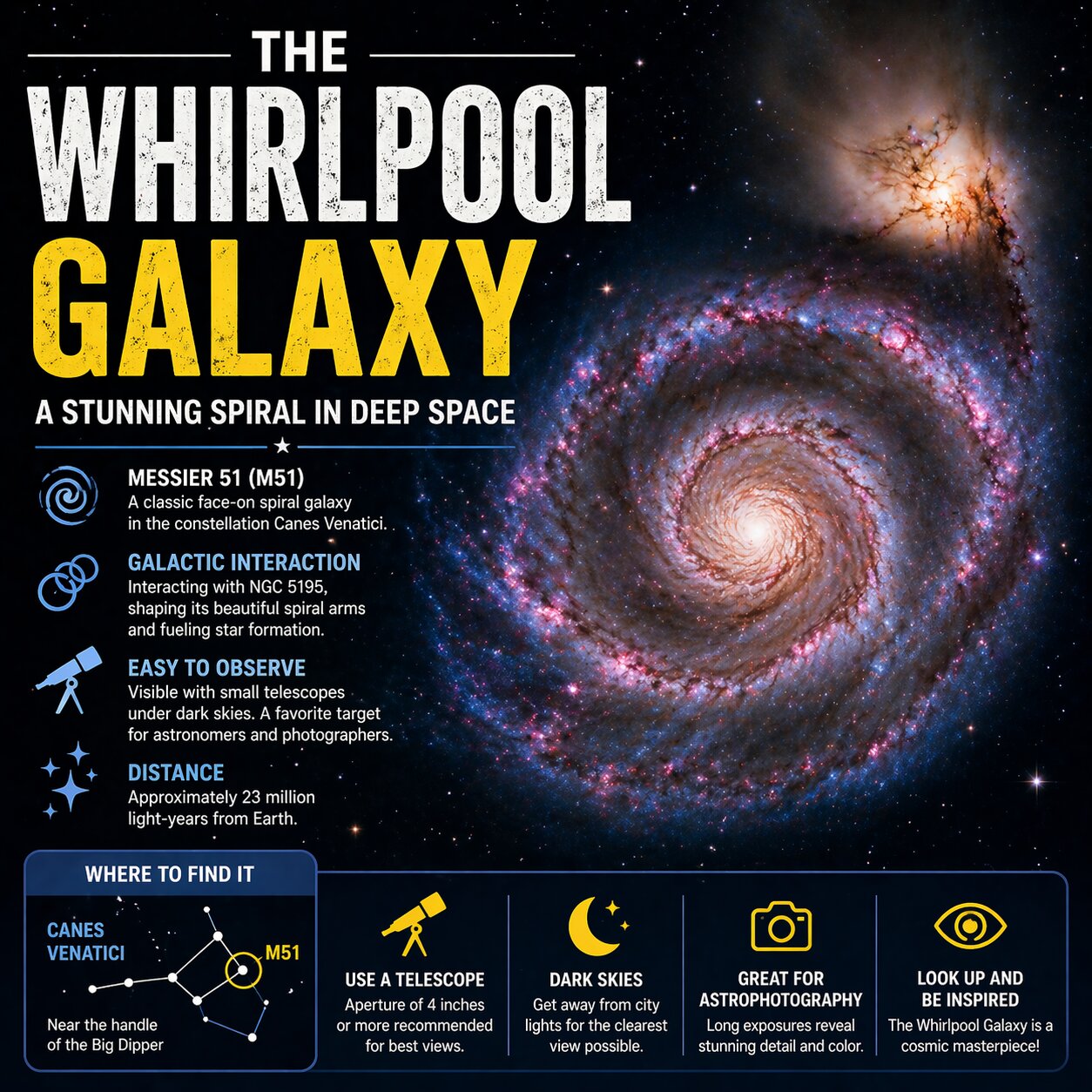
The Whirlpool Galaxy is a classic spiral galaxy known for its well-defined arms and bright core. It is officially designated as Messier 51, often shortened to M51.
This galaxy is located in the constellation Canes Venatici and is one of the easiest spiral galaxies to identify with telescopes. Its structure is so clear that it is often used as a textbook example of a “grand-design spiral galaxy.”
The Whirlpool Galaxy is not alone. It is interacting with a smaller companion galaxy called NGC 5195. This interaction is responsible for its pronounced spiral arms and increased star formation activity.
Studying the Whirlpool Galaxy helps astronomers understand how gravitational interactions shape galaxies over time.
A Close Look at Its Structure

One of the most striking features of the Whirlpool Galaxy is its spiral design. The arms are filled with bright regions where new stars are being born, giving the galaxy a vibrant and dynamic appearance.
At the centre lies a dense core that likely contains a supermassive black hole. Surrounding it are layers of stars, gas, and dust that form the iconic swirling pattern.
The interaction with NGC 5195 creates tidal forces that stretch and distort the galaxy’s structure. This gravitational pull enhances the spiral arms, making them more visible and active.
The Galaxy is a perfect example of how cosmic forces can create both beauty and complexity in the universe.
Where Is the Whirlpool Galaxy Located?
The Whirlpool Galaxy is located approximately 23 million light-years from Earth. While this distance may seem immense, it is relatively close in cosmic terms, making it accessible to amateur astronomers.
You can find the Galaxy in the direction of the constellation Canes Venatici, near the handle of the Big Dipper. This makes it easier to locate compared to many other deep-sky objects.
Under dark skies, it can be seen with small telescopes as a faint patch of light. Larger telescopes or long-exposure photography reveal its detailed spiral structure.
For observers in the Southern Hemisphere, including South Africa, the Whirlpool Galaxy is visible during certain times of the year, especially in autumn and early winter evenings when it appears higher above the horizon.
Why the Whirlpool Galaxy Is So Important
The Whirlpool Galaxy plays a significant role in astronomical research. It was one of the first galaxies where spiral structure was clearly observed, helping scientists understand the nature of galaxies beyond our own.
Its interaction with NGC 5195 provides valuable insights into how galaxies influence each other. These interactions can trigger star formation, alter structures, and even lead to mergers over time.
Key reasons the Galaxy is important include:
- It is a classic example of a grand-design spiral galaxy
- It shows clear evidence of galactic interaction
- It contains active star-forming regions
- It helps scientists study galaxy evolution
Because of these features, the Whirlpool Galaxy remains a key object for both research and education.
Observing the Whirlpool Galaxy
Observing the Galaxy can be a rewarding experience for amateur astronomers. While it may appear faint at first, patience and the right equipment can reveal its beauty.
A small telescope will show it as a dim, fuzzy object. With larger telescopes, you may begin to see hints of its spiral arms, especially under dark skies with minimal light pollution.
Astrophotography is where the Whirlpool Galaxy truly shines. Long exposures bring out its intricate details, colours, and the connection between it and its companion galaxy.
Planning your observation during clear, moonless nights will improve your chances of seeing this incredible object.
A Cosmic Masterpiece
The Whirlpool Galaxy stands as one of the most iconic and visually stunning galaxies in the universe. Its swirling arms, bright core, and interacting companion create a dynamic scene that continues to inspire both scientists and stargazers.
By studying and observing the Whirlpool Galaxy, we gain a deeper understanding of how galaxies form, evolve, and interact across vast distances.
Whether you are exploring the night sky with a telescope or simply learning about the cosmos, the Whirlpool Galaxy offers a glimpse into the beauty and complexity of the universe.