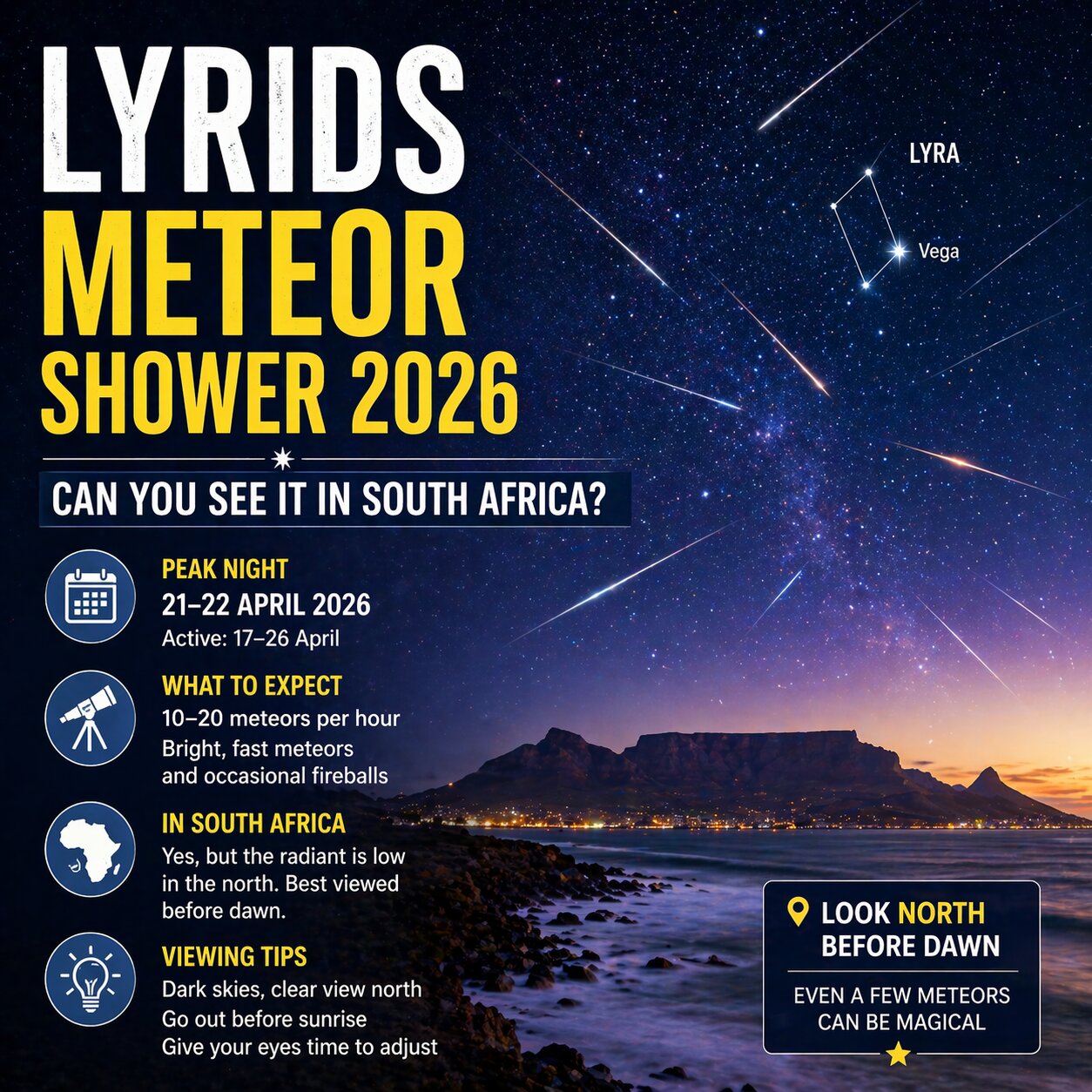

The Lyrids meteor shower is lighting up the skies again, and it is one of the oldest recorded meteor showers in human history. With observations dating back to 687 BC, this annual event continues to fascinate skywatchers around the world. The 2026 peak falls around 21–22 April, bringing bright streaks of light as Earth passes through debris left behind a comet.
But the big question for our readers is simple: can you see the Lyrids meteor shower in South Africa?
What makes the Lyrids special
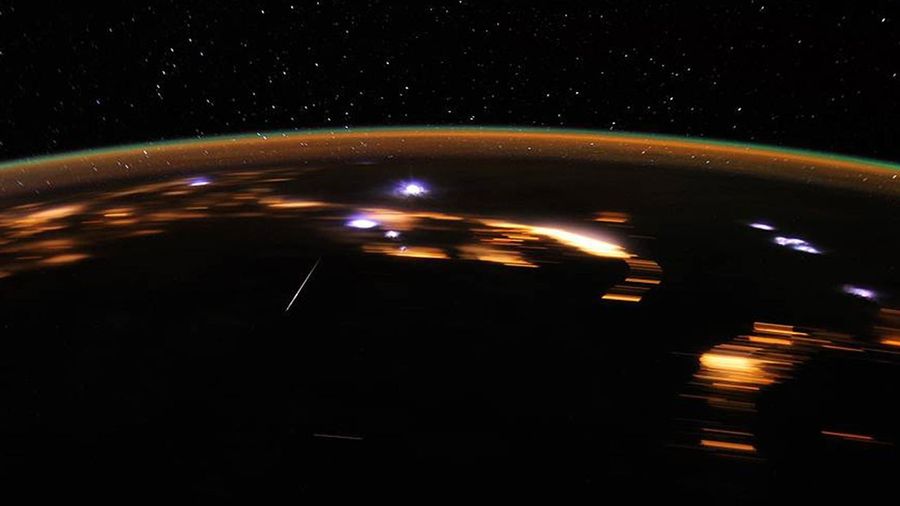
The Lyrids originate from the comet Comet C/1861 G1 Thatcher, which leaves a trail of dust behind as it travels through the solar system. Each year, Earth crosses this trail, and the particles burn up in our atmosphere, creating meteors.
Unlike some of the more famous showers, the Lyrids are known for their bright, fast meteors rather than sheer volume. On average, you can expect around 10 to 20 meteors per hour, although occasional surges have produced up to 100 meteors per hour in rare years.
This Lyrids meteor shower will travel at about 47 km per second, and while they do not often leave long glowing trails, they can produce stunning fireballs that briefly outshine everything else in the sky.
Where the meteors come from in the sky
The Lyrids appear to radiate from the Lyra constellation, near the bright star Vega. This point is known as the radiant.
However, you do not need to look directly at the radiant to enjoy the show. In fact, meteors often look longer and more dramatic when viewed away from that point due to perspective.
Can you see the Lyrids in South Africa?
Yes — but with limitations.
The Lyrids are best viewed in the Northern Hemisphere, where the radiant rises higher in the sky. In South Africa, the Lyra sits low on the northern horizon, especially in the early morning hours.
Here is what that means for local viewing:
- You can see the Lyrids from South Africa
- The number of visible meteors will be lower than in the Northern Hemisphere
- The best time to watch is just before dawn, when the radiant is highest
- You may only see a few meteors per hour, depending on conditions
So while it is not the strongest meteor shower for Southern Hemisphere observers, it is still worth looking up.
How to improve your chances of seeing it
If you want the best possible experience in South Africa, timing and location are everything:
- Find a dark sky location away from city lights
- Look towards the northern to north-eastern sky
- Go out in the early morning hours before sunrise
- Allow your eyes 20–30 minutes to adjust to the dark
- Be patient — meteor watching is a waiting game
Even if activity is lower, a single bright meteor or fireball can make the experience unforgettable.
A reminder of our place in space
The Lyrids meteor shower may not be the most intense display visible from South Africa, but it carries something special. It connects us to a cosmic cycle that has been observed for nearly 3,000 years.
Each meteor you see is a tiny fragment of a comet burning up high above Earth, leaving behind a brief streak of light that vanishes in seconds. Yet those moments remind us of the vastness of space and our place within it.
So if the skies are clear this April, step outside, look north, and give yourself time. You might just catch one of the oldest shows in the universe unfolding above you.