
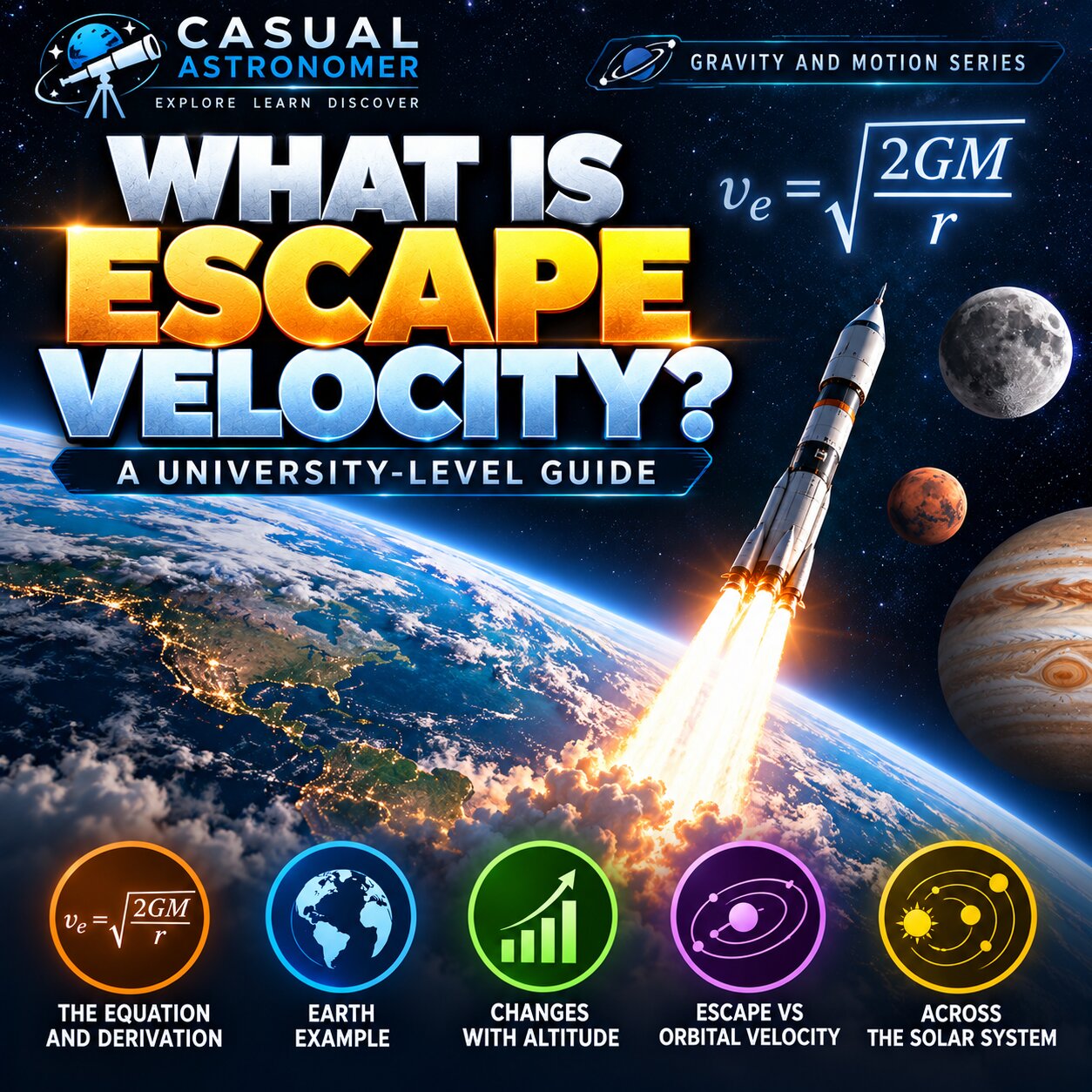

When a spacecraft leaves Earth, gravity doesn’t suddenly disappear once it reaches space. Earth’s gravitational influence extends indefinitely, becoming progressively weaker with distance. This raises an important question in orbital mechanics: how fast must an object travel if it is to escape a body’s gravitational field without additional propulsion?
The answer introduces escape velocity, one of the fundamental concepts connecting gravity and motion.
Escape velocity is the minimum initial speed required for an object to escape the gravitational influence of a massive body without further propulsion, assuming no atmospheric resistance or other forces interfere with its motion.
For Earth, this value is approximately 11.2 km/s, or about 40,300 km/h, when measured from the surface.
Understanding where this number comes from requires us to examine gravitational potential energy and conservation of mechanical energy.
Defining Escape Velocity
Imagine launching an object vertically from the surface of a planet.
If its initial velocity is relatively low, gravity slows it until its velocity reaches zero. The object then reverses direction and falls towards the planet.
Increase the launch speed and the object travels farther before returning.
There is theoretically a particular initial speed at which the object continues travelling away indefinitely while its velocity approaches zero as its distance approaches infinity.
That limiting initial speed is the escape velocity.
Importantly, escape velocity doesn’t mean that gravity stops acting on the object. Gravity continues exerting a force at every finite distance. The object simply possesses sufficient initial mechanical energy to avoid returning.
Deriving the Escape Velocity Equation
We can derive the equation using conservation of mechanical energy.
The gravitational potential energy of an object of mass located a distance from the centre of a spherical body of mass is:
where:
is the gravitational constant,
is the mass of the astronomical body,
is the mass of the escaping object,
and is the distance between their centres of mass.
The object’s kinetic energy is:
Therefore, its total mechanical energy is:
For the minimum escape condition, we define the object’s velocity at infinite distance as approaching zero.
At infinity:
and gravitational potential energy approaches:
Therefore:
Conservation of mechanical energy means the initial total energy must also equal zero:
Rearranging gives:
The mass of the escaping object cancels:
Multiplying by two:
Therefore:
This is the classical escape velocity equation.
Why the Spacecraft’s Mass Doesn’t Matter
One interesting result of the derivation is that the mass of the escaping object disappears from the final equation.
A one-kilogram object and a thousand-kilogram spacecraft therefore have the same escape velocity when starting from the same location, provided we ignore atmospheric drag and propulsion considerations.
This reflects a broader property of gravitational motion.
Although a more massive object experiences a greater gravitational force, it also possesses proportionally greater inertia. These effects cancel when determining its gravitational acceleration.
Escape velocity therefore depends on the mass and radius of the body being escaped rather than the mass of the escaping object.
Calculating Earth’s Escape Velocity
For Earth, we can use approximately:
and
Substituting these into our equation:
gives approximately:
or:
This is Earth’s approximate surface escape velocity.
It corresponds to roughly 40,300 km/h.
Escape Velocity Changes With Altitude
Escape velocity isn’t a single universal number for a planet.
Remember that:
As increases, the required escape velocity decreases.
A spacecraft already thousands of kilometres above Earth therefore requires less additional speed to escape Earth’s gravitational field than an object beginning at the surface.
This relationship is proportional to:
Doubling the distance from the centre of the planet doesn’t halve the escape velocity. Instead, it reduces it by a factor of .
Escape Velocity vs Orbital Velocity
Escape velocity shouldn’t be confused with orbital velocity.
For a circular orbit, gravity provides the centripetal acceleration required to keep an object moving around the planet.
The circular orbital velocity is:
Compare this with escape velocity:
Therefore:
At the same distance from the centre of a spherical body, escape velocity is therefore approximately 1.414 times the circular orbital velocity.
This relationship is an important result in introductory orbital mechanics.
Do Rockets Actually Reach 11.2 km/s at Launch?
The phrase “escape velocity” can create a misleading picture of spacecraft blasting vertically from Earth’s surface at 11.2 km/s.
Real rockets don’t normally operate this way.
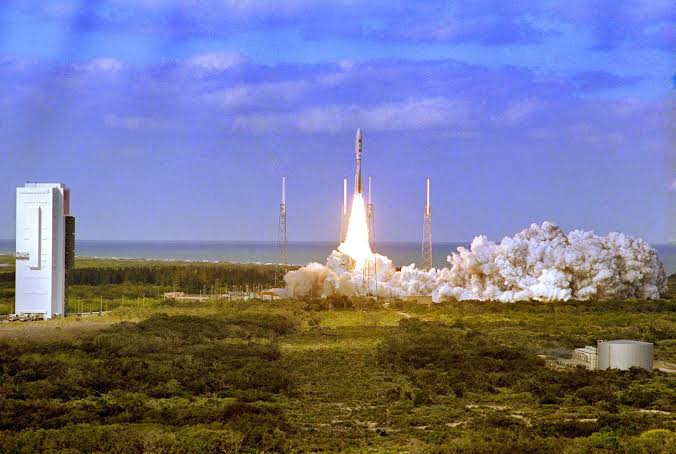
Instead, rocket engines continuously provide thrust as the vehicle climbs and accelerates. Launch trajectories are designed to manage atmospheric drag, gravitational losses, structural stresses and the enormous amount of energy required to reach orbital or escape trajectories.
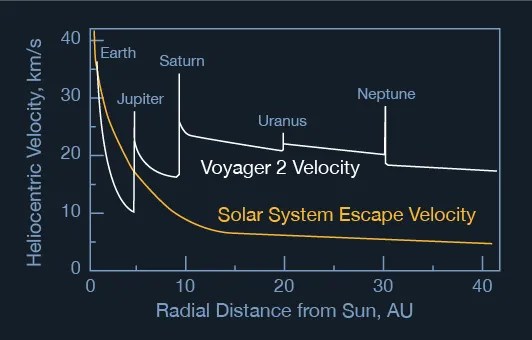
Many interplanetary missions first enter Earth orbit before performing additional burns that place them onto trajectories capable of leaving Earth’s gravitational influence.
The escape velocity equation therefore describes an idealised ballistic condition rather than prescribing how rockets must actually launch.
Escape Velocity Across the Solar System
Different astronomical bodies have dramatically different escape velocities because their masses and radii differ.
Approximate surface values include:
- Moon: 2.38 km/s
- Mars: 5.03 km/s
- Earth: 11.19 km/s
- Jupiter: 59.5 km/s
- Sun: 617.7 km/s
A body’s radius matters alongside its mass.
Jupiter is much more massive than Earth and consequently has a far greater escape velocity. The Sun’s enormous mass produces an even deeper gravitational potential well.
Small asteroids, meanwhile, can have escape velocities of only metres or even centimetres per second.
The Energy Interpretation
Escape velocity becomes especially useful when viewed through energy rather than simply speed.
An object gravitationally bound to a body has negative total mechanical energy:
The limiting escape trajectory has:
An object with positive total mechanical energy:
is gravitationally unbound and can reach infinity while retaining some non-zero speed.
This distinction leads naturally into the study of orbital trajectories.
Bound gravitational trajectories correspond to ellipses, including circular orbits as a special case. The limiting zero-energy escape trajectory is parabolic, while positive-energy trajectories are hyperbolic.
Escape Velocity Connects Gravity and Motion
Escape velocity demonstrates beautifully how gravitational physics and orbital motion are connected.
The equation
tells us that the required speed depends on the mass of the body and the object’s distance from its centre, but not on the mass of the escaping object.
More importantly, the derivation reveals what escape actually means physically.
An escaping object hasn’t travelled beyond gravity. Instead, it has enough mechanical energy that gravity can never bring it back.
That distinction transforms escape velocity from a number commonly associated with rocket launches into a fundamental concept for understanding gravitational systems, orbital mechanics and the motion of objects throughout the universe.



Leave a Reply