Astronomers have created the most detailed map of dark matter ever produced, using observations from the James Webb Space Telescope. Covering a region of sky nearly three times the size of the full Moon, this new cosmic map reveals the invisible framework that shapes the Universe on the largest scales.
Dark matter makes up the vast majority of matter in the cosmos, yet it cannot be seen directly. This breakthrough allows scientists to study how galaxies form, cluster, and evolve by tracing the unseen mass that governs their motion.
The discovery: mapping the invisible Universe
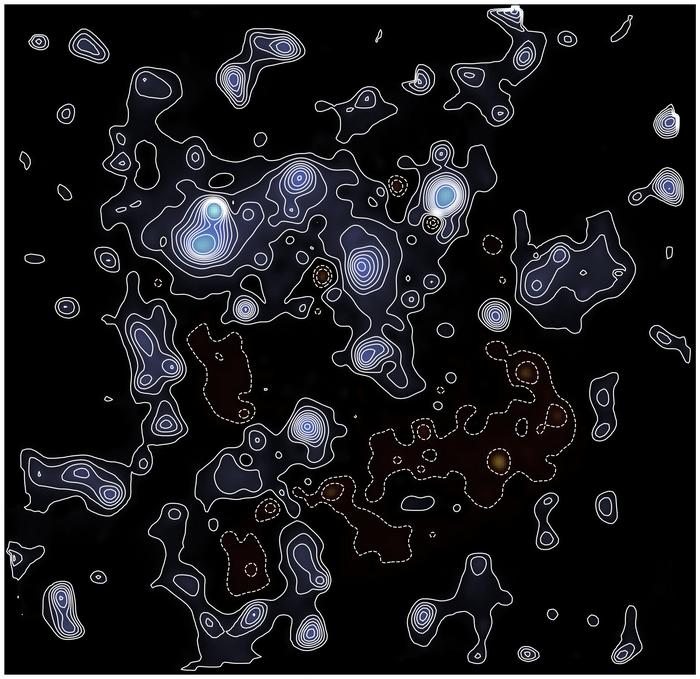
The new dark matter map was created by analysing subtle distortions in the shapes of roughly 250,000 distant galaxies. These distortions occur due to a phenomenon known as gravitational lensing, where the gravity of matter bends and warps the light travelling from distant galaxies toward Earth.
Because dark matter does not emit or reflect light, astronomers can only detect it through these gravitational effects. Webb’s infrared sensitivity and sharp imaging allowed scientists to measure these distortions with far greater precision than ever before, revealing dark matter structures that had previously gone unnoticed.
News Source: Reuters, Astronomy.com, James Webb Telescope
Why dark matter matters
Although ordinary matter forms stars, planets, and people, it accounts for only about 15% of all matter in the Universe. The remaining 85% is dark matter, an invisible substance that acts as the gravitational backbone of cosmic structure.
Dark matter determines how fast galaxies rotate, how galaxy clusters stay bound together, and how large-scale structures form. Without it, galaxies as we know them would not exist. Mapping its distribution is therefore essential to understanding how the Universe evolved from a nearly uniform early state into the richly structured cosmos we observe today.
Webb vs Hubble: a major leap forward
Previous dark matter maps relied on data from the Hubble Space Telescope, which provided groundbreaking but limited views. Webb’s new map offers roughly double the resolution, spans a larger cosmic volume, and looks much further back in time.
The observations probe the Universe as it existed 8 to 10 billion years ago, a crucial era when galaxies were rapidly forming and evolving. Webb’s six-times-greater light-gathering power allows astronomers to see fainter and more distant background galaxies, creating a denser and more accurate grid for mapping dark matter.
Revealing the cosmic web
The new map exposes the Universe’s large-scale structure, often called the cosmic web. This vast network consists of:
- Massive galaxy clusters
- Long filaments of dark matter connecting galaxies
- Large, low-density voids between structures
These features form the scaffolding upon which visible matter gathers. Webb’s observations provide the clearest picture yet of how this dark matter framework shapes the distribution of galaxies and gas across the cosmos.
Where the map comes from: the COSMOS field
The mapped region lies within the COSMOS field, a well-studied area of sky in the direction of the constellation Sextans. COSMOS has been observed by multiple telescopes across different wavelengths, making it an ideal laboratory for studying cosmic evolution.
By adding Webb’s high-resolution data, astronomers can now connect dark matter structures directly to the galaxies embedded within them, improving models of galaxy formation and growth.
What this means for cosmology
The findings strongly support the leading cosmological model known as Lambda-CDM, which describes a Universe dominated by dark matter and dark energy. In this model, dark matter provides the gravitational framework, while dark energy drives the Universe’s accelerating expansion.
The new map offers one of the sharpest observational confirmations of this theory to date, showing how dark matter forms the backbone of cosmic structure across billions of years.
Seeing the Universe’s hidden framework
By using the James Webb Space Telescope to map dark matter with unprecedented clarity, astronomers have taken a major step toward understanding the invisible forces that shape the Universe. This detailed view of the cosmic web not only confirms existing theories but opens new avenues for studying how galaxies form, evolve, and interact over cosmic time.
As Webb continues its mission, even deeper and more expansive dark matter maps are expected, bringing us closer to uncovering the true nature of the unseen matter that dominates the cosmos.